Loading...
Done
This tiny hedgehog is in a prickly position as hes unable to grow spikes, leaving him needing round-the-clock care. The woodland critter was found with no spikes and has been taken in by a family hoping to nurse him back to health so he can be released into the wild. Named Mr Prickleless, the hedgehog was rescued by Dina Nixon and her daughter Jennifer, 25, after being taken into a rescue centre in December last year. (Photo by Caters News Agency)

This tiny hedgehog is in a prickly position as hes unable to grow spikes, leaving him needing round-the-clock care. The woodland critter was found with no spikes and has been taken in by a family hoping to nurse him back to health so he can be released into the wild. Named Mr Prickleless, the hedgehog was rescued by Dina Nixon and her daughter Jennifer, 25, after being taken into a rescue centre in December last year. It is not known what happened to his spikes, but Dina has vowed that if they ever do return he will be returned to the wild. But for now the hedgehog has taken shelter in a rabbit hutch in her garden. (Photo by Caters News Agency)
Details
19 Jul 2014 11:03:00


“Snowflake (c. 1964 – November 24, 2003) was an albino gorilla. He was the only known albino gorilla so far, and the most popular resident of the Barcelona Zoo in Catalonia, Spain. Originally named Nfumu Ngui in Fang language ("white gorilla") by his captor, he was then nicknamed Floquet de Neu (Catalan for little snowflake) by his keeper Jordi Sabater Pi. On his arrival to Barcelona where he was given an official reception by the then Mayor of Barcelona, Josep Maria de Porcioles, in November 1966, he was called Blancanieves (“Snow White”) in the newspaper Tele/Exprés. But he became famous with the name given to him by Sabater when National Geographic Magazine featured him on the main page in March 1967, with the English name Snowflake. This name spread among the press (Stern, Life, Paris-Match) and was later translated to Spanish as Copito de Nieve. Sabater himself called the gorilla Floquet or Copi, and in the later years Nfumu. The asteroid 95962 Copito, discovered by Catalan astronomer J. Manteca, is named in his honour”.
Details
07 Mar 2011 15:50:00
Alfred Könner, “Bilderzoo” by Illustrator Mirko Hanák

Mirko Hanák was born in 1921 in Prague, Czech Republic and worked as a painter, graphic designer and illustrator. His specialties were animals and human figures that were full of life and fun. He also had a firm grasp on composition as his paintings were so well balanced despite his casual fluid line. He was working on “Charlotte's Web” the movie when he tragically died at the height of his career from leukemia in 1971.
Details
18 Mar 2013 10:13:00
Philip Levine

London born Philip started using his head as a canvas for creativity back in 2006 when he began to go bald. He did not want to conform to shaving his head like everyone else so started using it as an art form to express. Philip's head designs have now become iconic around the world. As a tastemaker, he has gained recognition with sites including Trend Hunter and NotCot with such terms as 'Baldazzling'. His designs are inspiring men and women alike who might be bald.
Details
11 Apr 2015 09:55:00
A replica of the truck made from matchsticks by Janusz Urbanski is pictured at his flat in Ruda Slaska, Poland May 4, 2016. (Photo by Kacper Pempel/Reuters)

A replica of the truck made from matchsticks by Janusz Urbanski is pictured at his flat in Ruda Slaska, Poland May 4, 2016. Janusz Urbanski has a one of a kind chessboard he never plays, a personalised guitar he does not strum and a boat he cannot sail. Why? They are all made from tens of thousands of matches. For the last 40 years, the former Polish miner and ironworker has harboured a passion to build replicas of objects, buildings and famous sites with just matchsticks and glue. (Photo by Kacper Pempel/Reuters)
Details
07 May 2016 12:54:00
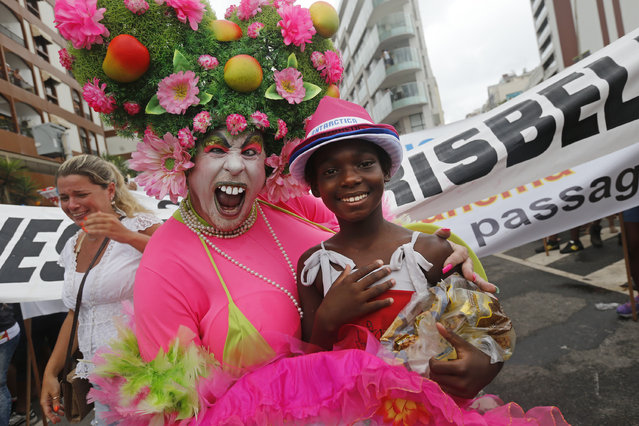
A reveler and a child street vendor pose for a photo during the Banda de Ipanema Carnival parade in Rio de Janeiro, Brazil, Saturday, January 31, 2015. Rio's over-the-top Carnival is the highlight of the year for many local residents. Hundreds of thousands of merrymakers are beginning to take to the streets in open-air “blocos” parties. (Photo by Silvia Izquierdo/AP Photo)

A reveler and a child street vendor pose for a photo during the Banda de Ipanema Carnival parade in Rio de Janeiro, Brazil, Saturday, January 31, 2015. Rio's over-the-top Carnival is the highlight of the year for many local residents. Hundreds of thousands of merrymakers are beginning to take to the streets in open-air “blocos” parties. (Photo by Silvia Izquierdo/AP Photo)
Details
03 Feb 2015 12:56:00
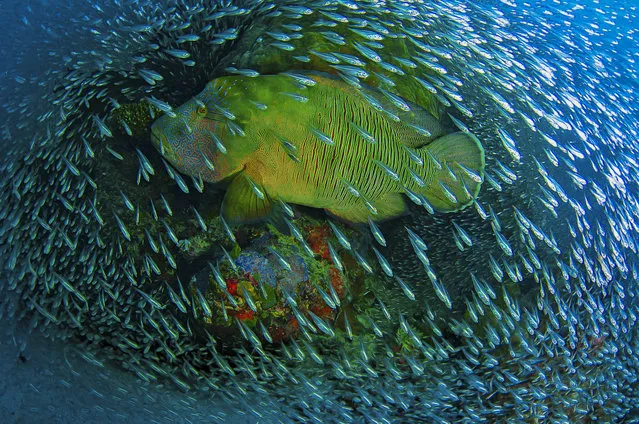
“7584 Fish”. On a windy day right after a Cyclone passed the far northern Great Barrier Reef i took some friends out to the reef. Never before i saw that many glass fish on this particular coral “bommie”. Just when i setup my camera, this Napoleon Wrasse swam right through the school of fish building a living frame. Photo location: Cairns, Great Barrier Reef, Flynn Reef, Australia. (Photo and caption by Christian Miller/National Geographic Photo Contest)

“7584 Fish”. On a windy day right after a Cyclone passed the far northern Great Barrier Reef i took some friends out to the reef. Never before i saw that many glass fish on this particular coral “bommie”. Just when i setup my camera, this Napoleon Wrasse swam right through the school of fish building a living frame. Photo location: Cairns, Great Barrier Reef, Flynn Reef, Australia. (Photo and caption by Christian Miller/National Geographic Photo Contest)
Details
07 Oct 2014 11:48:00
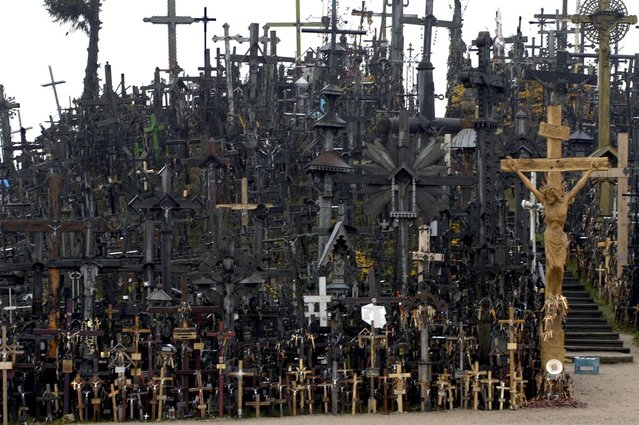
In 1831 an unsuccessful uprising against the Russian czar left many rebels dead. Relatives of the dead rebels, with no bodies to bury, instead left crosses, according to the Daily Mail. (Photo by Richard Gardner/Rex USA)

The phenomenon of the Hill of Crosses in northern Lithuania began when people started leaving crosses there hundreds of years ago – and continues to this day. These photos of a hill covered in crosses show the amazing sight it has become. Photo: In 1831 an unsuccessful uprising against the Russian czar left many rebels dead. Relatives of the dead rebels, with no bodies to bury, instead left crosses, according to the Daily Mail. (Photo by Richard Gardner/Rex USA)
Details
06 Jun 2013 09:56:00