Loading...
Done
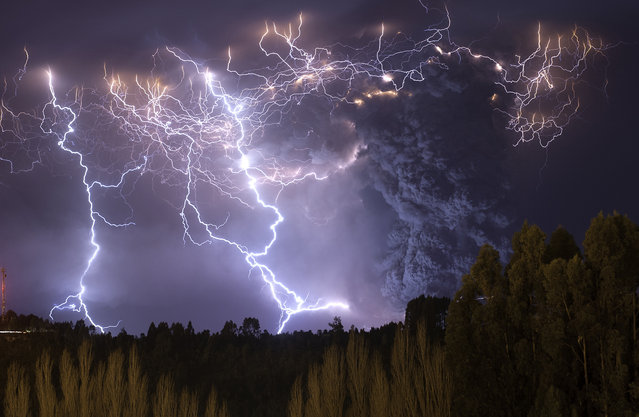
The eruption of Cordon Caulle began on June 4, 2011, located in the Region of Los Rios in Chile. For about 12 months, people and animals became accustomed to living with the daily fall of ash, which also caused problems in the air traffic in South America. The explosions and lightning during first days of the eruption could be seen from hundreds of miles around. This photograph was taken on the second night of eruption from the town of Lago Ranco. (Photo and caption by Francisco Negroni/National Geographic Traveler Photo Contest)

The eruption of Cordon Caulle began on June 4, 2011, located in the Region of Los Rios in Chile. For about 12 months, people and animals became accustomed to living with the daily fall of ash, which also caused problems in the air traffic in South America. The explosions and lightning during first days of the eruption could be seen from hundreds of miles around. This photograph was taken on the second night of eruption from the town of Lago Ranco. (Photo and caption by Francisco Negroni/National Geographic Traveler Photo Contest)

ATTENTION! All pictures are presented in high resolution. To see Hi-Res images – just TWICE click on any picture. In other words, click small picture – opens the BIG picture. Click BIG picture – opens VERY BIG picture.
Details
23 Jun 2013 11:24:00
A military police officer aims his gun to a demonstrator during a protest in Brasilia, Brazil, Tuesday, April 7, 2015. The officer had picked up a bottle that was thrown towards them but did not fire his gun and backed away. Thousands of workers have staged rallies in 12 cities across Brazil to protest against a proposed law that would allow companies to outsource their labor force. (Photo by Eraldo Peres/AP Photo)

A military police officer aims his gun to a demonstrator during a protest in Brasilia, Brazil, Tuesday, April 7, 2015. The officer had picked up a bottle that was thrown towards them but did not fire his gun and backed away. Thousands of workers have staged rallies in 12 cities across Brazil to protest against a proposed law that would allow companies to outsource their labor force. (Photo by Eraldo Peres/AP Photo)
Details
08 Apr 2015 10:58:00
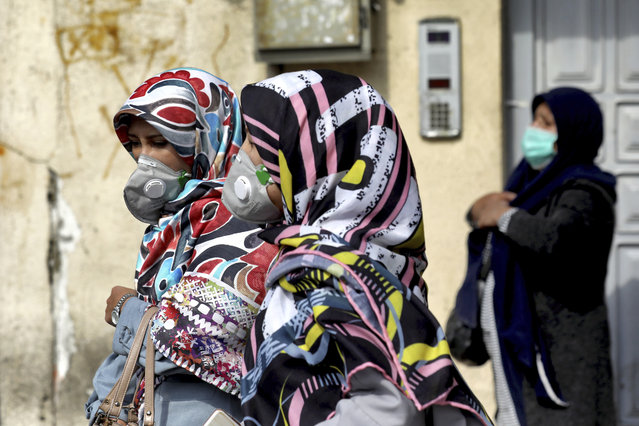
People wear masks to help guard against the Coronavirus in downtown Tehran, Iran, Sunday, February 23, 2020. On Sunday Iran's health ministry raised the death toll from the new virus to 8 people in the country, amid concerns that clusters there, as well as in Italy and South Korea, could signal a serious new stage in its global spread. (Photo by Ebrahim Noroozi/AP Photo)

People wear masks to help guard against the Coronavirus in downtown Tehran, Iran, Sunday, February 23, 2020. On Sunday Iran's health ministry raised the death toll from the new virus to 8 people in the country, amid concerns that clusters there, as well as in Italy and South Korea, could signal a serious new stage in its global spread. (Photo by Ebrahim Noroozi/AP Photo)
Details
25 Feb 2020 00:27:00
American dancer and model Dita von Teese performs a strip-tease, 23 October 2006 at the Crazy Horse saloon in Paris. Von Teese is giving eight performances of her show “the bath” at the famous Parisian cabaret. (Photo by Francois Guillot/AFP Photo)

American dancer and model Dita von Teese performs a strip-tease, 23 October 2006 at the Crazy Horse saloon in Paris. Von Teese is giving eight performances of her show “the bath” at the famous Parisian cabaret. (Photo by Francois Guillot/AFP Photo)
Details
16 Nov 2025 04:35:00
Attendees view a replica of the prehistoric Titanoboa, the largest snake to ever live, on display at Grand Central Terminal in New York City

“Titanoboa is a genus of snake that lived approximately 58–60 million years ago, during the Paleocene epoch, a 10-million-year period immediately following the dinosaur extinction event. The only known species is the Titanoboa cerrejonensis, the largest snake ever discovered, which supplanted the previous record holder, Gigantophis”. – Wikipedia

Photo: Leah Del Rio views a replica of the prehistoric Titanoboa, the largest snake to ever live, on display at Grand Central Terminal on March 23, 2012 in New York City. (Photo by Michael Loccisano/Getty Images)
Details
24 Mar 2012 10:14:00
True Friendship


Lucky & Susi Photos by Tina M.
Details
29 Jun 2012 02:14:00
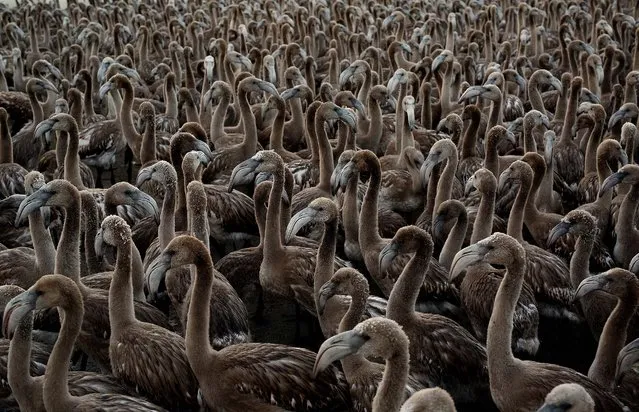
Flamingo chicks walk in an enclosure before they are tagged in Fuente de Piedra, Spain, on Jule 19, 2014. Fuente de Piedra lagoon is a natural reserve with more than 170 different species recorded and one of the main breeding grounds for flamingos in the Iberian Peninsule. Hundreds of flamingo chicks are tagged and checked annually to record the evolution of the species. (Photo by Pablo Blazquez Dominguez/Getty Images)

Flamingo chicks walk in an enclosure before they are tagged in Fuente de Piedra, Spain, on Jule 19, 2014. Fuente de Piedra lagoon is a natural reserve with more than 170 different species recorded and one of the main breeding grounds for flamingos in the Iberian Peninsule. Hundreds of flamingo chicks are tagged and checked annually to record the evolution of the species. (Photo by Pablo Blazquez Dominguez/Getty Images)
Details
21 Jul 2014 10:51:00
Zulmira Jesus poses for a portrait at a street in Povoa de Agracoes, near Chaves, Portugal April 19, 2016. (Photo by Rafael Marchante/Reuters)

Zulmira Jesus poses for a portrait at a street in Povoa de Agracoes, near Chaves, Portugal April 19, 2016. In the villages of Agracoes and Povoa de Agracoe, the steady drip-drip of emigration has brought down population numbers from more than 50 residents to fewer than a dozen each. These remaining villagers share the same glum acceptance that, after they have gone, their villages will die out too. It is the same desolate picture in scores of other backwater settlements in Portugal's interior, north to south. (Photo by Rafael Marchante/Reuters)
Details
29 Apr 2016 12:05:00