Loading...
Done


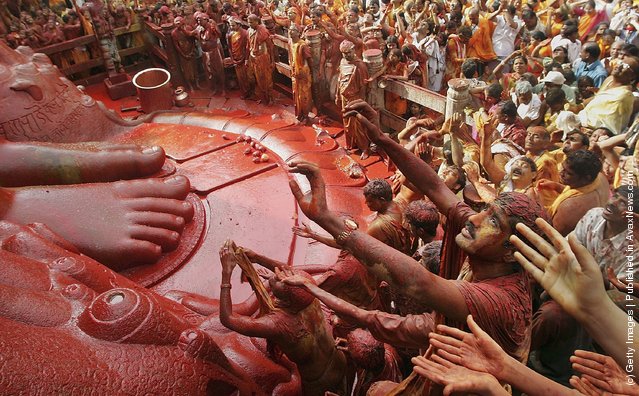
“The Mahamasthakabhisheka (or Mahamasthak Abhishek) is an important Jain festival held once every twelve years in the town of Shravanabelagola in Karnataka state, India. The festival is held in veneration of an immense 18 meter high statue of the Bhagwan (or Saint) Gomateshwara Bahubali. The anointing last took place in February 2006, and the next ceremony will occur in 2018”. – Wikipedia

Photo: A Jain Sadhu (2nd L) and devotees gather and pray at the feet of the monolithic statue of Jain sage Gomateswara during preparations for the Mahamastak Abhisheka ceremony February 7, 2006 in Shravanabelagola, India. The Mahamastak Abhisheka ceremony is held just once every twelve years where the statue will be bathed with milk, yogurt, saffron, gold coins and other religious items. The statue is said to be the world's largest monolith. The ceremony officially runs February 8-19. (Photo by Mario Tama/Getty Images)
Details
21 Jun 2011 12:27:00


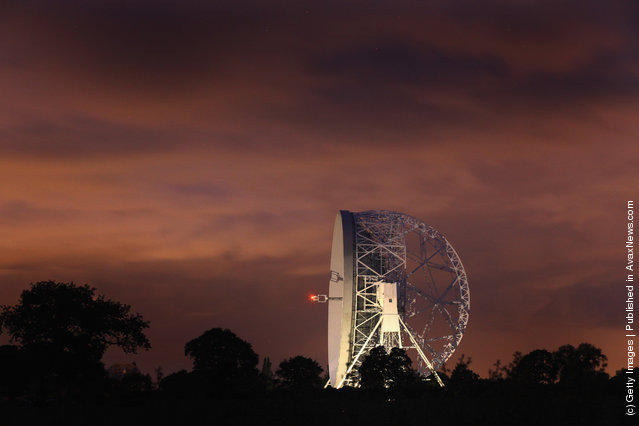
“The Lovell Telescope is a radio telescope at Jodrell Bank Observatory, near Goostrey, Cheshire in the north-west of England. When it was constructed in 1955, the telescope was the largest steerable dish radio telescope in the world at 76.2 m (250 ft) in diameter; it is now the third largest, after the Green Bank telescope in West Virginia, USA, and the Effelsberg telescope in Germany. It was originally known as the 250 ft (76 m) telescope or the Radio Telescope at Jodrell Bank, before becoming the Mark I telescope around 1961 when future telescopes (the Mark II, III, and IV) were being discussed. It was renamed to the Lovell Telescope in 1987 after Bernard Lovell, and became a Grade I listed building in 1988. The telescope forms part of the MERLIN and European VLBI Network arrays of radio telescopes”. – Wikipedia

Photo: The Lovell Telescope listens to the night sky for radio signals from space at Jodrell Bank on June 22, 2011 in Holmes Chapel, England. Jodrell Bank Centre for Astrophysics and it's world famous Lovell Telescope is on the shortlist of Britain's submission for Unesco World Heritage Site status. (Photo by Christopher Furlong/Getty Images)
Details
24 Jun 2011 09:34:00


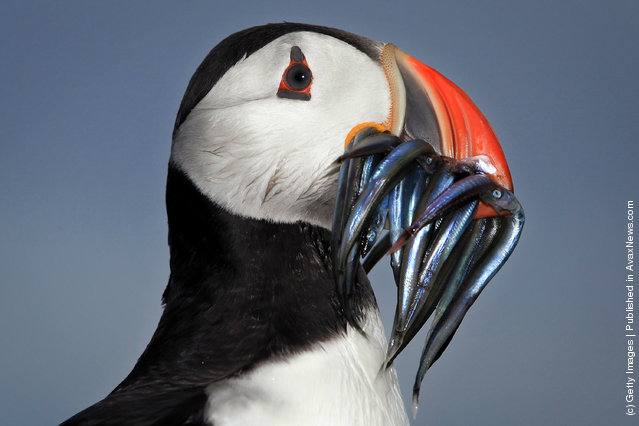
A Puffin returns to it's nest with a beak full of sand eels on June 25, 2011 on Inner Farne, England. The Farne Islands, which are run by the National Trust, are situated two to three miles off the Northumberland coastline. The archipeligo of 16-28 separate islands (depending on the tide) make the summer home to approximately 100,000 pairs of breeding seabirds including around 36,000 Puffins, 32,000 Guillemots and 2,000 pairs of Arctic Terns. The species of birds which nest in internationally important numbers include Shag, Sandwich Tern and Arctic Tern. The coastline around The Farnes are also the breeding ground to one of Europe's largest Grey Seal colonies with around 4,000 adults giving birth to 1500 pups every year. (Photo by Dan Kitwood/Getty Images)
Details
27 Jun 2011 12:58:00


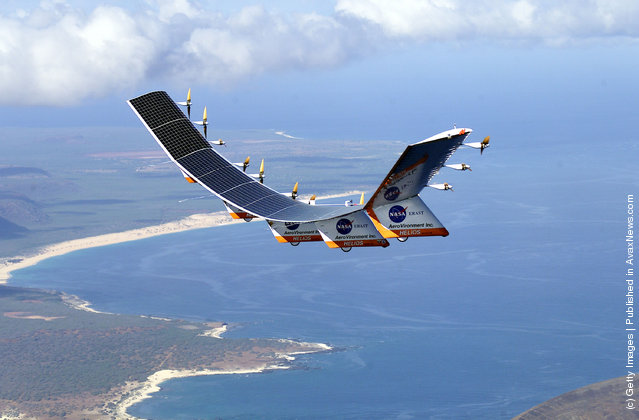
“NASA's Pathfinder, Pathfinder Plus, Centurion and Helios Prototype were an evolutionary series of solar- and fuel-cell-system-powered unmanned aerial vehicles. AeroVironment, Inc. developed the vehicles under NASA's Environmental Research Aircraft and Sensor Technology (ERAST) program. They were built to develop the technologies that would allow long-term, high-altitude aircraft to serve as “atmospheric satellites”, to perform atmospheric research tasks as well as serve as communications platforms”. – Wikipedia

Photo: The solar-electric Helios Prototype flying wing is flies over the Hawaiian islands of Niihau and Lehua during the first solar-powered test flight July 14, 2001 from the U.S. Navy's Pacific Missile Range Facility on Kauai, HI. The 18-hour flight was a functional checkout of the aircraft's systems and performance in preparation for an attempt to reach sustained flight at 100,000 feet altitude later in the summer. (Photo Courtesy of NASA/Getty Images)
Details
14 Jul 2011 09:24:00


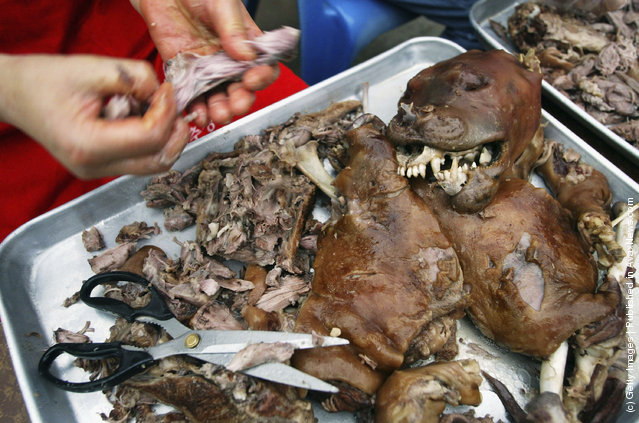
“Dog meat refers to edible parts and the flesh derived from (predominantly domestic) dogs. Human consumption of dog meat has been recorded in many parts of the world, including ancient China, ancient Mexico, and ancient Rome. According to contemporary reports, dog meat is consumed in a variety of countries such as Switzerland, China, Vietnam, the Philippines, and Korea. In addition, dog meat has also been used as survival food in times of war and/or other hardships”. – Wikipedia

Photo: A chef prepares dog meat at a restaurant on July 4, 2005 in Gwacheon, South Korea. Dog meat is a traditional dish in Korea dating back to the Samkuk period (period of the three kingdoms BC 57 – AD 668). Although many recipes existed historically for dog meat, now chefs only make soups, or dishes using boiled or roasted meat. Koreans traditionally eat dog meat on the hottest day of the summer, for it's reputed benefits of virility, invigoration and health. (Photo by Chung Sung-Jun/Getty Images)
Details
24 Jul 2011 13:21:00


“Hayley Dee Westenra (born 10 April 1987) is a New Zealand soprano, classical crossover artist, songwriter and UNICEF Ambassador. Her first internationally released album, Pure, reached #1 on the UK classical charts in 2003 and has sold more than two million copies worldwide. Pure is the fastest-selling international début classical album to date, having made Westenra an international star at age 16. In August 2006, she joined the Irish group Celtic Woman, was featured on their Celtic Woman: A New Journey CD and DVD, toured with them on their 2007 Spring Tour, and also was featured on their DVD, The Greatest Journey: Essential Collection, released in 2008”. – Wikipedia

Photo: The world's biggest-selling soprano, Hayley Westenra, has today been announced as the voice of ITV's coverage of this years Rugby World Cup, with her version of “World In Union”. The multi-million selling artist releases her fifth album, “Paradiso”, that has been produced by film composing legend Ennio Morricone, on 29th August. (Photo by Gareth Cattermole/Getty Images)
Details
29 Jul 2011 12:13:00
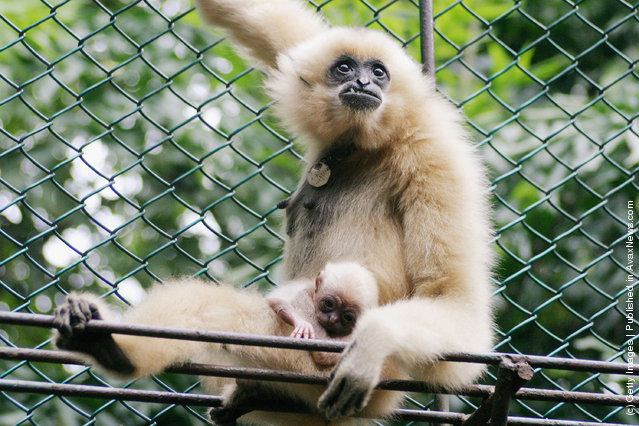
Newborn White-Cheeked Gibbon Nomascus

“Nomascus is the second most speciose genus of gibbons (family Hylobatidae). Originally this genus was a subgenus of Hylobates, and all individuals were considered one species, Hylobates concolor. Species within Nomascus are characterized by 52 chromosomes. Some species are all black, some light with a distinct black tuft of crown fur, and some by distinct, light-colored cheek patches. Nomascus is found from southern China (Yunnan) to southern Vietnam, and also on Hainan Island. One of the genus' species, Nomascus nasutus, has been deemed “the most critically endangered ape species in the world”. All of the species in this genus are endangered or critically endangered”. – Wikipedia

Photo: A newborn White-Cheeked Gibbon clings to its mother in the Nanning Zoo on April 12, 2004 in Nanning, Guangxi province, China. The White-Cheeked Gibbon's natural habitat is Southern China as well as Vietnam and Laos. They are classified as highly endangered and are on the brink of extinction due to poaching and reduction of natural rainforests. (Photo by Getty Images)
Details
12 Aug 2011 11:51:00
Dream Chaser

“The Dream Chaser is a planned crewed suborbital and orbital vertical-takeoff, horizontal-landing (VTHL) lifting-body spaceplane being developed by SpaceDev, a wholly owned subsidiary of Sierra Nevada Corporation (SNC). The Dream Chaser design is planned to carry seven people to and from low earth orbit. The vehicle would launch vertically on an Atlas V and land horizontally on conventional runways”. – Wikipedia

Photo: NASA Deputy Administrator Lori Garver talks during a press conference with Sierra Nevada's Dream Chaser spacecraft in the background at the University of Colorado at Boulder on February 5, 2011 in Boulder, Colorado. Sierra Nevada's Dream Chaser spacecraft is under development with support from NASA's Commercial Crew Development Program to provide crew transportation to and from low Earth orbit. NASA is helping private companies develop innovative technologies to ensure that the U.S. remains competitive in future space endeavors. (Photo by Bill Ingalls/NASA via Getty Images)
Details
12 Aug 2011 14:16:00