Loading...
Done
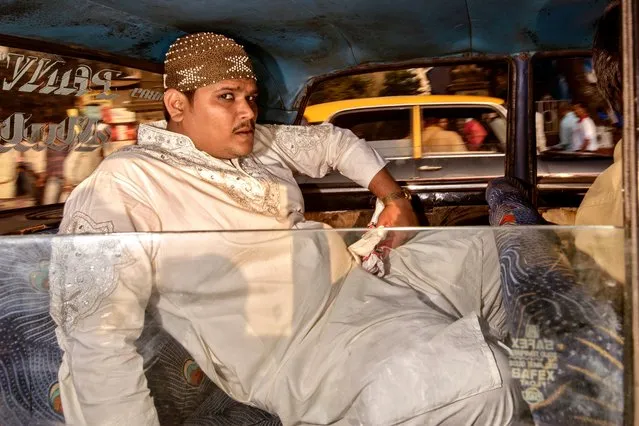
“I’m not scared of breaking the fourth wall”, Wallace has said of the photos where the subject is clearly aware of him taking the shot. “If they are looking at you in a photograph most photographers will think, oh, that’s not a good image. (But) people like to be involved and in the picture. You can see what they are thinking, see them talking”. (Photo by Dougie Wallace/The Guardian)

In Dougie Wallace’s photos of Mumbai taxis, the chatter, yelling, and constant horns of the city are almost audible. A selection of his images is on show at Gayfield Creative Spaces, Edinburgh, as part of the Retina photography festival until 30 July. For four years, the Glasgow-born Wallace focused his photos on one kind of taxi in particular: the Premier Padmini, a 1960s workhorse painted in black and yellow. Locally known as “Kaali-Peeli”, there were once more than 60,000 of them in the Indian city. But thanks to laws restricting pollution, the cars now are fast disappearing from Mumbai’s streets. (Photo by Dougie Wallace/The Guardian)
Details
13 Jul 2016 13:50:00
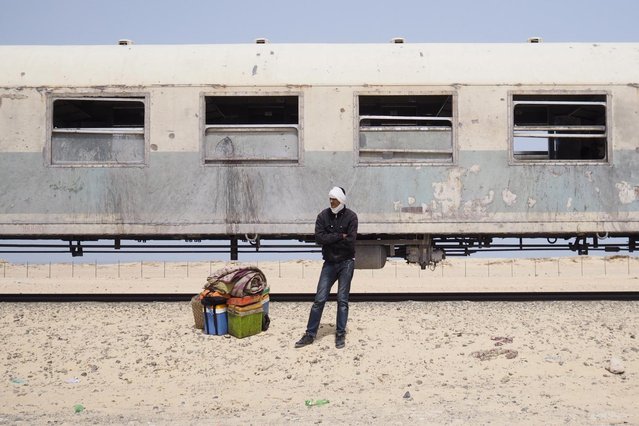
A passenger on a SNIM train carrying iron ore and mine workers waits for transport after arriving in Nouadhibou June 25, 2014. (Photo by Joe Penney/Reuters)

A passenger waits after his train arrived in Nouadhibou, Mauritania’s second largest city and the main export port for the country’s iron ore industry, on June 25, 2014. The mining company’s employees proudly call their firm the lung of their nation's economy and the train that ferries the ore to the coast stretches some two kilometres, making it one of the world's longest. SNIM mines black iron ore in the northern town of Zouerate, a remote desert location which nevertheless attracts people from all over the country looking for work. (Photo by Joe Penney/Reuters)
Details
27 Oct 2014 11:51:00
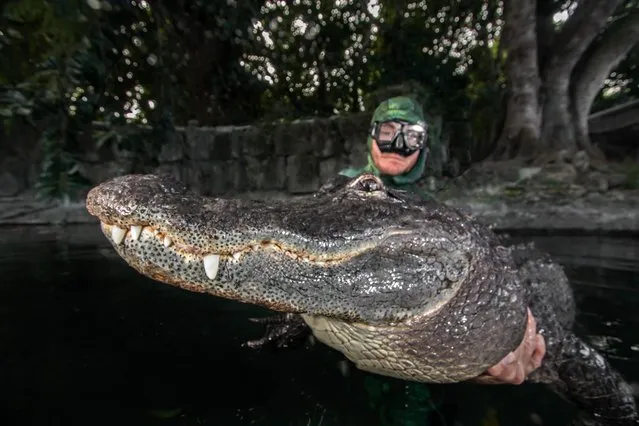
He brings the beast up close and personal to the camera. (Photo by Chris Gillette and Michael Dornellas/Mediadrumworld.com)

The incredible photographs show the three alligators crowding around the man’s head as they look directly at the camera and one even appears to sit on his lap whilst another reptile places a claw on his arm as it swims towards the surface. Photographs taken from above the surface show animal handler, Chris Gillette (29) from Fort Lauderdale, Florida, USA holding an alligator out of the water. The images of Chris were taken by Michael Dornellas at the Everglades Outpost Wildlife Rescue, Florida USA. Here: Mich­ael Dornellas brings the beast up close and personal to the camera. (Photo by Chris Gillette and Michael Dornellas/Mediadrumworld.com)
Details
20 Jan 2017 08:03:00
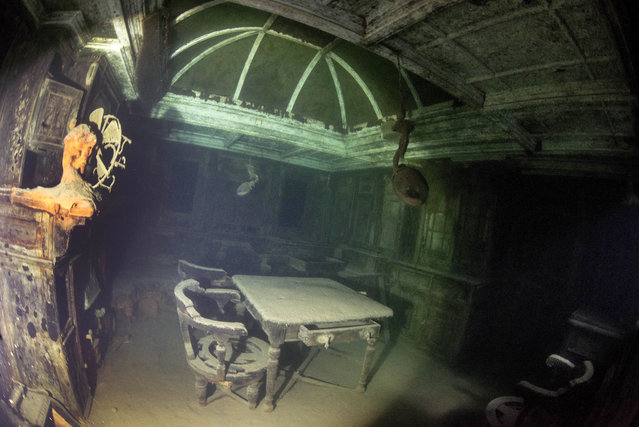
Not many divers visit the Gunilda, due to its remote location, depths of 270 feet, and chilly (38 degrees F/3 degrees C) temperatures. (Photo by Becky Kagan Schott/Caters News Agency)

These stunning images reveal the remains of a more than century-old sunken ship that has been preserved beneath freezing Lake Superior. The ship looks almost exactly the same as it did the day it sunk beneath waves all those years ago. At 60 meters long (approximately 198 feet), the «Gunilda» sunk after it struck some rocks and was not saved. Now, these stunning images have been captured 107 years after the sinking when a small group of divers revisited the vessel. (Photo by Becky Kagan Schott/Caters News Agency)
Details
25 Apr 2018 00:01:00
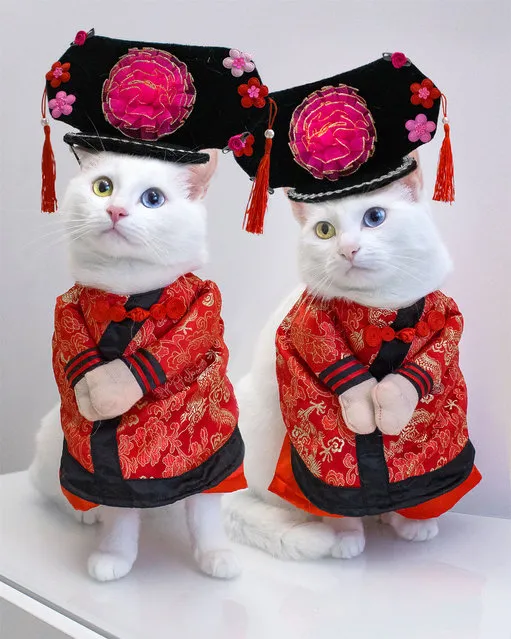
These adorable cats – which are twins – showcase their contrasting blue and green eyes. The fascinating pair, Iriss and Abyss, live with their owner Pavel Dyagilev, 34, in St. Petersburg, Russia. The cats have a condition called heterochromia iridis, which causes each eye to vary in color. Dyagilev said: “When I found an ad on social media that two kittens were seeking a new home, I never imagined that I'd end up with two. But I looked through the pictures of kittens and saw two twins always together on the photos. And my heart melted”. (Photo by @sis.twins/Caters News Agency)

These adorable cats – which are twins – showcase their contrasting blue and green eyes. The cats have a condition called heterochromia iridis, which causes each eye to vary in color. (Photo by @sis.twins/Caters News Agency)
Details
14 Aug 2019 00:03:00
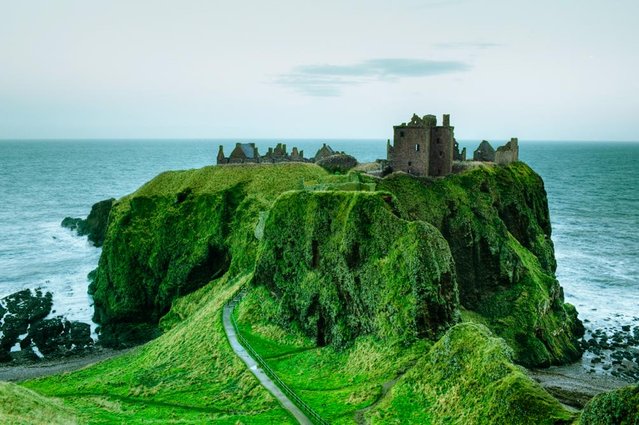
Dunnottar Castle In Scottish

Dunnottar Castleis a ruined medieval fortress located upon a rocky headland on the north-east coast of Scotland, about 3 kilometres (1.9 mi) south of Stonehaven. The surviving buildings are largely of the 15th and 16th centuries, but the site is believed to have been fortified in the Early Middle Ages. Dunnottar has played a prominent role in the history of Scotland through to the 18th-century Jacobite risings because of its strategic location and the strength of its situation. Dunnottar is best known as the place where the Honours of Scotland, the Scottish crown jewels, were hidden from Oliver Cromwell's invading army in the 17th century. The property of the Keiths from the 14th century, and the seat of the Earl Marischal, Dunnottar declined after the last Earl forfeited his titles by taking part in the Jacobite rebellion of 1715. The castle was restored in the 20th century and is now open to the public.
Details
13 Jan 2014 11:31:00


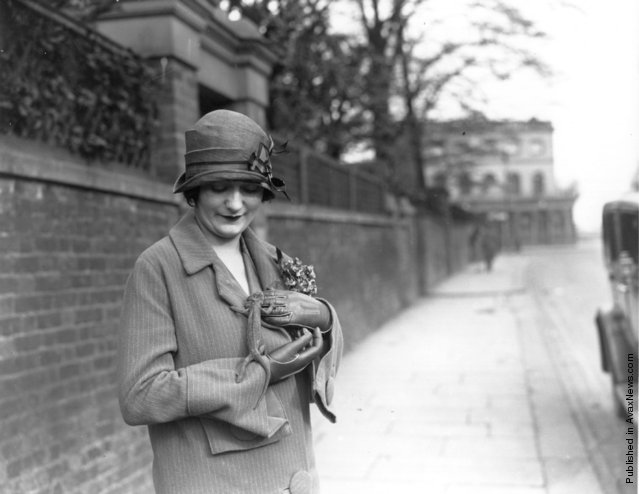
“Chameleons (family Chamaeleonidae) are a distinctive and highly specialized clade of lizards. They are distinguished by their parrot-like zygodactylous feet, their separately mobile and stereoscopic eyes, their very long, highly modified, and rapidly extrudable tongues, their swaying gait, the possession by many of a prehensile tail, crests or horns on their distinctively shaped heads, and the ability of some to change color. Uniquely adapted for climbing and visual hunting, the approximately 160 species of chameleon range from Africa, Madagascar, Spain and Portugal, across south Asia, to Sri Lanka, have been introduced to Hawaii, California and Florida, and are found in warm habitats that vary from rain forest to desert conditions”. – Wikipedia

Photo: A woman with the latest fashion accessory, a chameleon. (Photo by Fox Photos/Getty Images). Circa 1926
Details
20 Mar 2011 15:45:00
Nuclear Football

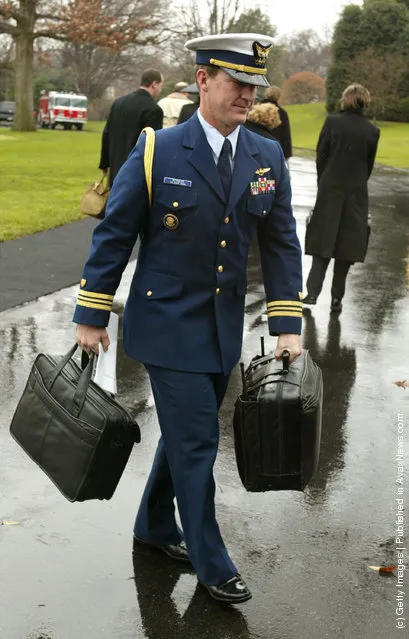
“The nuclear football (also known as the atomic football, the president's emergency satchel, the button, the black box, or just the football) is a briefcase, the contents of which are to be used by the President of the United States of America to authorize a nuclear attack while away from fixed command centers, such as the White House Situation Room. It functions as a mobile hub in the strategic defense system of the United States. It is a metallic Zero Halliburton briefcase carried in a black leather “jacket”. The package weighs around 45 pounds (20 kilograms). A small antenna protrudes from the bag near the handle”. – Wikipedia

Photo: A U.S. Military officer carries the “football”, which carries nuclear launch codes, on South Lawn after returning with U.S. President George W. Bush to the White House January 7, 2002 in Washington, DC. (Photo by Mark Wilson/Getty Images)
Details
06 Aug 2011 12:53:00