Loading...
Done
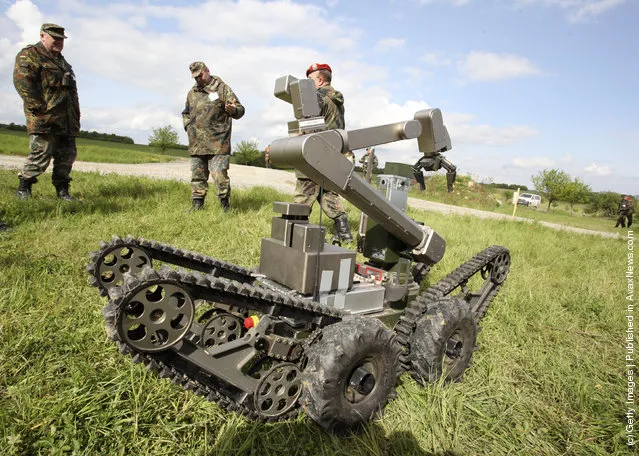
European Land-Robot Trial (ELROB), Military robot, teleMAX

The land-robot “teleMAX” of German company telerob stands next to soldiers during a trial at the German army base on May 18, 2010 in Hammelburg, Germany. ELROB provides an overview of the current state of affairs in European unmanned system technology and to evaluate commercial off-the-shelf products for military use. It is to show what is feasible in robotics, to support technological developments in Europe, and to find solutions for the current military challenges. (Photo by Ralph Orlowski/Getty Images)
Details
16 Aug 2011 11:47:00
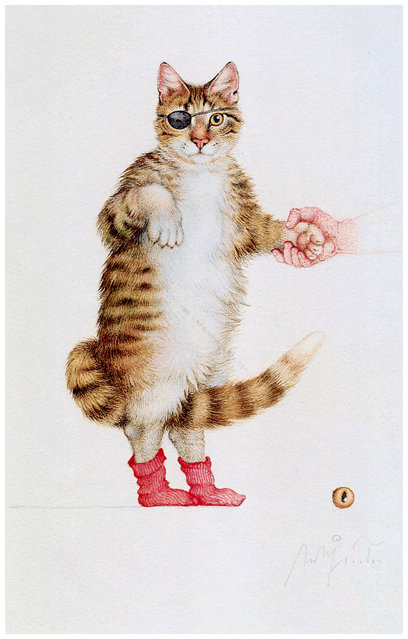
Katerfruehstueck. Artwork by Michael Mathias Prechtl

“Michael Mathias Prechtl (April 26, 1926, Amberg – March 19, 2003, Nuremberg) was a German artist, illustrator and cartoonist. He served as a soldier on the Eastern Front during World War II and spent 1945-49 as a prisoner of war in the Soviet Union”. – Wikipedia

Photo: “Der Gestiefelte Kater (Puss in Boots)”, 1997. Artwork by Michael Mathias Prechtl
Details
09 Sep 2012 10:45:00
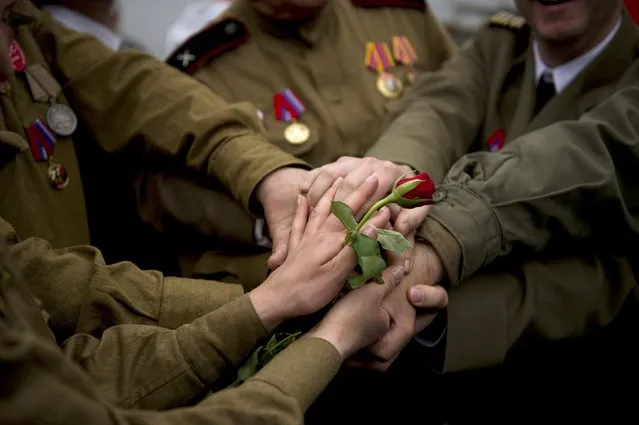
Members of a historical re-enactment group dressed as U.S. and Soviet Army soldiers take part in Elbe Day celebrations, in eastern German city of Torgau at the river Elbe, April 25, 2015. (Photo by Stefanie Loos/Reuters)

Members of a historical re-enactment group dressed as U.S. and Soviet Army soldiers take part in Elbe Day celebrations, in eastern German city of Torgau at the river Elbe, April 25, 2015. Elbe Day commemorates the encounter of the Allies 70 years ago, on the 25th of April 1945 when American and Soviet army units joined together on the destroyed bridge over the river Elbe. The photograph of the meaningful handshake made its way around the world and became a symbol of the near end of World War II in Europe. (Photo by Stefanie Loos/Reuters)
Details
26 Apr 2015 08:58:00
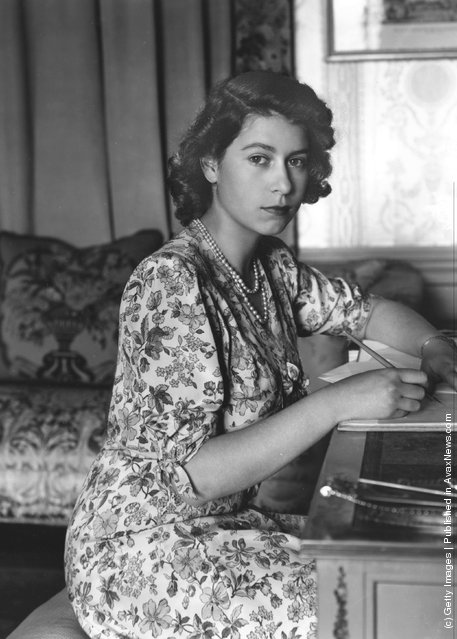
1944: Queen Elizabeth II (as Princess Elizabeth) writing at her desk in Windsor Castle, Berkshire

Queen Elizabeth II (as Princess Elizabeth) writing at her desk in Windsor Castle, Berkshire. (Photo by Lisa Sheridan/Studio Lisa/Getty Images). 30th May 1944
Details
24 Oct 2011 13:52:00
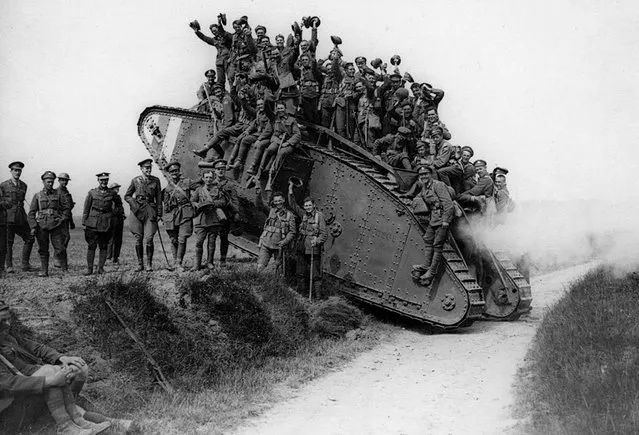
These black-and-white photos are taken from the new book “Armoured Warfare in the First World War 1916 – 1918” by Anthony Tucker-Jones and published by Pen & Sword Military. “Interestingly the British, French and Germans took completely different approaches with varying results”. The British military produced “Little Willie” in Autumn 1915 weighing 18 tonnes, which had a crew of two plus four gunners. “Inspired by a tracked artillery tractor “Little Willie” was referred to as a water tank – hence the name tank – to ensure secrecy”, said Anthony. “This led to the strange looking Mark I with its peculiar rhomboid shape, designed to cross trenches with guns in sponsons on either side. The Germans saw the tank as unchivalrous and were slow to grasp its utility. They favoured the Stormtrooper (specialist soldiers used to infiltrate enemy trenches) and artillery, not the tank”, said Anthony. “However, they didn’t hesitate to make use of captured British tanks. Although the tank helped secure victory and German soldiers dubbed it “Germany’s Downfall” the country was ultimately brought to its knees by the Allies blockade”. Here: British troops hitch a ride on a Mark IV after the massed tank fleet spearheading attack at Cambrai on November 20, 1917. (Photo by Anthony Tucker-Jones/Mediadrumworld.com)

These black-and-white photos are taken from the new book “Armoured Warfare in the First World War 1916 – 1918” by Anthony Tucker-Jones and published by Pen & Sword Military. Here: British troops hitch a ride on a Mark IV after the massed tank fleet spearheading attack at Cambrai on November 20, 1917. (Photo by Anthony Tucker-Jones/Mediadrumworld.com)
Details
23 Feb 2017 00:02:00
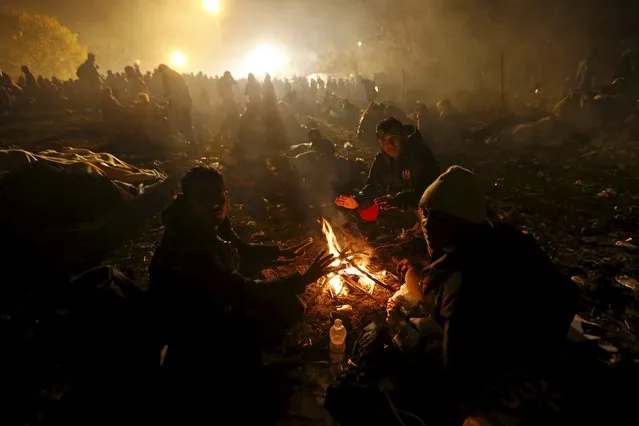
Migrants wait to cross the Slovenia-Austria border in Sentilj, Slovenia, October 27, 2015. The first five border guards – all German – of 400 promised to Slovenia by fellow EU countries are expected to arrive on Wednesday to help channel a huge flow of migrants through the tiny Alpine state, its government said. (Photo by Srdjan Zivulovic/Reuters)

Migrants wait to cross the Slovenia-Austria border in Sentilj, Slovenia, October 27, 2015. The first five border guards – all German – of 400 promised to Slovenia by fellow EU countries are expected to arrive on Wednesday to help channel a huge flow of migrants through the tiny Alpine state, its government said. Interior Ministry state secretary Bostjan Sefic also said 100-120 customs police would join Slovenian soldiers, regular police and private security firms in dealing with an influx that has strapped the country's limited resources. (Photo by Srdjan Zivulovic/Reuters)
Details
30 Oct 2015 08:03:00
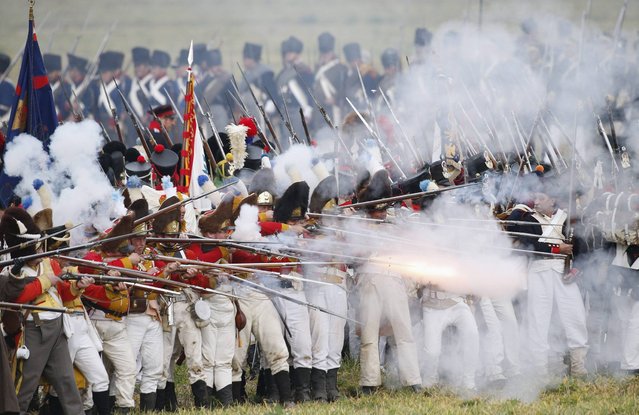
Performers wearing 19th century French military uniforms fire their weapons as they attack Allied forces during a reenactment of the Battle of the Nations, in a field in the village of Markkleeberg near Leipzig October 20, 2013. (Photo by Fabrizio Bensch/Reuters)

Performers wearing 19th century French military uniforms fire their weapons as they attack Allied forces during a reenactment of the Battle of the Nations, in a field in the village of Markkleeberg near Leipzig October 20, 2013. The east German city of Leipzig commemorated the 200th anniversary of the largest battle of the Napoleonic Wars on Sunday by reenacting the Battle of the Nations, with 6,000 military-historic association enthusiasts from all over Europe. The decisive encounter in which tens of thousands of soldiers were killed, took place from October 17-19, 1813, just outside of Leipzig. At the height of the hostilities Napoleon fielded more than 200,000 men against an Allied force of some 360,000 soldiers which included troops from Russia, Austria, Prussia and Sweden. (Photo by Fabrizio Bensch/Reuters)
Details
21 Oct 2013 11:19:00
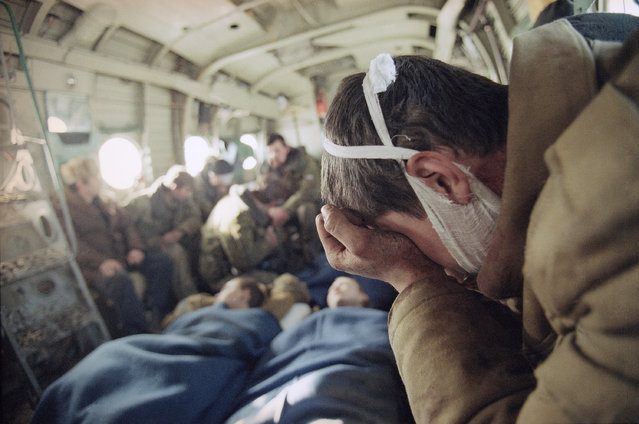
A wounded Russian soldier, who has been evacuated with his comrades, weeps in a helicopter on his way out of Grozny on Friday, February 3, 1995, as the fighting in the Chechen capital continues. The massive Russian force that invaded Chechnya has taken very heavy losses against a small but determined guerrilla force. (Photo by Karsten Thielker/AP Photo/File)

Karsten Thielker, a Pulitzer Prize-winning German photographer with The Associated Press who covered human suffering in conflict zones around the globe, has died at the age of 54. Thielker died on October 3 in Berlin of esophageal cancer, his wife Janna Ressel said. Here: A wounded Russian soldier, who has been evacuated with his comrades, weeps in a helicopter on his way out of Grozny on Friday, February 3, 1995, as the fighting in the Chechen capital continues. The massive Russian force that invaded Chechnya has taken very heavy losses against a small but determined guerrilla force. (Photo by Karsten Thielker/AP Photo/File)
Details
11 Oct 2020 00:05:00