A woman looks at the honour guard soldiers marching at the Tomb of the Unknown Soldier by the Kremlin wall, in downtown Moscow, on June 28, 2021. (Photo by Alexander Nemenov/AFP Photo)
A pedestrian waits for a bus in front of a “Living Wall” art project, produced in collaboration with The National Portrait Galler and the Earls Court Development Company, in west London on May 26, 2022. (Photo by Adrian Dennis/AFP Photo)
A changing of the honor guard ceremony by the Tomb of the Unknown Soldier in Alexander Garden by the Kremlin Wall in Moscow, Russia on May 29, 2020. (Photo by Vladimir Gerdo/TASS)
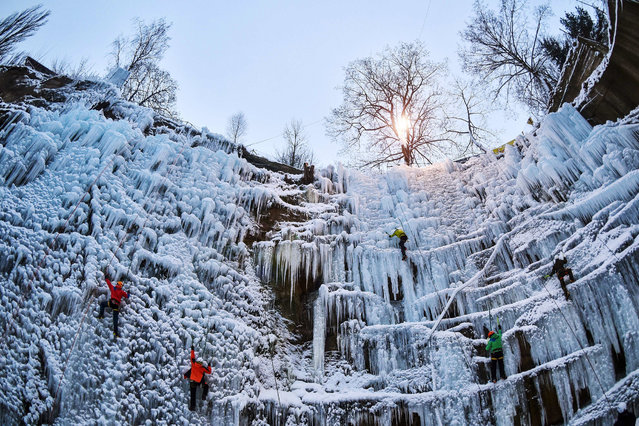
People climb on an artificial ice-wall in Liberec, about 100 km north of Prague, Czech Republic, Saturday, January 23, 2015. The wall was prepared in a former quarry just near the centre of the city. (Photo by Radek Petrasek/CTK via AP Photo)
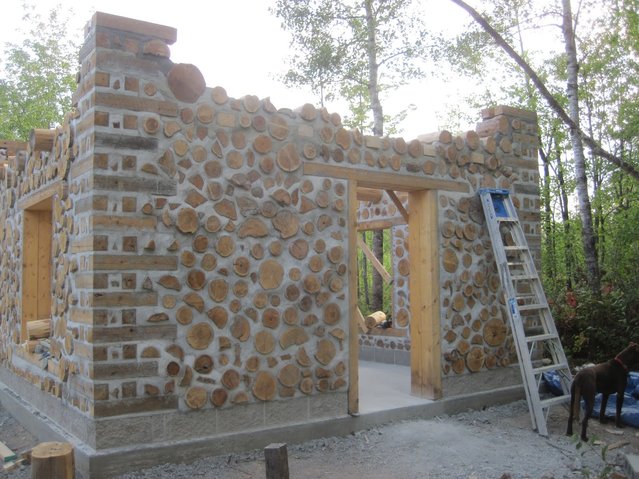
Cordwood construction is a method of natural building that originated roughly one thousand years ago in Greece and Siberia. This method involves using pieces of wood that slightly protrude from the mortar, giving the walls an attractive appearance. Usually, the walls are made 12 to 24 inches thick. However, in some parts of Canada, the walls can be as thick as 36 inches. This method appeals to many people due to its ease of construction economy of resources. Cordwood Construction can be separated into two main types: mortar-insulation-mortar (M-I-M) and Throughwall. M-I-M is a more preferable and widely used choice as it allows for better insulating properties.
Protestors affiliated with the Occupy Wall Street movement block the entrance to the Iowa Democratic Party headquarters during a protest on December 29, 2011 in Des Moines, Iowa. Thirteen people were arrested during the protest. (Photo by Andrew Burton/Getty Images)