Loading...
Done
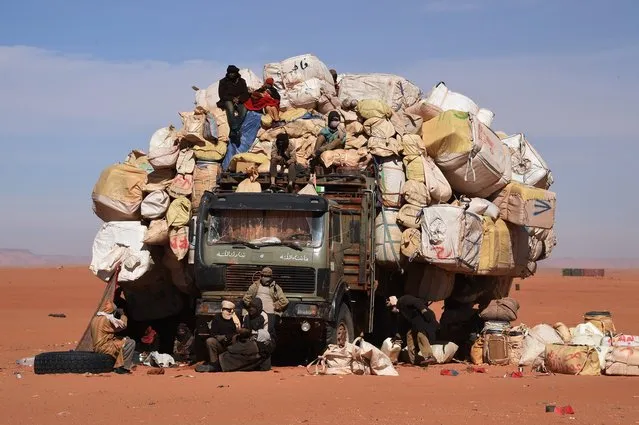
People sit near a fully loaded in Madama near the border with Lybia on January 1, 2015. French Defence Minister Jean-Yves Le Drian paid a surprise visit to northern Niger on January 1, to visit a base being built to combat the growing flow of weapons and jihadists from neighbouring Libya. Le Drian travelled from Chad to Madama, a desert outpost about 100 kilometres from Libya, where he saw in the New Year with troops at a French base. (Photo by Dominique Faget/AFP Photo)

People sit near a fully loaded in Madama near the border with Lybia on January 1, 2015. French Defence Minister Jean-Yves Le Drian paid a surprise visit to northern Niger on January 1, to visit a base being built to combat the growing flow of weapons and jihadists from neighbouring Libya. Le Drian travelled from Chad to Madama, a desert outpost about 100 kilometres from Libya, where he saw in the New Year with troops at a French base. Madama is situated on the route used by jihadists and arms smugglers in southern Libya to reach northern Mali and Niger. (Photo by Dominique Faget/AFP Photo)
Details
03 Jan 2015 13:27:00


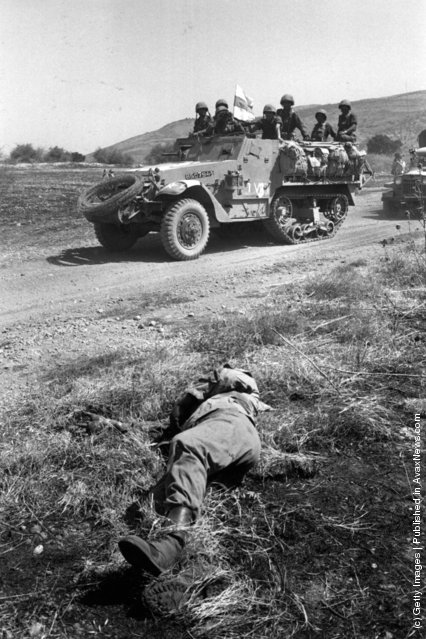
“The Six-Day War or June War, also known as the 1967 Arab-Israeli War or the Third Arab-Israeli War, was fought between June 5 and June 10, 1967, by Israel and the neighboring states of Egypt (known then as the United Arab Republic [UAR]), Jordan, and Syria. The war began with a large-scale surprise air strike by Israel on Egypt. The outcome was a swift and decisive Israeli victory. Israel took effective control of the Gaza Strip and the Sinai Peninsula from Egypt, the West Bank and East Jerusalem from Jordan, and the Golan Heights from Syria. Opinions are divided on whether Israel's attack was an act of aggression or a preemptive strike of a defensive nature”. – Wikipedia

Photo: The corpse of a soldier lying on the line of the Israeli advance into Syria during the Six-Day War. (Photo by Terry Fincher/Getty Images). 1967
Details
21 May 2011 08:29:00
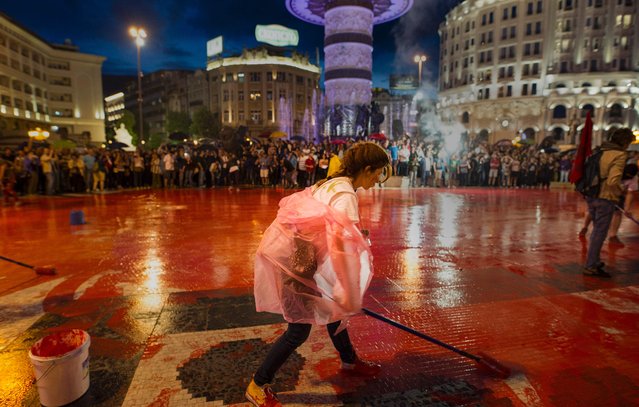
Protestors disperse color paint during a protest against the government, at central square, during an anti-government protest in Skopje on June 6, 2016, in a series of protests dubbed Colourful Revolution. Macedonia's president on June 6, 2016 said he was revoking all the controversial pardons he had granted in April to dozens of people implicated in a huge wiretapping scandal. President Gjorge Ivanov had on April 12 said he was halting probes into 56 Macedonians suspected of involvement in the scandal – a surprise decision that sparked international condemnation and angry street protests. (Photo by Robert Atanasovski/AFP Photo)

Protestors disperse color paint during a protest against the government, at central square, during an anti-government protest in Skopje on June 6, 2016, in a series of protests dubbed Colourful Revolution. Macedonia's president on June 6, 2016 said he was revoking all the controversial pardons he had granted in April to dozens of people implicated in a huge wiretapping scandal. President Gjorge Ivanov had on April 12 said he was halting probes into 56 Macedonians suspected of involvement in the scandal – a surprise decision that sparked international condemnation and angry street protests. (Photo by Robert Atanasovski/AFP Photo)
Details
08 Jun 2016 10:32:00
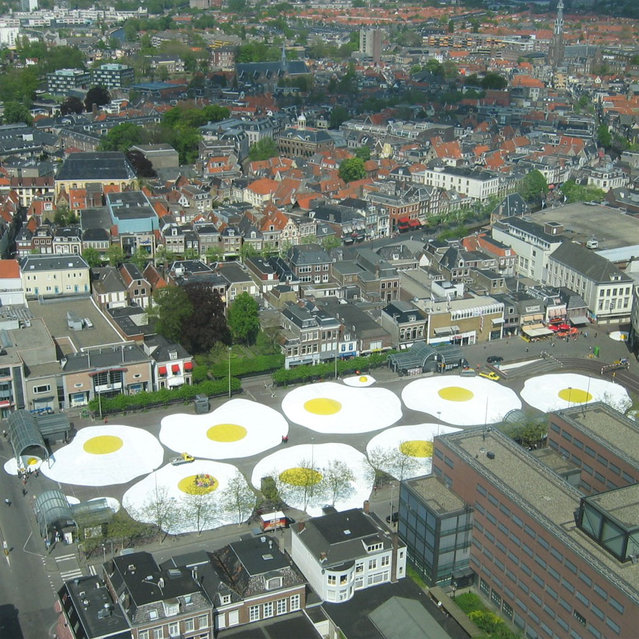
Art Eggcident By Henk Hofstra

With "Art Eggcident," Dutch artist Henk Hofstra demonstrates what it would look like if God threw giant eggs down at us. The eight large, sunny side up eggs measure almost 100 feet wide in diameter. The installation took place in Leeuwarden, a city in the north of the Netherlands.
"I hope it becomes a meeting place with room for art," says Henk. "Art that is different than a framed picture on the wall or a boring bronze sculpture. Art that shows us a different look, surprises us, or makes us angry or happy. Art that allows photographers to grab their cameras and arouses journalists. Art that evokes emotion, or provokes wild laughter."
Details
07 May 2014 10:54:00
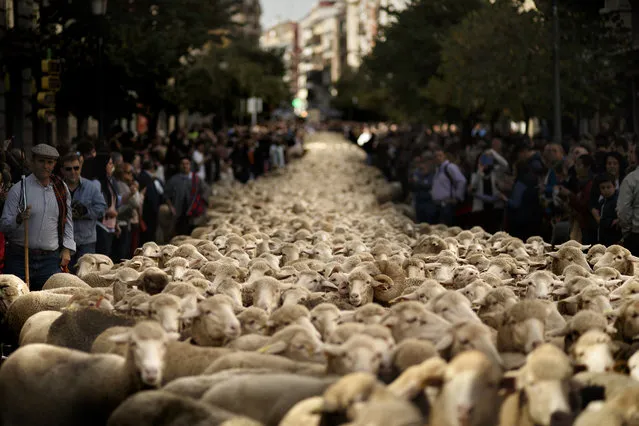
Shepherds lead their sheep through the centre of Madrid, Spain, Sunday, October 25, 2015. Shepherds have guided a flock of 2,000 sheep through Madrid streets in defense of ancient grazing, droving and migration rights increasingly threatened by urban sprawl and modern agricultural practices. Photo by Daniel Ochoa de Olza/AP Photo)

Shepherds lead their sheep through the centre of Madrid, Spain, Sunday, October 25, 2015. Shepherds have guided a flock of 2,000 sheep through Madrid streets in defense of ancient grazing, droving and migration rights increasingly threatened by urban sprawl and modern agricultural practices. Tourists and city-dwellers were surprised to see the capital's traffic cut to permit the ovine parade to bleat bells clanking its way past the city's most emblematic locations. (Photo by Daniel Ochoa de Olza/AP Photo)
Details
28 Oct 2015 08:02:00
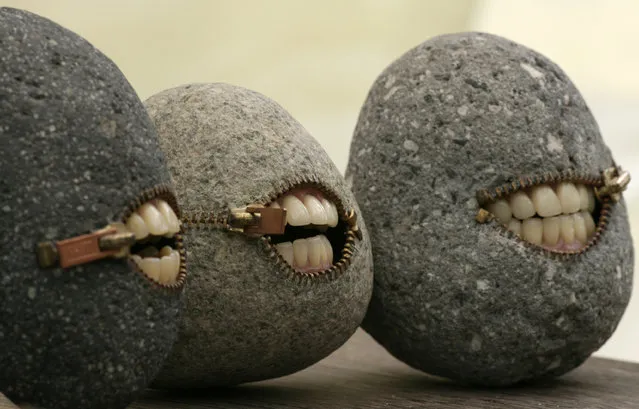
stone art by Hirotoshi Itoh

Hirotoshi Itoh graduated from Tokyo National Fine Arts University in 1982 and later went into his family business as a stonemason. He spent several years working with metal before turning his attention to stones. He utilizes stones found in a river bank near his home, and he creates sculptures that juxtapose the original shape and hardness of the material with surprising humor and texture. You can find more of his work on his Deviant Art page.
Details
17 May 2012 10:58:00
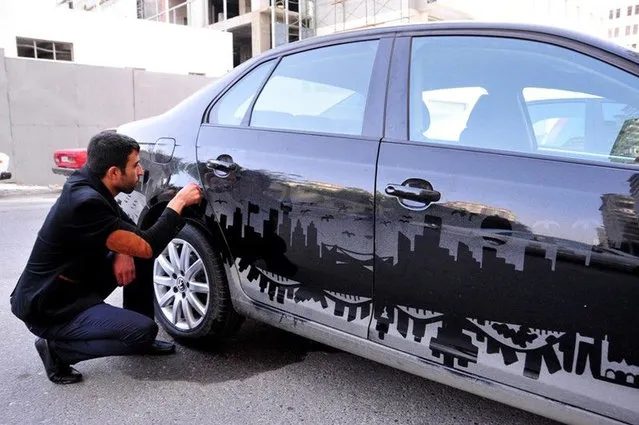
Dirty Art Car By Rafael Veyisov

During work hours on one of the busiest streets of Baku, Azerbaijan’s capital, parking attendant Rafael Veyisov wipes off the dust on cars with his fingers, slowly contouring the shapes of tall buildings and flying birds. In his artwork, he generally illustrates real towns to educate people about other countries, but sometimes he also lets his imagination run wild and produces impressive original works. Surprised by his talent, the car owners who regularly leave their vehicles in Rafael’s care, often leave them dirty just to give him an excuse to play around, and take photos of his beautiful artworks.
Details
13 Oct 2013 17:31:00
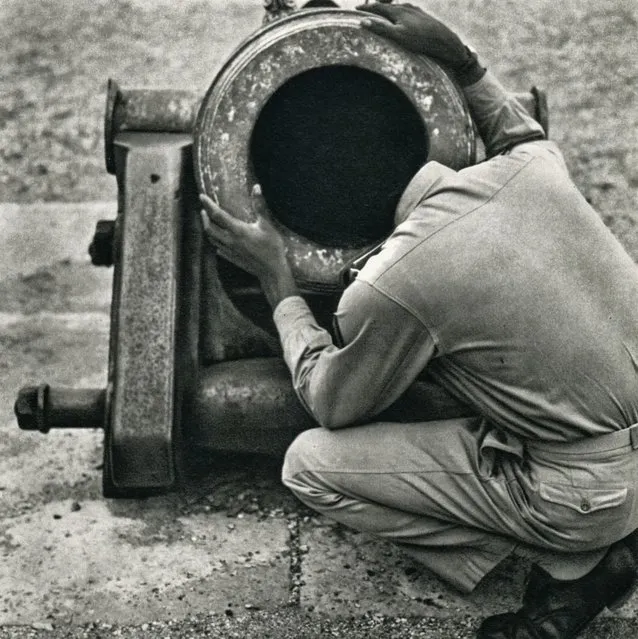
Humour Photography By Rene Maltete

René Maltête was a French photographer and poet. His pictures were based on the element of surprise and incongruity, often having a humorous and even philosophical side to them. At the start of his career, he often had to resort to manual labor as an addition to his to his profession in order to pay the bills. However, René's talent of seeing and being able to capture in time humorous moment of mundane, day-to-day life payed off in the end. Over the years, his works were published in a number of magazines in addition to numerous exhibitions that were held worldwide to popularize his work. (Photo by René Maltête)
Details
23 Oct 2014 11:34:00