Loading...
Done
Cheongdo Bullfighting Festival

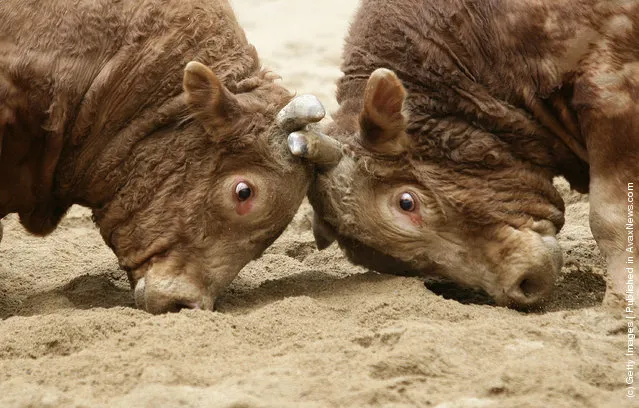
Bulls fight during the annual Bullfighting Festival on March 17, 2010 in Cheongdo, South Korea. More than 130 bulls from South Korea and abroad charge and lock horns in the annual festival which was run March 21, 2010. The bulls are grouped into three weight categories and fight head on until one of the bulls turns its head and runs away. (Photo by Chung Sung-Jun/Getty Images)
Details
21 Dec 2011 13:10:00
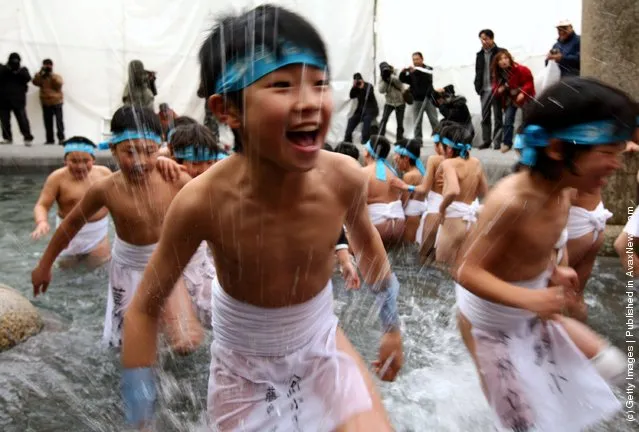
Japanese children wear loincloths as they splash about in freezing cold water during Saidaiji Naked Festival, at Saidaiji Temple

“A Hadaka Matsuri (“Naked Festival”) is a type of Japanese festival, or matsuri, in which participants wear a minimum amount of clothing; usually just a Japanese loincloth (called fundoshi), sometimes with a short happi coat, and rarely completely naked. Whatever the clothing, it is considered to be above vulgar, or everyday, undergarments, and on the level of holy Japanese shrine attire. Naked festivals are held in dozens of places throughout Japan every year, usually in the summer or winter. The most famous festival is held in Okayama, where the festival originated. Every year, over 9,000 men participate in this festival”. – Wikipedia

Photo: Japanese men wear loincloths as they splash about in freezing cold water during Saidaiji Naked Festival, at Saidaiji Temple on February 18, 2012 in Okayama, Japan. (Photo by Buddhika Weerasinghe/Getty Images)

Details
19 Feb 2012 12:18:00
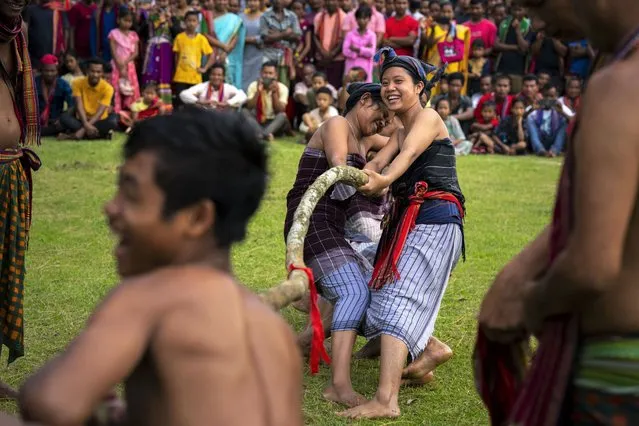
Indian Rabha tribal women in traditional attire take part in a tug of war competition with men during Baikho festival at Gamerimura village along the Assam Meghalaya border, west of Gauhati, India, Saturday, June 4, 2022. (Photo by Anupam Nath/AP Photo)

Indian Rabha tribal women in traditional attire take part in a tug of war competition with men during Baikho festival at Gamerimura village along the Assam Meghalaya border, west of Gauhati, India, Saturday, June 4, 2022. (Photo by Anupam Nath/AP Photo)

Details
09 Jun 2022 04:57:00
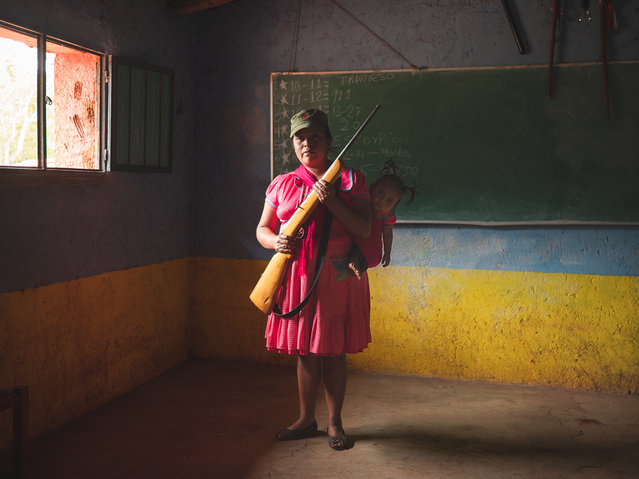
Forgotten Guerrero. A female member of the community defence force holds her weapon. Since early 2019, the village has been attacked repeatedly by Los Ardillos cartel, prompting residents to take action. Rincón de Chautla, Guerrero, 10 June 2019. (Photo by Alfredo Bosco/Luz with the support of Le Figaro Magazine, Winner of the 2020 Humanitarian Visa d’or award, International Committee of the Red Cross/International Festival of Photojournalism 2020)

Forgotten Guerrero. A female member of the community defence force holds her weapon. Since early 2019, the village has been attacked repeatedly by Los Ardillos cartel, prompting residents to take action. Rincón de Chautla, Guerrero, 10 June 2019. (Photo by Alfredo Bosco/Luz with the support of Le Figaro Magazine, Winner of the 2020 Humanitarian Visa d’or award, International Committee of the Red Cross/International Festival of Photojournalism 2020)
Details
02 Sep 2020 00:05:00
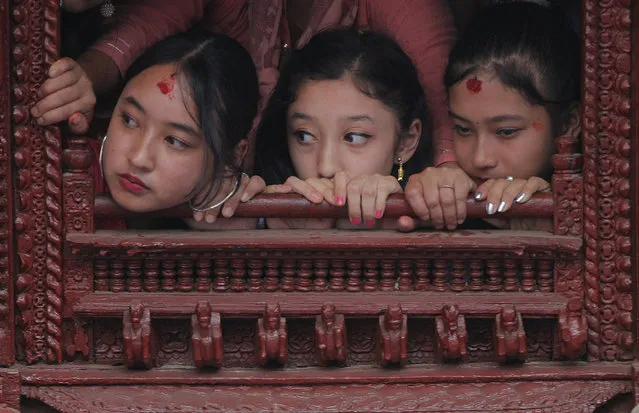
A former living goddess Kumari, middle, watches the Indra Jatra festival, an eight-day festival that honors Indra, the Hindu god of rain, in Kathmandu, Nepal, Friday, September 13, 2019. (Photo by Niranjan Shrestha/AP Photo)

A former living goddess Kumari, middle, watches the Indra Jatra festival, an eight-day festival that honors Indra, the Hindu god of rain, in Kathmandu, Nepal, Friday, September 13, 2019. (Photo by Niranjan Shrestha/AP Photo)
Details
18 Sep 2019 00:03:00
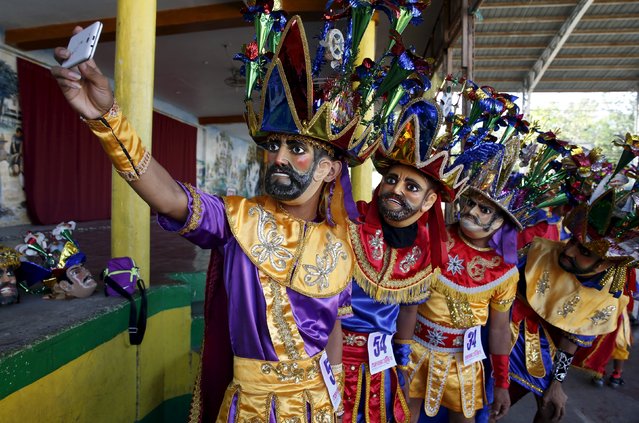
Penitents wearing masks, known locally as “Morions” take a selfie during the start of Holy Week celebrations in Mogpog, Marinduque in central Philippines March 21, 2016. (Photo by Erik De Castro/Reuters)

Penitents wearing masks, known locally as “Morions” take a selfie during the start of Holy Week celebrations in Mogpog, Marinduque in central Philippines March 21, 2016. The Moriones is an annual festival held on Holy Week on the island of Marinduque, Philippines. The “Moriones” are men and women in costumes and masks replicating the garb of biblical Roman soldiers as interpreted by local folks. (Photo by Erik De Castro/Reuters)
Details
22 Mar 2016 11:29:00
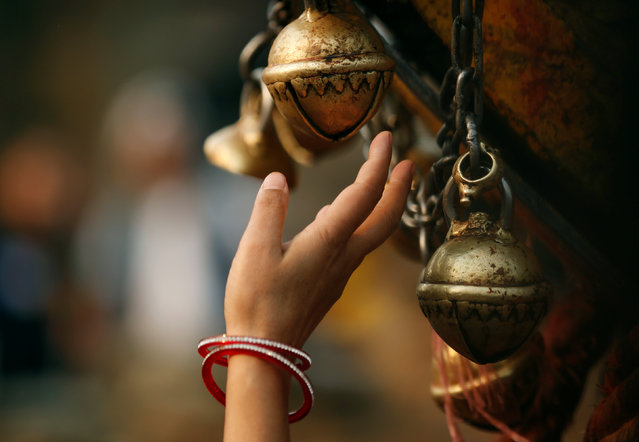
A hand of a devotee is pictured as she rings a bell while offering prayers to the chariot of God Bhairab during the Bisket festival in Bhaktapur, Nepal, April 13, 2016. (Photo by Navesh Chitrakar/Reuters)

A hand of a devotee is pictured as she rings a bell while offering prayers to the chariot of God Bhairab during the Bisket festival in Bhaktapur, Nepal, April 13, 2016. During the festival, also regarded as Nepalese New Year, images of the Hindu god Bhairava and his female counterpart Bhadrakali are enshrined in two large chariots and pulled to an open square after which rituals and festivities are performed. (Photo by Navesh Chitrakar/Reuters)
Details
15 Apr 2016 11:20:00
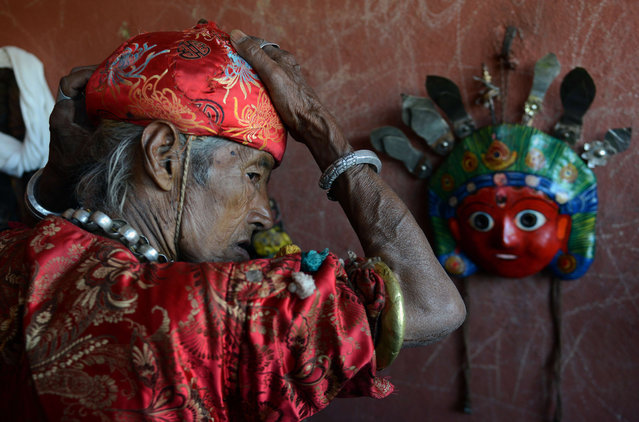
A Nepalese Hindu devotee dresses as a deity as he prepares to participate in festivities at the Shikali Temple during celebrations for the Shikali Jatra festival in the village of Khokana, on the outskirts of Kathmandu, on October 19, 2015. Local villagers, who normally do not celebrate the country's most famous festival of Dashain, celebrate the Shikali Jatra each year. (Photo by Prakash Mathema/AFP Photo)

A Nepalese Hindu devotee dresses as a deity as he prepares to participate in festivities at the Shikali Temple during celebrations for the Shikali Jatra festival in the village of Khokana, on the outskirts of Kathmandu, on October 19, 2015. Local villagers, who normally do not celebrate the country's most famous festival of Dashain, celebrate the Shikali Jatra each year. (Photo by Prakash Mathema/AFP Photo)
Details
22 Oct 2015 08:04:00