Loading...
Done
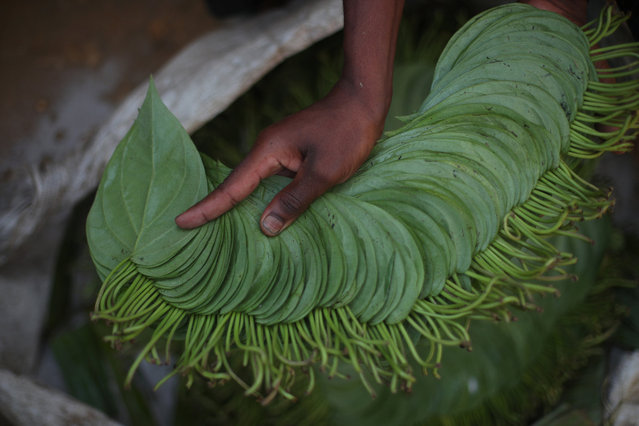
Faruk, 17, a Rohingya refugee trader holds betel leaves which are on sale at a stall in Palong Khali refugee camp near Cox's Bazar, Bangladesh, November 3, 2017. He left his village in Myanmar when the military opened fire towards the Rohingya. “I buy this betel leaf from Palong Khali market, in one bundle there are 160 pieces, I buy it for 80 taka and I sell it for 100 taka. Bangladeshi's and I sell for the same rate in the camp. Outside in the local market it is 80 taka per bundle. My problem is that I don't have money so I can't buy anything to eat, I can't buy fish to eat”, he said. (Photo by Hannah McKay/Reuters)

Faruk, 17, a Rohingya refugee trader holds betel leaves which are on sale at a stall in Palong Khali refugee camp near Cox's Bazar, Bangladesh, November 3, 2017. He left his village in Myanmar when the military opened fire towards the Rohingya. “I buy this betel leaf from Palong Khali market, in one bundle there are 160 pieces, I buy it for 80 taka and I sell it for 100 taka (1 Bangladeshi Taka = 0.012 US Dollar). Bangladeshi's and I sell for the same rate in the camp. Outside in the local market it is 80 taka per bundle. My problem is that I don't have money so I can't buy anything to eat, I can't buy fish to eat”, he said. (Photo by Hannah McKay/Reuters)
Details
27 Nov 2017 08:54:00
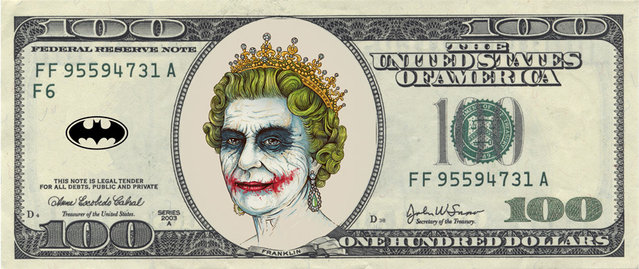
Make Your Franklin By Martin Joubert Part 1

Having $100 in your pocket would be so much cooler if it was designed by Martin Joubert. He went all out and created a number of different designs for the 100 USD banknotes, ranging from silly to witty. We especially liked the one with “That’s right. This is real money” written on it, showing just how many cups of coffee, basketballs, and guns you can buy with 100 dollars. All in all, even the currency that we have today is nothing but paper, even though it looks official and strict. There is nothing backing it up except for our noble military that ensures that Gulf States sell their oil using only the “green” kind of currency. (Photo by Martin Joubert)
Details
17 Dec 2014 11:19:00
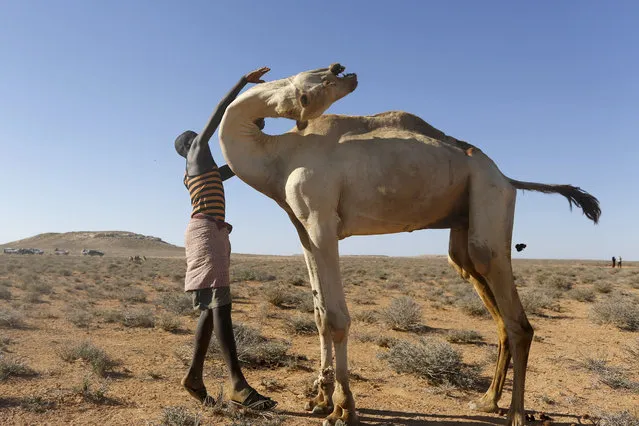
Ali Asair, who has left his family behind and traveled hundreds of kilometers in search for a pasture for his animals, attends to his camel in a pastoralists' settlement in the Bandarbeyla district in Somalia's semi-autonomous region of Puntland, Somalia, 24 March 2017. According to media reports, the United Nations says only 31 percent of 864 million US dollars appeal for a drought-hit Somalia is funded. The UN said the world is facing the largest humanitarian crisis since 1945, adding that more than 20 million people are facing the threat of famine in Somalia, Yemen, South Sudan and Nigeria and 1.4 million children could die from starvation this year. (Photo by Dai Kurokawa/EPA)

Ali Asair, who has left his family behind and traveled hundreds of kilometers in search for a pasture for his animals, attends to his camel in a pastoralists' settlement in the Bandarbeyla district in Somalia's semi-autonomous region of Puntland, Somalia, 24 March 2017. According to media reports, the United Nations says only 31 percent of 864 million US dollars appeal for a drought-hit Somalia is funded. The UN said the world is facing the largest humanitarian crisis since 1945, adding that more than 20 million people are facing the threat of famine in Somalia, Yemen, South Sudan and Nigeria and 1.4 million children could die from starvation this year. (Photo by Dai Kurokawa/EPA)
Details
28 Mar 2017 09:01:00
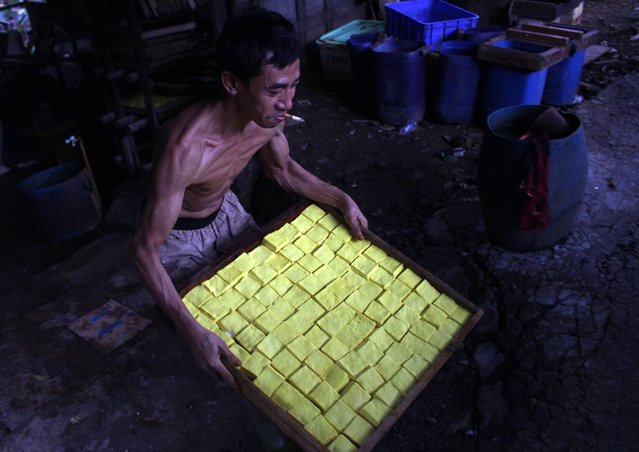
A  worker carries a tray of boiled tofu in a traditional tofu factory in Depok, Indonesia, 21 January 2015. (Photo by Adi Weda/EPA)

A worker carries a tray of boiled tofu in a traditional tofu factory in Depok, Indonesia, 21 January 2015. Tofu has been a common side dish for many Indonesian families. It is healthy, inexpensive and easy to find throughout the city. Tofu entrepreneurs in Indonesia are suffering due to the weakening of the rupiah against the US dollar and the rise in prices of imported soybeans in the international market, forcing tofu-makers to cut their production and lay off staff. (Photo by Adi Weda/EPA)
Details
27 Jan 2015 12:35:00


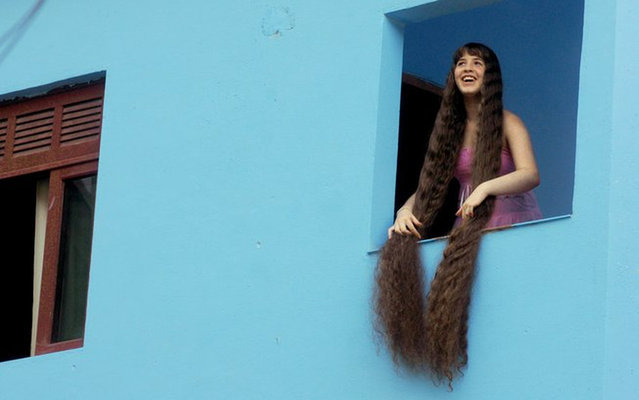
Nicknamed “Rapunzel” by her schoolmates, Natasha has not cut her hair – which at 5 feet, 2 inches long was only one inch shorter than her petite frame – since she was a baby.

And while Natasha currently sleeps in a tiny, windowless room, she got R$9,000 (about £3,000) from selling the hair for extensions which she has put towards a new home for her family.
Details
24 Nov 2012 17:05:00
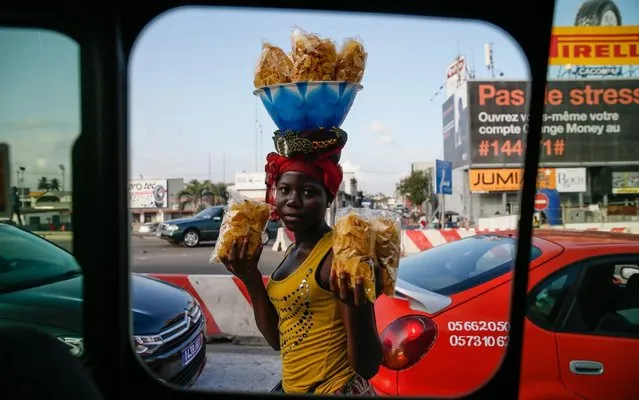
A woman sells chips in Abidjan, Ivory Coast on August 09, 2019. World's number one cacao producer Ivory Coast's capital Abidjan set peace after the 201011 Ivorian crisis. Women in Abidjan work in various jobs to help their families' budget. (Photo by Mahmut Serdar Alakus/Anadolu Agency via Getty Images)

A woman sells chips in Abidjan, Ivory Coast on August 09, 2019. World's number one cacao producer Ivory Coast's capital Abidjan set peace after the 201011 Ivorian crisis. Women in Abidjan work in various jobs to help their families' budget. (Photo by Mahmut Serdar Alakus/Anadolu Agency via Getty Images)
Details
13 Aug 2019 00:05:00
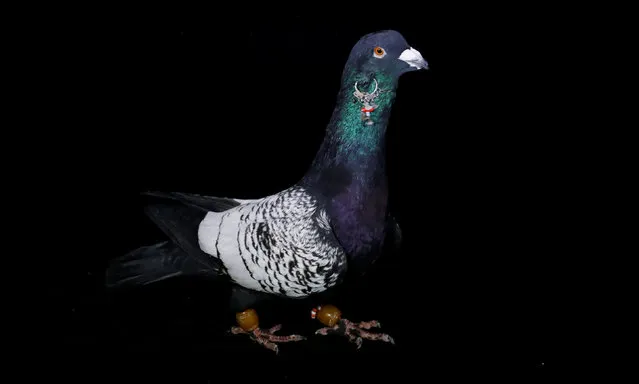
A pigeon, known as Siyah Kinifirli, with an approximate market value of 1000 Turkish Lira ($263), bred by 23-year-old Ismail Ozbek, is pictured in Sanliurfa, Turkey, December 23, 2016. As night-time approaches in Sanliurfa, southeastern Turkey, most of the alleyways of the city's old bazaar are emptying out of buyers and vendors, except for one. The bustle of daytime trading has died down, but on this little street, a stream of men carry cardboard boxes filled with pigeons to a cluster of three teahouses. Here, they sell the birds at Sanliurfa's famed auctions to a dedicated band of pigeon keepers and breeders, a pastime that has been thriving for hundreds of years across the region and over the nearby border into war-torn Syria. In a country where the minimum wage is about 1,400 Liras ($367) a month, enthusiasts regularly easily spend hundreds of dollars for one bird. “I once sold a pair of pigeons for 35,000 Turkish Lira”, says auctioneer Imam Dildas. “This is a passion, a hobby you cannot quit. I've been known to sell the fridge and my wife's gold bracelets to pay for pigeons”. (Photo by Umit Bektas/Reuters)

A pigeon, known as Siyah Kinifirli, with an approximate market value of 1000 Turkish Lira ($263), bred by 23-year-old Ismail Ozbek, is pictured in Sanliurfa, Turkey, December 23, 2016. As night-time approaches in Sanliurfa, southeastern Turkey, most of the alleyways of the city's old bazaar are emptying out of buyers and vendors, except for one. (Photo by Umit Bektas/Reuters)
Details
17 Jan 2017 12:05:00
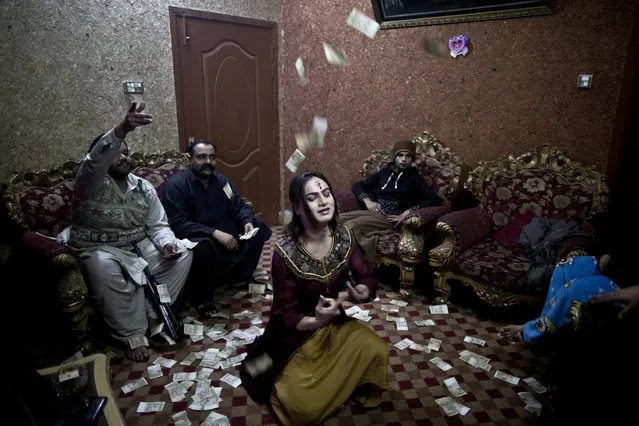
Pakistani Waseem Akram, 27, dances during a private party in Rawalpindi, Pakistan. By day, Akram sells mobile phone accessories from an alleyway shop in an old neighborhood of this Pakistani city, Thursday, January 15, 2015. (Photo by Muhammed Muheisen/AP Photo)

Pakistani Waseem Akram, 27, dances during a private party in Rawalpindi, Pakistan. By day, Akram sells mobile phone accessories from an alleyway shop in an old neighborhood of this Pakistani city, Thursday, January 15, 2015. Across conservative Pakistan, where Islamic extremists launch near-daily attacks and many follow a strict interpretation of their Muslim faith, male cross-dressers and the transgendered face a challenge of balancing two identities. Some left their villages for the anonymity of a big city, fearing the reactions of their families while still concealing their identity from neighbors and co-workers. (Photo by Muhammed Muheisen/AP Photo)
Details
21 Jan 2015 13:27:00