Loading...
Done
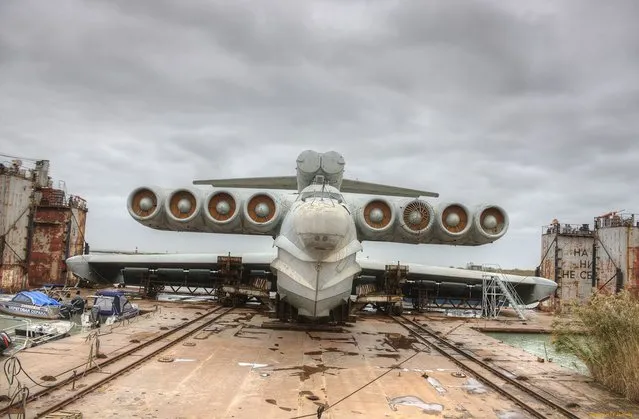
The Lun-class Ekranoplane was used by the Soviet Navy starting in 1987, and wasn't retired until the late 1990s, after the Soviet Union's fall. (Igor113)

“The Lun-class ekranoplan (NATO reporting name Duck) was a ground effect vehicle (GEV) designed by Rostislav Evgenievich Alexeev and used by the Soviet and Russian navies from 1987 until sometime in the late 1990s. It “flew” using the lift generated by the ground effect of its large wings when close to the surface of the water – about four metres or less. Although they might look similar and/or have related technical characteristics, ekranoplans like the Lun are not aircraft, seaplanes, hovercraft, or hydrofoils – ground effect is a separate technology altogether. The International Maritime Organization classifies these vehicles as maritime ships. The name Lun comes from the Russian for harrier”. – Wikipedia (Photo by Igor113)
Details
08 Aug 2014 10:51:00
A humanoid robot named Kansei, meaning “sensibility” in Japanese, makes a facial expression depicting “happiness”, next to the word “Love” during a demonstration at a laboratory of Meiji University's Robot and Science Institute in Kawasaki, south of Tokyo in this June 4, 2007 file photo. (Photo by Yuriko Nakao/Reuters)

A humanoid robot named Kansei, meaning “sensibility” in Japanese, makes a facial expression depicting “happiness”, next to the word “Love” during a demonstration at a laboratory of Meiji University's Robot and Science Institute in Kawasaki, south of Tokyo in this June 4, 2007 file photo. Three-fourths of robot installations over the next decade are expected to be concentrated in four areas: transportation equipment, including the automotive sector; computer and electronic products; electrical equipment and machinery. Labor costs have climbed in countries such as China that have been popular for outsourcing production, while technological advances for robots allow them to be more flexible and perform more tasks. (Photo by Yuriko Nakao/Reuters)
Details
17 Apr 2015 09:39:00
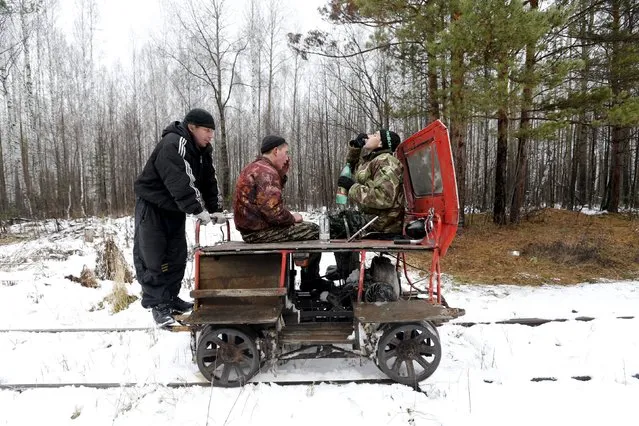
(L-R) A man nicknamed "Barcelona", Alexey Bolotov and Alexey Jakushin drink vodka as they travel by a pioneer motorised railcar on their way to Kalach, Sverdlovsk region, Russia October 18, 2015. The "pioneer," a light auxiliary rail vehicle, is a popular form of transport among people who live along the Alapayevsk railway. (Photo by Maxim Zmeyev/Reuters)

(L-R) A man nicknamed "Barcelona", Alexey Bolotov and Alexey Jakushin drink vodka as they travel by a pioneer motorised railcar on their way to Kalach, Sverdlovsk region, Russia October 18, 2015. The "pioneer," a light auxiliary rail vehicle, is a popular form of transport among people who live along the Alapayevsk railway. In a remote corner of the Urals region at the end of a narrow-gauge railway is Kalach, population about a dozen. Three decades ago 600 people called the village home, but the local forestry industry suffered as the former Soviet Union imploded and people moved away in search of work. In Kalach today there are no telephones, no mobile reception and only a few hours of electricity a day. (Photo by Maxim Zmeyev/Reuters)
Details
15 Nov 2015 08:06:00
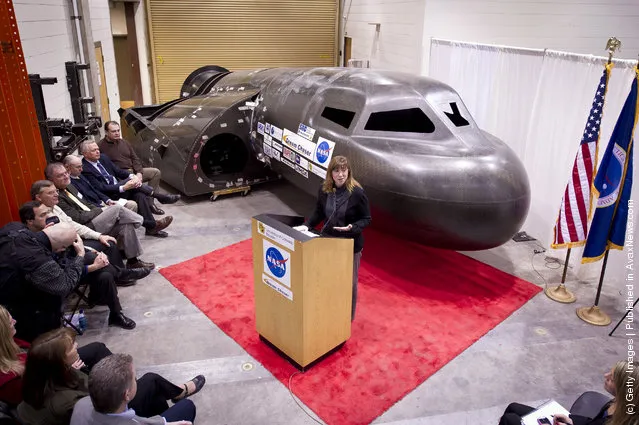
Dream Chaser

“The Dream Chaser is a planned crewed suborbital and orbital vertical-takeoff, horizontal-landing (VTHL) lifting-body spaceplane being developed by SpaceDev, a wholly owned subsidiary of Sierra Nevada Corporation (SNC). The Dream Chaser design is planned to carry seven people to and from low earth orbit. The vehicle would launch vertically on an Atlas V and land horizontally on conventional runways”. – Wikipedia

Photo: NASA Deputy Administrator Lori Garver talks during a press conference with Sierra Nevada's Dream Chaser spacecraft in the background at the University of Colorado at Boulder on February 5, 2011 in Boulder, Colorado. Sierra Nevada's Dream Chaser spacecraft is under development with support from NASA's Commercial Crew Development Program to provide crew transportation to and from low Earth orbit. NASA is helping private companies develop innovative technologies to ensure that the U.S. remains competitive in future space endeavors. (Photo by Bill Ingalls/NASA via Getty Images)
Details
12 Aug 2011 14:16:00


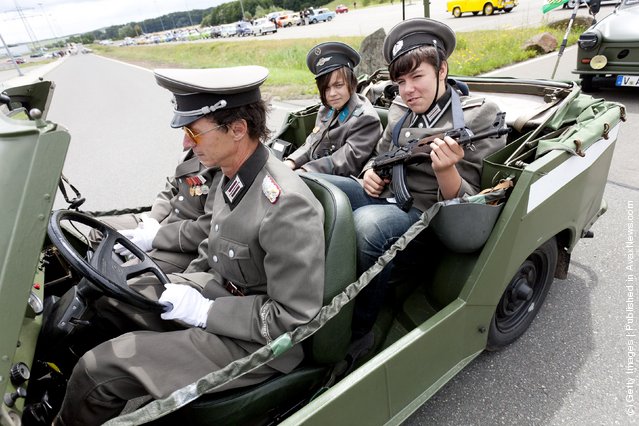
“The Trabant is a car that was produced by former East German auto maker VEB Sachsenring Automobilwerke Zwickau in Zwickau, Sachsen. It was the most common vehicle in East Germany, and was also exported to countries both inside and outside the communist bloc. The main selling points was that it had room for four adults and luggage in a compact, light and durable shell and that it was fast (when introduced) and durable. With its mediocre performance, smoky two-stroke engine, and production shortages, the Trabant is often cited as an example of the disadvantages of centralized planning; on the other hand, it is regarded with derisive affection as a symbol of the failed former East Germany and of the fall of communism (in former West Germany, as many East Germans streamed into West Berlin and West Germany in their Trabants after the opening of the Berlin Wall in 1989). It was in production without any significant changes for nearly 30 years with 3,096,099 Trabants produced in total”. – Wikipedia

Photo: Enthusiasts weared in uniforms of the former eastern german army trive in a military Trabant car as fans and owners of East German-era Trabant cars gather at the 2011 International Trabantfahrer Treffen (International Trabant Drivers Meeting) on June 26, 2011 in Zwickau, Germany. The Trabant, also known as the Trabi, was among the main cars produced in communist East Germany and built by VEB Sachsenring Automobilwerke in Zwickau for 30 years until 1989. Today the car has cult status for many followers and one company, IndiKar, is even seeking to revive the brand in a modern, electric version. (Photo by Carsten Koall/Getty Images)

Details
27 Jun 2011 12:21:00
Tokyo, “Electric City”

Tokyo, “Electric City”. August 24, 2009. (Photo by Caribb; Source: Flickr)
Details
01 May 2012 11:15:00
Two men using an electric power saw to fell a tree circa 1940's

Two men using an electric power saw to fell a tree circa 1940's. (Photo by Keystone View/FPG/Getty Images)
Details
18 Sep 2011 11:53:00
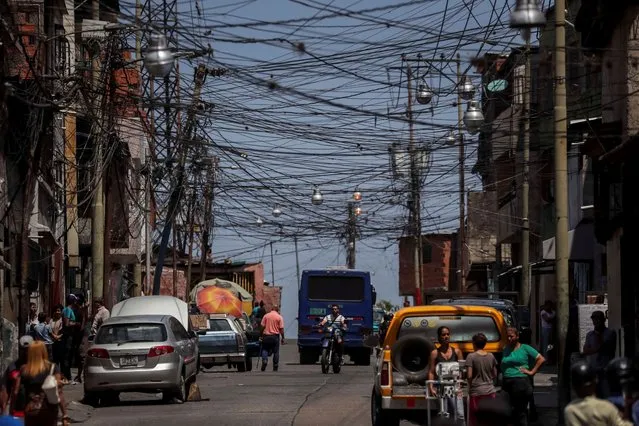
A view of electricity wires, in Caracas, Venezuela, 03 April 2019. West Venezuela started receiving electricity intermittently in the states of Zulia, Falcon, Merida and Trujillo after 100 hours without power. (Photo by Miguel Gutierrez/EPA/EFE/Rex Features/Shutterstock)

A view of electricity wires, in Caracas, Venezuela, 03 April 2019. West Venezuela started receiving electricity intermittently in the states of Zulia, Falcon, Merida and Trujillo after 100 hours without power. (Photo by Miguel Gutierrez/EPA/EFE/Rex Features/Shutterstock)
Details
02 May 2019 00:03:00