Loading...
Done
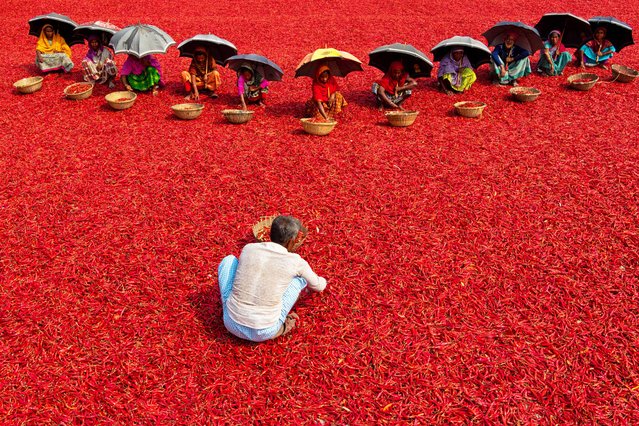
Rows of workers shelter under umbrellas from the scorching heat as they painstakingly sort through a red carpet of millions of chilli peppers in Bogra, Bangladesh on October 3, 2023. They sort the rotten and broken chilli peppers out to separate the poor quality ones which won't sell. In a line, the pickers who are paid less than £3 for a 10-hour shift slowly move forward with their baskets to separate the bad from the good after the chilies have been dried in the sun for a week. The dried & sorted chillies are then packaged and taken to the local market where they are brought mainly by companies to be made into chilli powder. The workers sort them in a warm environment, with temperatures reaching up to 45°C. More than 5,000 people work in almost 100 chilli farms in the Bogra district of Bangladesh to supply local spice companies with chillies for their recipes. Known as “Lal Morich” to the locals, chilli peppers are a major part of Bengali cuisine and are used as part of a combination of spices for various meat dishes, including chicken and beef. (Photo by Joy Saha/Rex Features/Shutterstock)

Rows of workers shelter under umbrellas from the scorching heat as they painstakingly sort through a red carpet of millions of chilli peppers in Bogra, Bangladesh on October 3, 2023. They sort the rotten and broken chilli peppers out to separate the poor quality ones which won't sell. In a line, the pickers who are paid less than £3 for a 10-hour shift slowly move forward with their baskets to separate the bad from the good after the chilies have been dried in the sun for a week. (Photo by Joy Saha/Rex Features/Shutterstock)
Details
21 Oct 2023 04:04:00
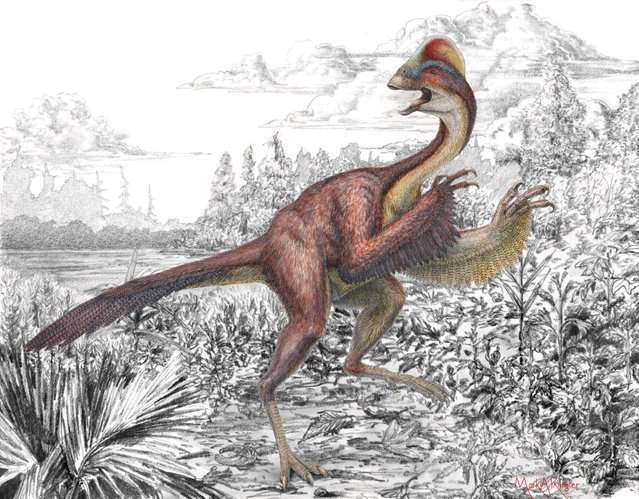
Life reconstruction of the new oviraptorosaurian dinosaur species Anzu wyliei in its 66 million-year-old environment in western North America as seen in an undated handout illustration by Mark A. Klinger, Carnegie Museum of Natural History. Some 18,000 species, great and small, were discovered in 2014, adding to the 2 million already known, scientists said on May 21, 2015 as they released a “Top 10” list that highlights the diversity of life. (Photo by Mark A. Klingler/Reuters/Carnegie Museum of Natural History)

Life reconstruction of the new oviraptorosaurian dinosaur species Anzu wyliei in its 66 million-year-old environment in western North America as seen in an undated handout illustration by Mark A. Klinger, Carnegie Museum of Natural History. Some 18,000 species, great and small, were discovered in 2014, adding to the 2 million already known, scientists said on May 21, 2015 as they released a “Top 10” list that highlights the diversity of life. Anzu wyliei, one of the top 10, dubbed “the chicken from hell”, is extinct. The feathered dinosaur whose partial skeletons were unearthed in the Dakotas was a contemporary of T. rex and Triceratops. (Photo by Mark A. Klingler/Reuters/Carnegie Museum of Natural History)
Details
22 May 2015 12:31:00
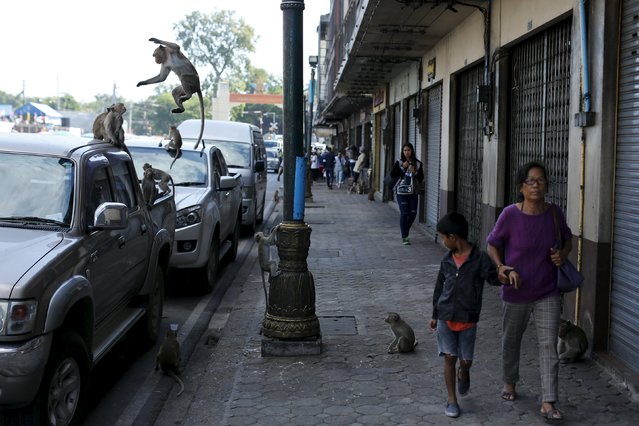
People walk along a street with long-tailed macaques in Lopburi, north of Bangkok November 29, 2015. (Photo by Jorge Silva/Reuters)

People walk along a street with long-tailed macaques in Lopburi, north of Bangkok November 29, 2015. (Photo by Jorge Silva/Reuters)
Details
01 Dec 2015 08:06:00
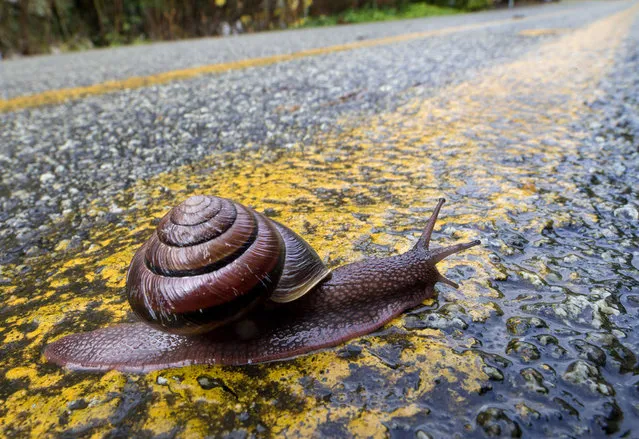
A large Pacific sideband snail slowly crosses a rain wet road in rural Douglas County, Oregon near Elkton on Sunday, December 2, 2012. The moisture loving snail should be very content with the recent heavy rains in southwestern Oregon and northern California. (Photo by Robin Loznak)

A large Pacific sideband snail slowly crosses a rain wet road in rural Douglas County, Oregon near Elkton on Sunday, December 2, 2012. The moisture loving snail should be very content with the recent heavy rains in southwestern Oregon and northern California. (Photo by Robin Loznak)
Details
13 Dec 2012 10:58:00
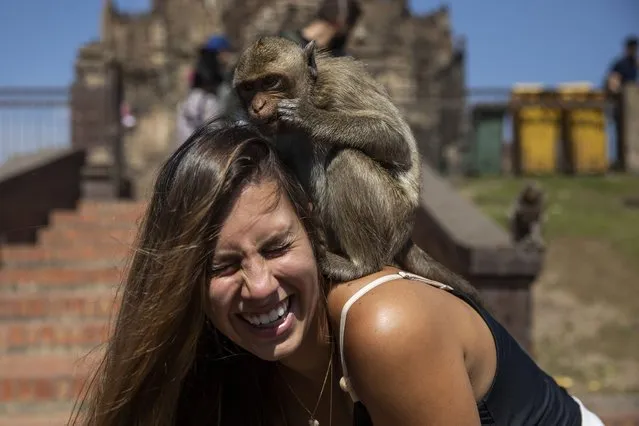
A monkey chews on a brazillian tourist's hair at the Pra Prang Sam Yod temple during the Lopburi Monkey Festival on November 28, 2021 in Lop Buri, Thailand. (Photo by Lauren DeCicca/Getty Images)

A monkey chews on a brazillian tourist's hair at the Pra Prang Sam Yod temple during the Lopburi Monkey Festival on November 28, 2021 in Lop Buri, Thailand. Lopburi holds its annual Monkey Festival where local citizens and tourists gather to provide a banquet to the thousands of long-tailed macaques that live in central Lopburi. (Photo by Lauren DeCicca/Getty Images)
Details
11 Dec 2021 08:35:00
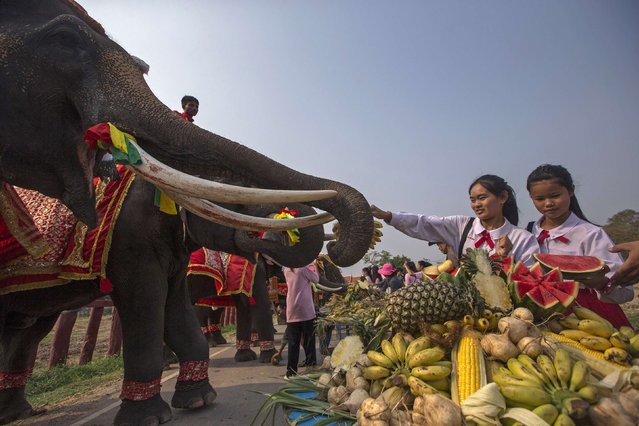
Students feed fruit to an elephant during Thailand's National Elephant Day in the ancient Thai capital Ayutthaya March 13, 2015. Thais honoured the elephant on Friday with special fruits and Buddhist ceremonies across the country to pay homage to their national animal. (Photo by Athit Perawongmetha/Reuters)

Students feed fruit to an elephant during Thailand's National Elephant Day in the ancient Thai capital Ayutthaya March 13, 2015. Thais honoured the elephant on Friday with special fruits and Buddhist ceremonies across the country to pay homage to their national animal. (Photo by Athit Perawongmetha/Reuters)
Details
14 Mar 2015 14:17:00
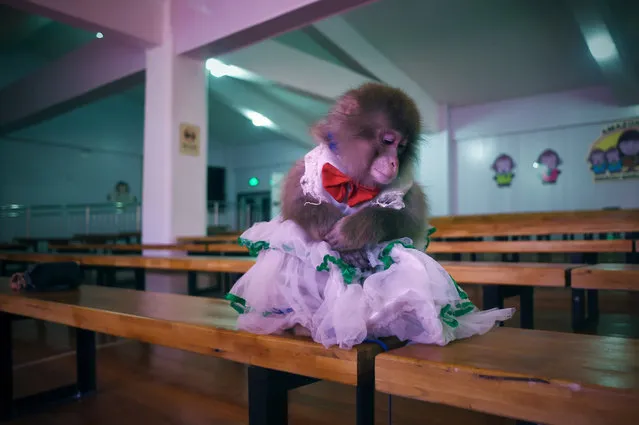
This picture taken on January 26, 2016 shows a monkey sitting on a bench during rehearsal at a monkey training school in a zoo in Dongying, eastern China's Shandong province. Shows featuring performing simians, popular in China and throughout Asia, are expecting a boost in the Lunar New Year of the monkey, which begins on February 8. But they are facing a growing backlash from Chinese people concerned about animal welfare. (Photo by Wang Zhao/AFP Photo)

This picture taken on January 26, 2016 shows a monkey sitting on a bench during rehearsal at a monkey training school in a zoo in Dongying, eastern China's Shandong province. Shows featuring performing simians, popular in China and throughout Asia, are expecting a boost in the Lunar New Year of the monkey, which begins on February 8. But they are facing a growing backlash from Chinese people concerned about animal welfare. (Photo by Wang Zhao/AFP Photo)
Details
09 Feb 2016 13:30:00
What the World Eats By Peter Menzel And Faith D'Aluisio Part 1

A stunning photographic collection featuring portraits of people from 30 countries and the food they eat in one day. In this fascinating study of people and their diets, 80 profiles are organized by the total number of calories each person puts away in a day. Featuring a Japanese sumo wrestler, a Massai herdswoman, world-renowned Spanish chef Ferran Adria, an American competitive eater, and more, these compulsively readable personal stories also include demographic particulars, including age, activity level, height, and weight. Essays from Harvard primatologist Richard Wrangham, journalist Michael Pollan, and others discuss the implications of our modern diets for our health and for the planet. This compelling blend of photography and investigative reportage expands our understanding of the complex relationships among individuals, culture, and food.
Details
23 Apr 2014 14:34:00