Loading...
Done
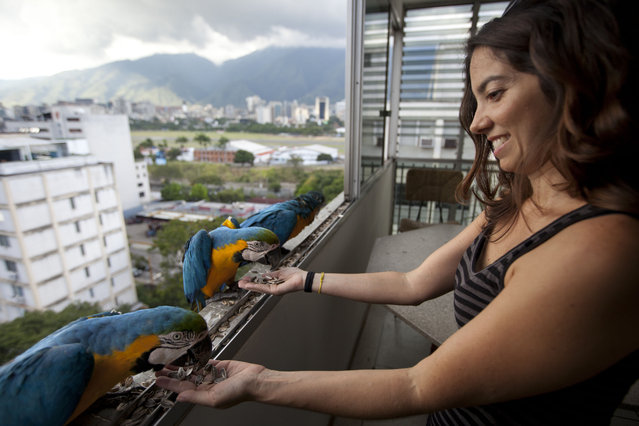
Vanessa Silva, 38, feeds macaws that fly to her apartment window every day looking for food, in Caracas, Venezuela. A group of gold-and-royal blue birds poked their heads through Silva’s window, as if saying “I’m here, is anyone home?” “I’d seen them flying when I was down on the street, and I thought ‘Oh how pretty,’” the 38-year-old said, a macaw eating out of her hand. (Photo by Ariana Cubillos/AP Photo)

Vanessa Silva, 38, feeds macaws that fly to her apartment window every day looking for food, in Caracas, Venezuela, on November 24, 2014. A group of gold-and-royal blue birds poked their heads through Silva’s window, as if saying “I’m here, is anyone home?” “I’d seen them flying when I was down on the street, and I thought ‘Oh how pretty,’” the 38-year-old said, a macaw eating out of her hand. (Photo by Ariana Cubillos/AP Photo)
Details
27 Nov 2014 15:27:00


Viagra Boys – Ain't Nice. Viagra Boys are a Swedish post-punk band from Stockholm. In 2018, they released their first album, Street Worms. Nils Hansson, a journalist at the newspaper Dagens Nyheter described the band favorably, praising their musical style, as well as their use of black humor and satire, and rated the album a five out of five. In 2019, the band won the Independent Music Companies Association (IMPALA) Album of the Year Award for Street Worms.
Details
12 Jun 2021 09:06:00
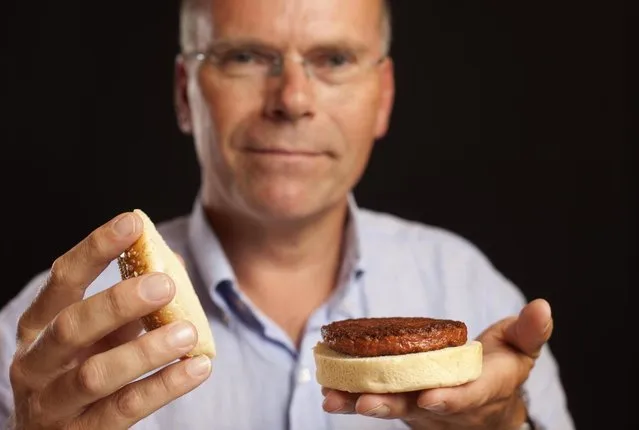
In this handout image provided by Ogilvy, a burger made from cultured beef, which has been developed by Professor Mark Post of Maastricht University in the Netherlands (pictured) is shown to the media during a press conference on August 5, 2013 in London, England. Cultured Beef could help solve the coming food crisis and combat climate change with commercial production of Cultured Beef beginning within ten to twenty years. (Photo by David Parry via Getty Images)

In this handout image provided by Ogilvy, a burger made from cultured beef, which has been developed by Professor Mark Post of Maastricht University in the Netherlands (pictured) is shown to the media during a press conference on August 5, 2013 in London, England. The in-vitro burger, cultured from cattle stem cells, the first example of what its creator says could provide an answer to global food shortages and help combat climate change, was fried in a pan and tasted by two volunteers. The burger is the result of years of research by Dutch scientist Mark Post, a vascular biologist at the University of Maastricht, who is working to show how meat grown in petri dishes might one day be a true alternative to meat from livestock.The meat in the burger has been made by knitting together around 20,000 strands of protein that has been cultured from cattle stem cells in Post's lab. (Photo by David Parry)
Details
06 Aug 2013 08:48:00
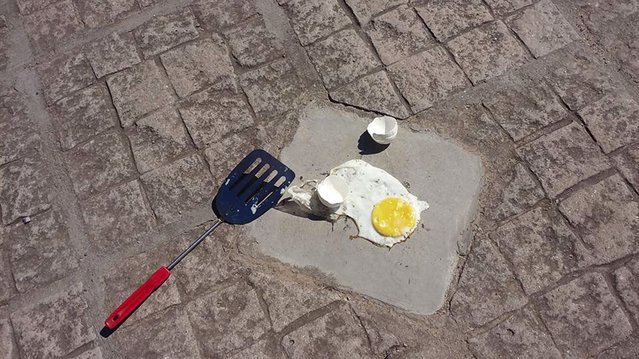
View of an egg fried on the pavement in Pozo Hondo, Santiago del Estero, Argentina on January 23, 2016, while the real feel was 57 degrees Celsius. Pozo Hondo's Mayor Claudio Nicolau fried an egg on the pavement of the main square of the city Saturday. (Photo by AFP Photo/Stringer)

View of an egg fried on the pavement in Pozo Hondo, Santiago del Estero, Argentina on January 23, 2016, while the real feel was 57 degrees Celsius. Pozo Hondo's Mayor Claudio Nicolau fried an egg on the pavement of the main square of the city Saturday. (Photo by AFP Photo/Stringer)
Details
26 Jan 2016 12:43:00
Employees cover bacon on fried dranik, a potato pancake that is the national dish of Belarus, in the Sula History Park near the village of Sula, Belarus March 7, 2016. (Photo by Vasily Fedosenko/Reuters)

Employees cover bacon on fried dranik, a potato pancake that is the national dish of Belarus, in the Sula History Park near the village of Sula, Belarus March 7, 2016. According to the park's representatives, the two-metre-wide pancake was an attempt to enter the Guinness World Records as the world's largest dranik. (Photo by Vasily Fedosenko/Reuters)
Details
08 Mar 2016 13:41:00
Spectacular images offering insight into the lives of the Huaorani people in the Ecuadorian Amazon have been revealed showing how they use traditional methods to hunt monkeys for food. The stunning pictures were taken by conservation photographer Pete Oxford from Torquay, Devon in the Ecuadorian Amazon. “The Huaorani Indians are a forest people highly in tune with their environment. Many are now totally acculturated since the 1950s by missionaries”, said Pete. “Today they face radical change to their culture to the proximity of oil exploration within their territory and the Yasuni National Park and Biosphere Reserve, they are vastly changed. Some still live very traditionally and for this shoot, through my Huaorani friend, a direct relative of those photographed he wanted to depict them as close to their original culture as possible. They still largely hunt with blow pipes and spears eating a lot of monkeys and peccaries”. The Huaorani are also known as the Waorani, Waodani or the Waos and are native Amerindians. Their lands are located between the Curaray and Napo rivers and speak the Huaorani language. Pete says that during his visit he was welcomed into the group and hopes that ancient cultures can be saved. Here: The tribe were seen celebrating after a hunter returned to camp with a wild pig. (Photo by Pete Oxford/Mediadrumworld.com)

Spectacular images offering insight into the lives of the Huaorani people in the Ecuadorian Amazon have been revealed showing how they use traditional methods to hunt monkeys for food. The stunning pictures were taken by conservation photographer Pete Oxford from Torquay, Devon in the Ecuadorian Amazon. Here: The tribe were seen celebrating after a hunter returned to camp with a wild pig. (Photo by Pete Oxford/Mediadrumworld.com)
Details
20 Jan 2017 07:58:00
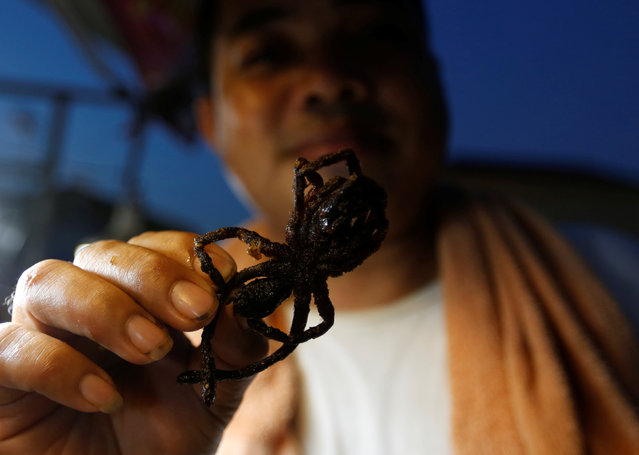
A vendor holds a fried spider along a street in Phnom Penh, Cambodia, April 10, 2017. (Photo by Samrang Pring/Reuters)

A vendor holds a fried spider along a street in Phnom Penh, Cambodia, April 10, 2017. (Photo by Samrang Pring/Reuters)
Details
29 May 2017 06:41:00
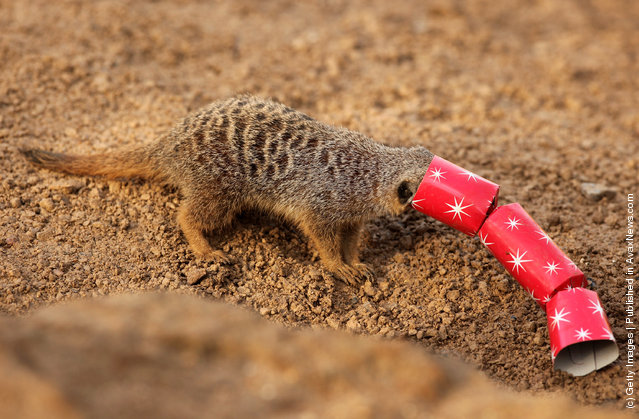
Christmas Treats For Meerkats

Meerkats at ZSL (Zoological Society of London) London Zoo received an early Christmas gift from their keepers of home-made crackers filled with meal worms and locusts on December 17, 2009 in London, England. (Photo by Oli Scarff/Getty Images)
Details
10 Dec 2011 09:55:00