Loading...
Done
A woman takes part in a global March for marijuana in Medellin, Colombia, May 7, 2016. The Global Marijuana March (GMM) is an annual rally held at different locations across the planet. It refers to cannabis-related events that occur on the first Saturday in May, or thereabouts, and may include marches, meetings, rallies, raves, concerts, festivals and information tables. The Global Marijuana March also goes by the name of the Million Marijuana March (MMM). It began in 1999. (Photo by Fredy Builes/Reuters)

A woman takes part in a global March for marijuana in Medellin, Colombia, May 7, 2016. The Global Marijuana March (GMM) is an annual rally held at different locations across the planet. It refers to cannabis-related events that occur on the first Saturday in May, or thereabouts, and may include marches, meetings, rallies, raves, concerts, festivals and information tables. (Photo by Fredy Builes/Reuters)
Details
09 May 2016 09:05:00
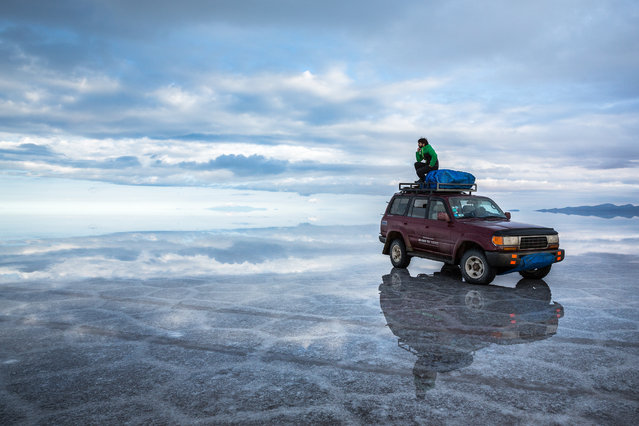
At 10,582 square kilometres, the Bolivian salt flats – otherwise known as Salar de Uyuni – are the largest on the planet and contain between 50 and 70% of the world’s lithium reserves. After exploring Chile and Argentina, photographer Joel Santos decided to travel to Bolivia in January 2017 to check the salt flats off his bucket list. With an electrical storm rolling in, Joel and his two travelling companions were the only souls left on the vast flats and captured the eerie flats without a person in sight. (Photo by Joel Santos/Barcroft Images)

At 10,582 square kilometres, the Bolivian salt flats – otherwise known as Salar de Uyuni – are the largest on the planet and contain between 50 and 70% of the world’s lithium reserves. After exploring Chile and Argentina, photographer Joel Santos decided to travel to Bolivia in January 2017 to check the salt flats off his bucket list. With an electrical storm rolling in, Joel and his two travelling companions were the only souls left on the vast flats and captured the eerie flats without a person in sight. (Photo by Joel Santos/Barcroft Images)
Details
12 Aug 2019 00:03:00
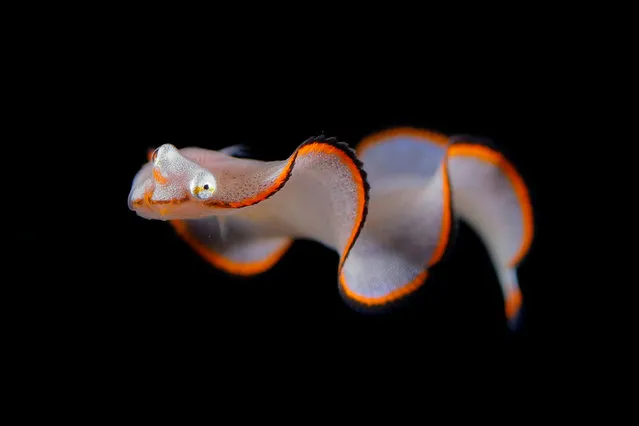
Batesian mimicry by a Soleichthys fish larva. (Photo by Ryo Minemizu/The Guardian)

Ryo Minemizu, one of Japan’s emerging stars in the field of marine life photography and the 2017 winner of the Nikkei National Geographic photography prize, captures the beauty and complexity of plankton that drift in our planet’s oceans and other bodies of water in meticulous detail. Here: Batesian mimicry by a Soleichthys fish larva. (Photo by Ryo Minemizu/The Guardian)
Details
21 Aug 2018 00:05:00
Maeklong Railway Market. (Photo by Trent Strohm)

“Maeklong Railway Market, located in Samut Songkhram, Thailand, around 37 miles west of Bangkok, looks like any other open-air market in Asia. HOWEVER...”. – Kaushik via Amusing Planet. Photo: Maeklong Railway Market (Photo by Trent Strohm)
Details
04 Jan 2013 16:16:00


If you are interested, the Korean call this style Trot (ppongjjak); a very simple life story is told with three guitar chords – quite a typical situation for our planet. Long-legged dolls from LPG (by the way, “Lovely Pretty Girls” could be “Long Pretty Girls”) are certainly smiling, though it would have been more logical for them to cry their hearts out, but that's what the Korean are like; who has seen doramas, will understand.
Details
08 Jan 2019 00:03:00
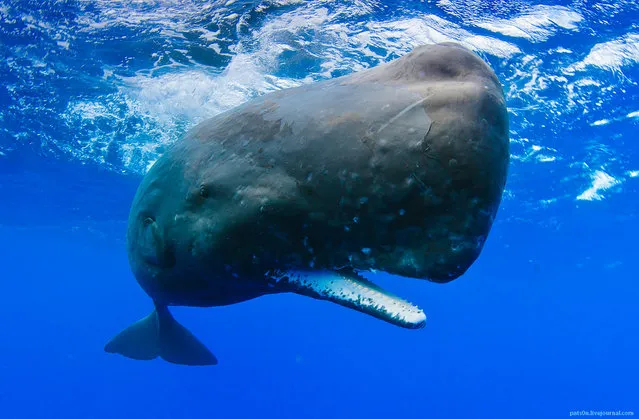
“Sperm whale opening it's huge mouth, Ogasawara Islands, Japan. Sperm whales are the biggest carnivorous animals on the planet. Each teeth in the mouth of adult specimen weights more than 1 kilogram. Interestingly enough that modern marine biologists believe that these teeth despite being fearsome play little role in capturing and eating giant squid – with their main function being mainly ritual aggression between males!”. (Alexander Safonov)

“Sperm whale opening it's huge mouth, Ogasawara Islands, Japan. Sperm whales are the biggest carnivorous animals on the planet. Each teeth in the mouth of adult specimen weights more than 1 kilogram. Interestingly enough that modern marine biologists believe that these teeth despite being fearsome play little role in capturing and eating giant squid – with their main function being mainly ritual aggression between males!”. (Photo by Alexander Safonov)
Details
30 Nov 2012 11:22:00
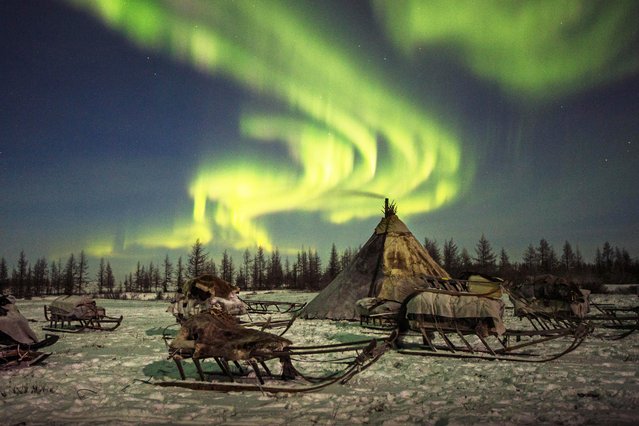
An empty camp is shown beneath a colourful sky in Siberia, December 2016. (Photo by Timothy Allen/Barcroft Productions)

A British photographer has captured life at the “edge of the world”. Timothy Allen, best known for his work on BBC's Human Planet, trekked through the freezing Siberian wilderness for 16 days as he joined part of an 800km migration of reindeer in the Yamal-Nenets region – a name that roughly translates to “edge of the world”. The stunning pictures feature the nomadic Nenets tribe, who drink blood to survive in -45°C temperatures. Timothy's epic journey, which will be revealed in an eight-minute documentary on Animal Planet USA, saw him travel across the bleak terrain of the frozen Ob River with the Nenets people in December last year. Here: An empty camp is shown beneath a colourful sky in Siberia, December 2016. (Photo by Timothy Allen/Barcroft Productions)
Details
19 Sep 2017 07:48:00
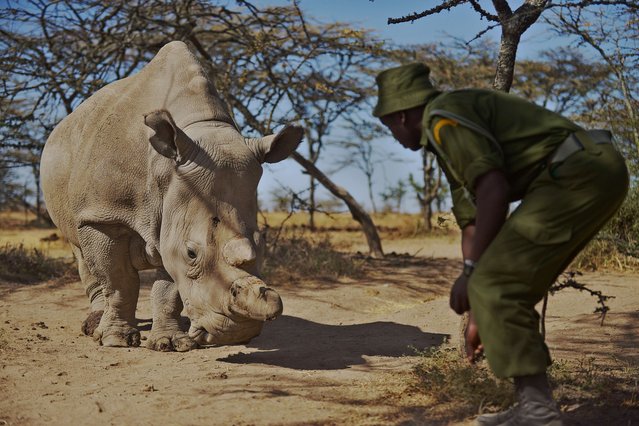
A park ranger stands next to a nothern white female rhinoceros named Najin at Ol Pejeta Conservancy, some 290 kms north of the Kenyan capital, Nairobi, on January 27, 2015. Najin is one of only five members of the sub-species left on the planet, three of which reside at Ol Pejeta Conservancy. (Photo by Tony Karumba/AFP Photo)

A park ranger stands next to a nothern white female rhinoceros named Najin at Ol Pejeta Conservancy, some 290 kms north of the Kenyan capital, Nairobi, on January 27, 2015. Najin is one of only five members of the sub-species left on the planet, three of which reside at Ol Pejeta Conservancy. Conservationists and scientists met in Kenya this week to come up with a last ditch plan to save the northern white rhinoceros from extinction. (Photo by Tony Karumba/AFP Photo)
Details
31 Jan 2015 14:07:00