Loading...
Done
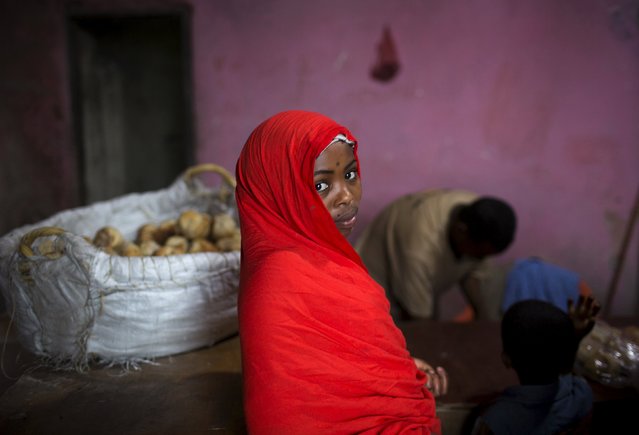
A girl is seen in a bakery in the old walled town of Harar in eastern Ethiopia, May 19, 2015. (Photo by Siegfried Modola/Reuters)

A girl is seen in a bakery in the old walled town of Harar in eastern Ethiopia, May 19, 2015. Daily life of people in Ethiopia, where elections are held this weekend, is portrayed in the east African nation's churches and mosques, coffee shops and markets, both in the capital Addis Ababa and the walled town of Harar in the east. Ethiopia, home to nearly 100 million people, holds the first poll on Sunday since long-serving leader Meles Zenawi died in 2012. (Photo by Siegfried Modola/Reuters)
Details
25 May 2015 09:43:00
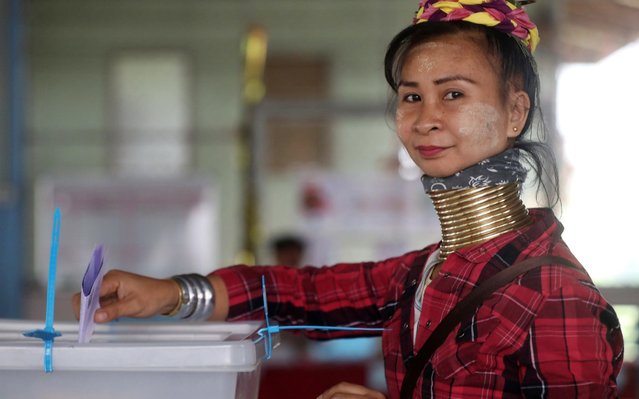
An ethnic Kayan woman, also known as a long neck villager casts her vote for the general election in Mae Hong Son, Thailand, March 24, 2019. (Photo by Ann Wang/Reuters)

An ethnic Kayan woman, also known as a long neck villager casts her vote for the general election in Mae Hong Son, Thailand, March 24, 2019. This is Thailand's first election since a military coup in 2014. Voters head to the polls to elect members of the lower house and Prime Minister. (Photo by Ann Wang/Reuters)
Details
26 Mar 2019 07:48:00
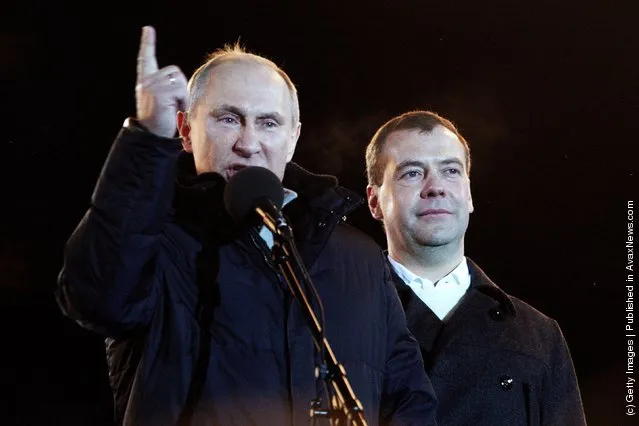
Russian Prime Minister and presidential candidate Vladimir Putin speaks as current President Dmitry Medvedev (R) listens during a rally after Putin claimed victory in the presidential election at the Manezhnya Square March, 4, 2012 in Moscow, Russia

Russian Prime Minister and presidential candidate Vladimir Putin speaks during a rally after Putin claimed victory in the presidential election at the Manezhnya Square March, 4, 2012 in Moscow, Russia. Exit polls showed Putin had over 60 percent of the vote according to state television in an election that has been alleged to be marred by widespread violations. (Photo by Oleg Nikishin/Epsilon/Getty Images)
Details
05 Mar 2012 11:12:00
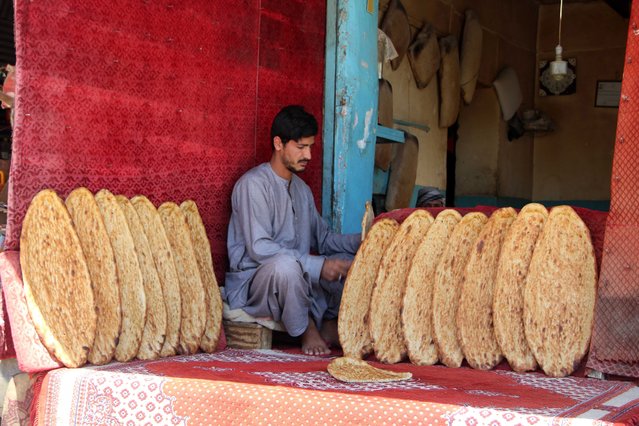
An Afghani man sells bread on a roadside in Kandahar, Afghanistan, 23 April 2024.  A recent World Bank report reveals a 26% decrease in Afghanistan's gross output over the past year, primarily attributed to a 1.3 billion USD income reduction for farmers due to the ban on drug cultivation. Although tax revenue saw a modest increase of 13% in 2023, exports experienced a 15% decline specifically to Pakistan. Afghan officials highlighted efforts to spur domestic production, improve trade, stabilize the national currency, and initiate key economic projects. (Photo by Qudratullah Razwan/EPA/EFE)

An Afghani man sells bread on a roadside in Kandahar, Afghanistan, 23 April 2024. A recent World Bank report reveals a 26% decrease in Afghanistan's gross output over the past year, primarily attributed to a 1.3 billion USD income reduction for farmers due to the ban on drug cultivation. Although tax revenue saw a modest increase of 13% in 2023, exports experienced a 15% decline specifically to Pakistan. Afghan officials highlighted efforts to spur domestic production, improve trade, stabilize the national currency, and initiate key economic projects. (Photo by Qudratullah Razwan/EPA/EFE)
Details
22 May 2024 03:16:00
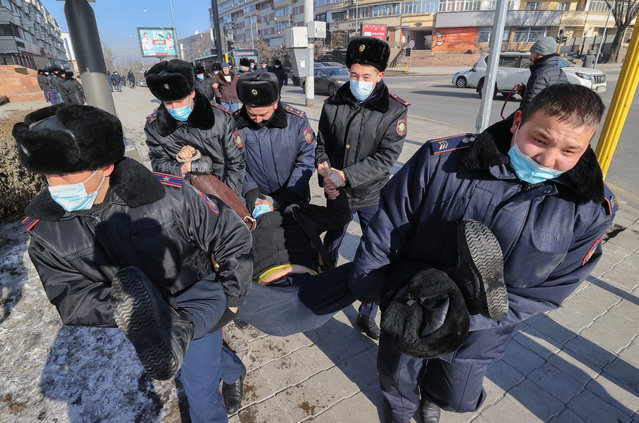
A protester is taken away by law enforcement officers during a rally held by opposition supporters on the parliamentary election day in Almaty, Kazakhstan on January 10, 2021. (Photo by Petr Trotsenko/Radio Free Europe/Radio Liberty)

A protester is taken away by law enforcement officers during a rally held by opposition supporters on the parliamentary election day in Almaty, Kazakhstan on January 10, 2021. Dozens of activists were detained in at least three major cities, including the capital, Nur-Sultan, and Almaty, with reports of independent observers being denied access or detained at some polling stations. (Photo by Petr Trotsenko/Radio Free Europe/Radio Liberty)
Details
12 Jan 2021 00:07:00
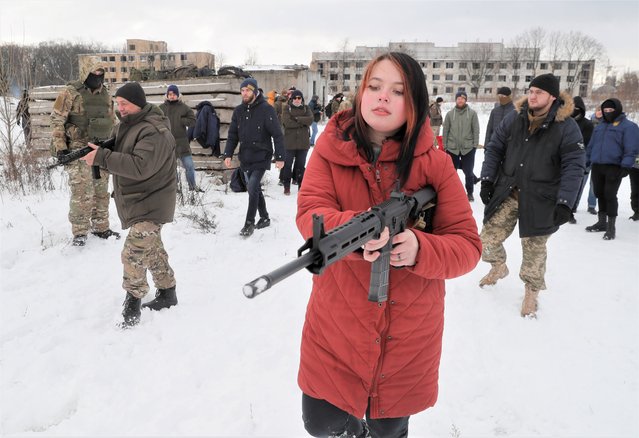
Ukrainians attend an open military training for civilians on a training range in Kiev, Ukraine, 30 January 2022. According to a survey conducted by the Kiev International Institute of Sociology (KIIS) from December 2021, 50.2 percent of Ukrainians said they would resist in case of a Russian military intervention into their city, town or village. Every third respondent to the poll said they were ready to engage in armed resistance, and 21.7 percent said they were ready to participate in civil resistance actions. (Photo by Sergey Dolzhenko/EPA/EFE)

Ukrainians attend an open military training for civilians on a training range in Kiev, Ukraine, 30 January 2022. According to a survey conducted by the Kiev International Institute of Sociology (KIIS) from December 2021, 50.2 percent of Ukrainians said they would resist in case of a Russian military intervention into their city, town or village. Every third respondent to the poll said they were ready to engage in armed resistance, and 21.7 percent said they were ready to participate in civil resistance actions. (Photo by Sergey Dolzhenko/EPA/EFE)
Details
31 Jan 2022 06:47:00
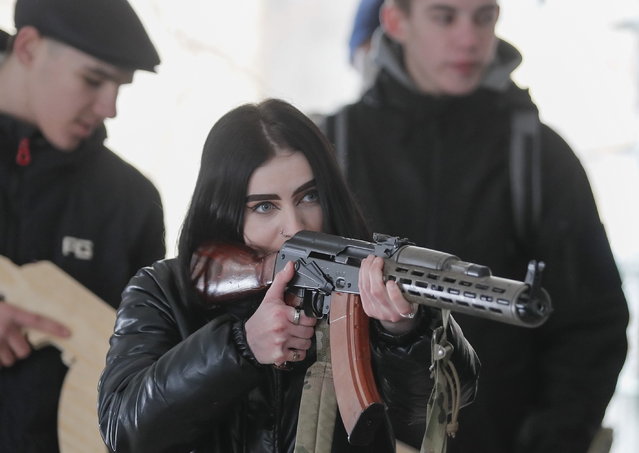
Ukrainians attend an open military training for civilians on a training range in Kiev, Ukraine, 06 February 2022. According to a survey conducted by the Kiev International Institute of Sociology (KIIS) from December 2021, 50.2 percent of Ukrainians said they would resist in case of a Russian military intervention into their city, town or village. Every third respondent to the poll said they were ready to engage in armed resistance, and 21.7 percent said they were ready to participate in civil resistance actions. (Photo by Sergey Dolzhenko/EPA/EFE/Rex Features/Shutterstock)

Ukrainians attend an open military training for civilians on a training range in Kiev, Ukraine, 06 February 2022. According to a survey conducted by the Kiev International Institute of Sociology (KIIS) from December 2021, 50.2 percent of Ukrainians said they would resist in case of a Russian military intervention into their city, town or village. Every third respondent to the poll said they were ready to engage in armed resistance, and 21.7 percent said they were ready to participate in civil resistance actions. (Photo by Sergey Dolzhenko/EPA/EFE/Rex Features/Shutterstock)
Details
15 Feb 2022 05:34:00
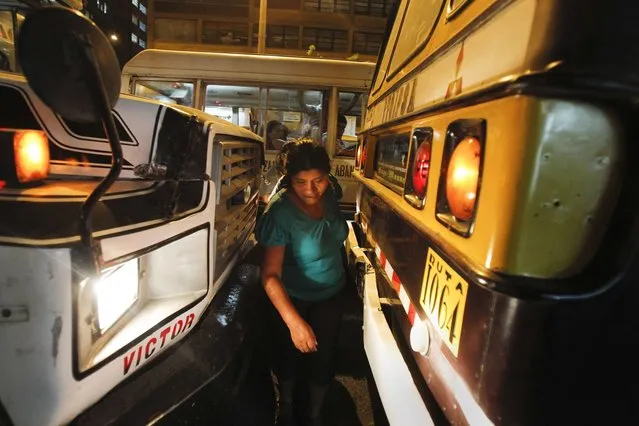
A woman squeezes between two public buses in downtown Lima, March 17, 2014. Bogota and two other Latin American capitals – Mexico City, and Lima in Peru – were named as the three capitals with the least safe transport systems for women in the Thomson Reuters Foundation poll of more than 6,550 women and gender and city planning experts. (Photo by Enrique Castro-Mendivil/Reuters)

A woman squeezes between two public buses in downtown Lima, March 17, 2014. Bogota and two other Latin American capitals – Mexico City, and Lima in Peru – were named as the three capitals with the least safe transport systems for women in the Thomson Reuters Foundation poll of more than 6,550 women and gender and city planning experts. Women in Latin America say they face a wide range of daily threats on public transport, and not enough is done to ensure their safety. (Photo by Enrique Castro-Mendivil/Reuters)
Details
04 Nov 2014 12:00:00