Loading...
Done
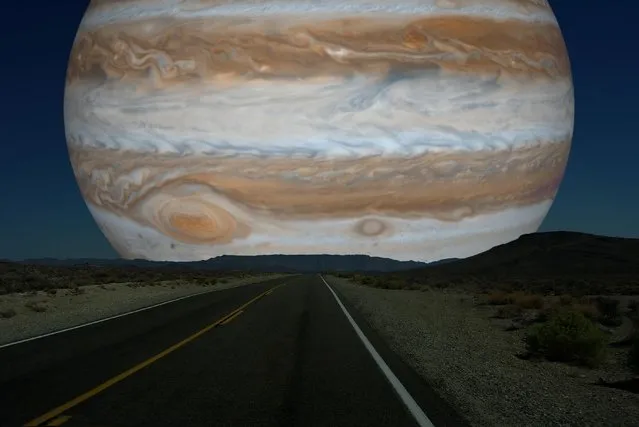
If The Moon Were Replaced With Some Of Our Planets

Our moon is a pretty big object. It's big enough to be a respectable planet in its own right, if it were orbiting the sun instead of the Earth. (Actually, it is orbiting the sun in a nearly perfectly circular orbit, that the Earth only slightly perturbs... but that's a topic for another day.) The Moon is a quarter the diameter of the Earth. Only Pluto has a satellite that is larger, in proportion to the size of the planet it orbits.

Details
29 Mar 2013 10:12:00
Dramatic changes spotted in HD 189733b exoplanet atmosphere

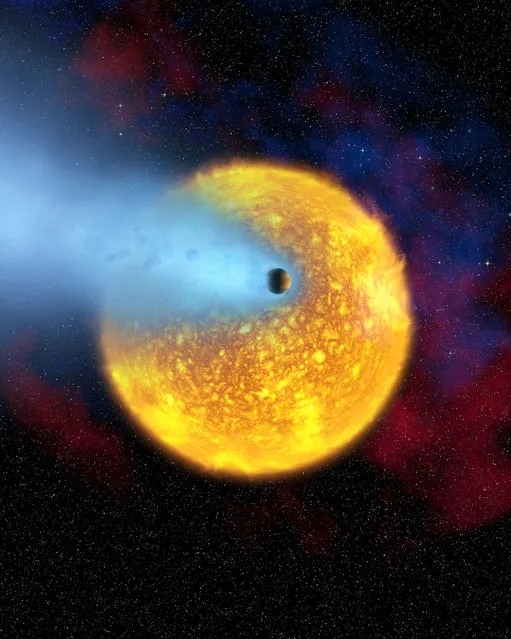
This artist's rendering illustrates the evaporation of HD 189733b's atmosphere in response to a powerful eruption from its host star. NASA's Hubble Space Telescope detected the escaping gases and NASA's Swift satellite caught the stellar flare. (Credit: NASA's Goddard Space Flight Center)
Details
29 Jun 2012 09:45:00
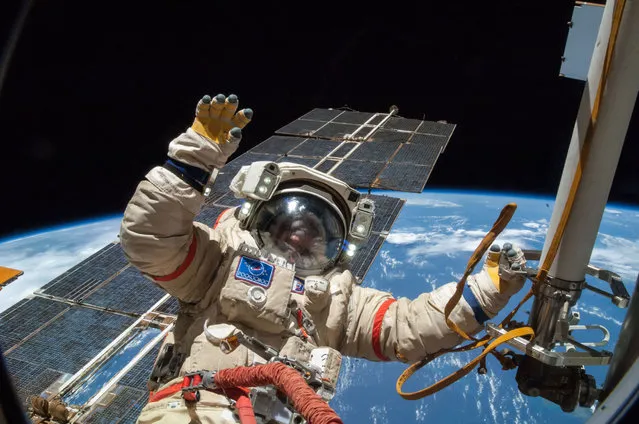
Russian cosmonaut Alexander Skvortsov, Expedition 40 flight engineer, attired in a Russian Orlan spacesuit, participates in a session of extravehicular activity (EVA) in support of science and maintenance on the International Space Station on August 18, 2014. During the five-hour, 11-minute spacewalk, Skvortsov and cosmonaut Oleg Artemyev (out of frame) deployed a small science satellite, retrieved and installed experiment packages and inspected components on the exterior of the orbital laboratory. (Photo by NASA)

Russian cosmonaut Alexander Skvortsov, Expedition 40 flight engineer, attired in a Russian Orlan spacesuit, participates in a session of extravehicular activity (EVA) in support of science and maintenance on the International Space Station on August 18, 2014. During the five-hour, 11-minute spacewalk, Skvortsov and cosmonaut Oleg Artemyev (out of frame) deployed a small science satellite, retrieved and installed experiment packages and inspected components on the exterior of the orbital laboratory. (Photo by NASA)
Details
13 Apr 2022 06:53:00
The Daily Life Of Darth Vader By Pawel Kadysz

If you want to be Dart Vader, you will have to deal with his everyday problems, too. That’s what Paweł Kadysz is doing with his new photo project. He aims to take a picture every day for a year – and each one of them should show the Dark Lord of the Sith tackling everyday life. Washing dishes, ironing clothes, eating breakfast – all those little things that heroes do off screen.
Details
25 Nov 2015 10:06:00
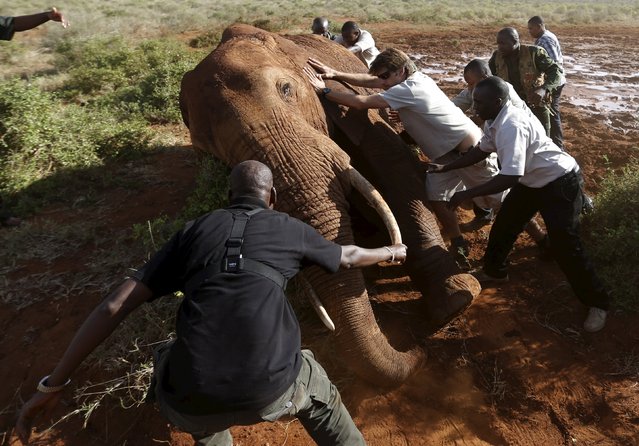
Kenya Wildlife Service and Save The Elephants staff push an elephant as they undertake the collaring of ten elephants ranging near the Standard Gauge Railway to fit them with advanced satellite radio tracking collars in Tsavo National Park, Kenya March 15, 2016. (Photo by Goran Tomasevic/Reuters)

Kenya Wildlife Service and Save The Elephants staff push an elephant as they undertake the collaring of ten elephants ranging near the Standard Gauge Railway to fit them with advanced satellite radio tracking collars in Tsavo National Park, Kenya March 15, 2016. (Photo by Goran Tomasevic/Reuters)
Details
17 Mar 2016 15:28:00
Egmont National Park in New Zealand with Mt. Taranaki at its center is seen in a Landsat 8 satellite image. (Photo by Reuters/NASA/USGS)

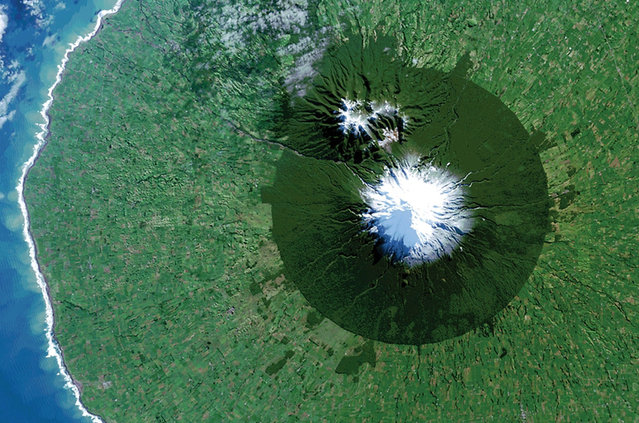
Egmont National Park in New Zealand with Mt. Taranaki at its center is seen in a Landsat 8 satellite image taken July 3, 2014 and released by NASA November 14, 2014. The image is from the book “Sanctuary: Exploring the World's Protected Areas from Space”, published by the Institute for Global Environmental Strategies with support from NASA, which was released this week. (Photo by Reuters/NASA/USGS)
Details
16 Nov 2014 12:15:00
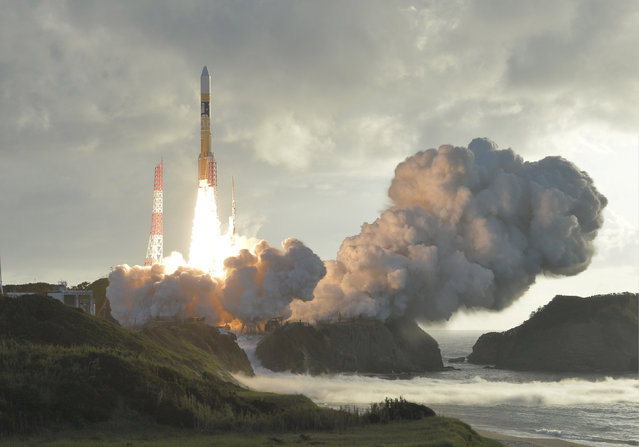
An H-2A rocket carrying Japan's fourth and final quasi-zenith satellite, the Michibiki No. 4, lifts off from the Tanegashima Space Center in Kagoshima Prefecture, southwestern Japan in this photo taken by Kyodo on October 10, 2017. (Photo by Reuters/Kyodo News)

An H-2A rocket carrying Japan's fourth and final quasi-zenith satellite, the Michibiki No. 4, lifts off from the Tanegashima Space Center in Kagoshima Prefecture, southwestern Japan in this photo taken by Kyodo on October 10, 2017. (Photo by Reuters/Kyodo News)
Details
11 Oct 2017 07:50:00
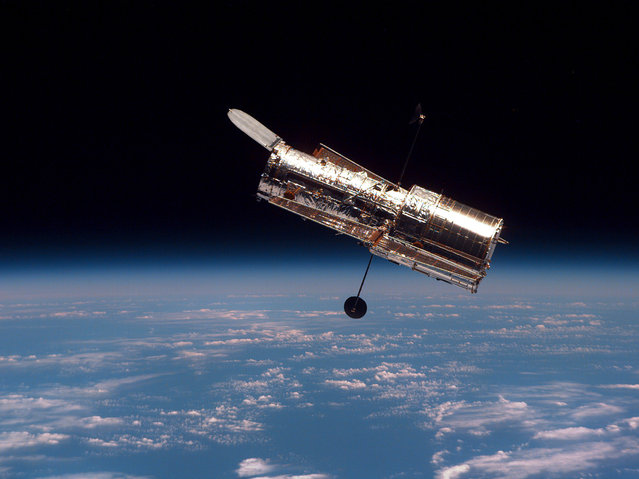
The Hubble Space Telescope is shown following its release from the space shuttle Discovery Wednesday, February 19, 1997. The Hubble Space Telescope, one of NASA'S crowning glories, marks its 25th anniversary on Friday, April 24, 2015. With more than 1 million observations, including those of the farthest and oldest galaxies ever beholden by humanity, no man-made satellite has touched as many minds or hearts as Hubble. (Photo by AP Photo/NASA)

The Hubble Space Telescope is shown following its release from the space shuttle Discovery Wednesday, February 19, 1997. The Hubble Space Telescope, one of NASA'S crowning glories, marks its 25th anniversary on Friday, April 24, 2015. With more than 1 million observations, including those of the farthest and oldest galaxies ever beholden by humanity, no man-made satellite has touched as many minds or hearts as Hubble. (Photo by AP Photo/NASA)
Details
24 Apr 2015 11:25:00