Loading...
Done
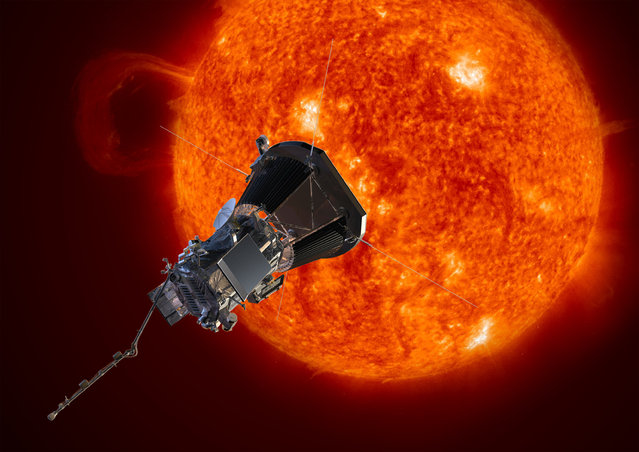
This image made available by the Johns Hopkins University Applied Physics Laboratory on Wednesday, May 31, 2017 depicts NASA's Solar Probe Plus spacecraft approaching the sun. On Wednesday, NASA announced it will launch the probe in summer 2018 to explore the solar atmosphere. It will be subjected to brutal heat and radiation like no other man-made structure before. (Photo by Johns Hopkins University Applied Physics Laboratory via AP Photo)

This image made available by the Johns Hopkins University Applied Physics Laboratory on Wednesday, May 31, 2017 depicts NASA's Solar Probe Plus spacecraft approaching the sun. On Wednesday, NASA announced it will launch the probe in summer 2018 to explore the solar atmosphere. It will be subjected to brutal heat and radiation like no other man-made structure before. (Photo by Johns Hopkins University Applied Physics Laboratory via AP Photo)
Details
08 Sep 2017 09:42:00
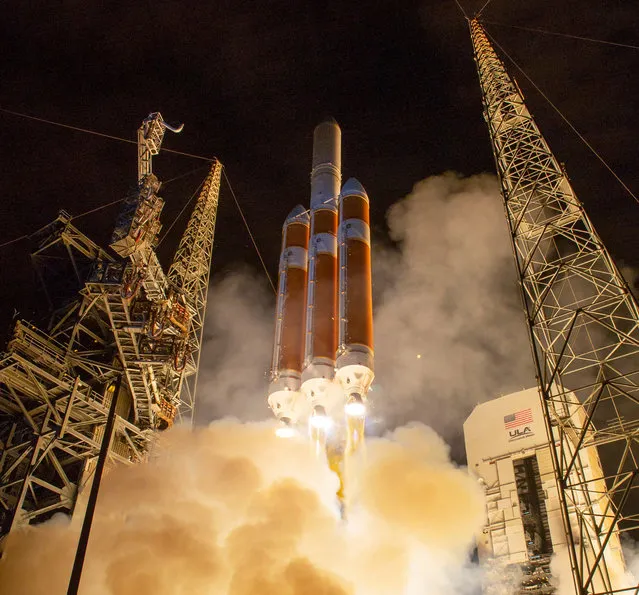
A handout photo made available by the NASA shows the United Launch Alliance Delta IV Heavy rocket launches NASA's Parker Solar Probe to touch the Sun, from Launch Complex 37 at Cape Canaveral Air Force Station, Florida, USA, 12 August 2018. Parker Solar Probe is humanity’s first-ever mission into a part of the Sun’s atmosphere called the corona. Here it will directly explore solar processes that are key to understanding and forecasting space weather events that can impact life on Earth. (Photo by Bill Ingalls/EPA-EFE/NASA)

A handout photo made available by the NASA shows the United Launch Alliance Delta IV Heavy rocket launches NASA's Parker Solar Probe to touch the Sun, from Launch Complex 37 at Cape Canaveral Air Force Station, Florida, USA, 12 August 2018. Parker Solar Probe is humanity’s first-ever mission into a part of the Sun’s atmosphere called the corona. Here it will directly explore solar processes that are key to understanding and forecasting space weather events that can impact life on Earth. (Photo by Bill Ingalls/EPA-EFE/NASA)
Details
13 Aug 2018 07:26:00
A dancer performs before a judging panel during the World Irish Dancing Championships in Dublin, Ireland on April 11, 2017. (Photo by Clodagh Kilcoyne/Reuters)

A dancer performs before a judging panel during the World Irish Dancing Championships in Dublin, Ireland on April 11, 2017. The April 9-16 event draws some 5,000 performers from Ireland and overseas, including from both the Irish diaspora in places like the United States and Australia as well as less likely countries such as Russia and Japan. (Photo by Clodagh Kilcoyne/Reuters)
Details
13 Apr 2017 09:33:00
Francisco da Silva Vale, 61, cools off fish with ice produced on solar-powered ice machines at Vila Nova do Amana community in the Sustainable Development Reserve, in Amazonas state, Brazil, September 23, 2015. Three solar-powered machines, are producing about ninety kilos of ice per day, in a region with poor access to electric energy, which used to be produced only with diesel oil, in the Amazon rain forest. (Photo by Bruno Kelly/Reuters)

Francisco da Silva Vale, 61, cools off fish with ice produced on solar-powered ice machines at Vila Nova do Amana community in the Sustainable Development Reserve, in Amazonas state, Brazil, September 23, 2015. Three solar-powered machines, are producing about ninety kilos of ice per day, in a region with poor access to electric energy, which used to be produced only with diesel oil, in the Amazon rain forest. (Photo by Bruno Kelly/Reuters)
Details
10 Oct 2015 08:03:00


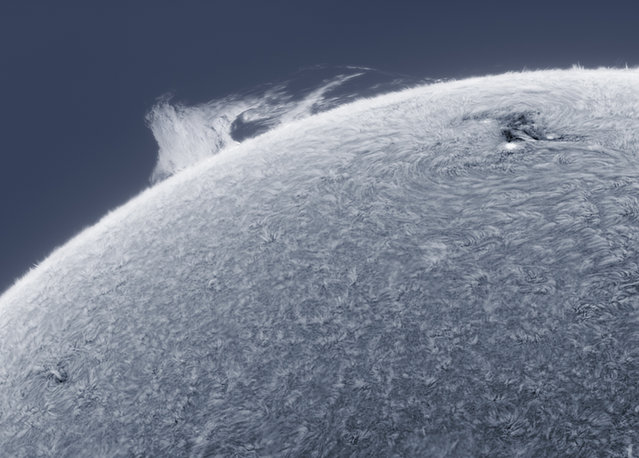
Alan Friedman, sun photographed with a solar telescope using a Hydrogen alpha filter.
Details
03 Oct 2012 09:02:00
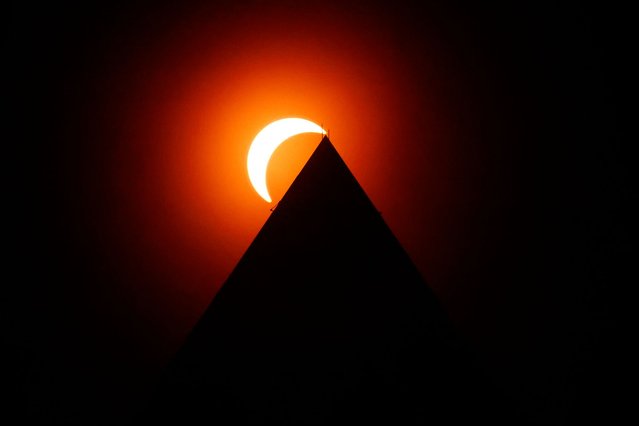
The solar eclipse is seen above the Washington Monument on April 08, 2024 in Washington, DC. People have traveled to areas across North America that are in the “path of totality” in order to experience the eclipse today. The next total solar eclipse that can be seen from a large part of North America won't happen until 2044. (Photo by Chip Somodevilla/Getty Images)

The solar eclipse is seen above the Washington Monument on April 08, 2024 in Washington, DC. People have traveled to areas across North America that are in the “path of totality” in order to experience the eclipse today. The next total solar eclipse that can be seen from a large part of North America won't happen until 2044. (Photo by Chip Somodevilla/Getty Images)
Details
20 May 2024 02:29:00
Former leader of Britain's UKIP party, Nigel Farage (C) reacts as he speaks with Italian-Swedish MEP Anna Maria Corazza Bildt (L) and British Journalist Rachel Johnson during a panel discussion at a conference on Brexit, at the Saatchi Gallery in London on February 19, 2019. The British government on Friday dismissed as a “hiccup” its latest parliamentary defeat over Brexit, saying it would press on with trying to renegotiate its EU divorce deal as exit day looms in just six weeks. (Photo by Tolga Akmen/AFP Photo)

Former leader of Britain's UKIP party, Nigel Farage (C) reacts as he speaks with Italian-Swedish MEP Anna Maria Corazza Bildt (L) and British Journalist Rachel Johnson during a panel discussion at a conference on Brexit, at the Saatchi Gallery in London on February 19, 2019. The British government on Friday dismissed as a “hiccup” its latest parliamentary defeat over Brexit, saying it would press on with trying to renegotiate its EU divorce deal as exit day looms in just six weeks. (Photo by Tolga Akmen/AFP Photo)
Details
23 Dec 2019 00:01:00


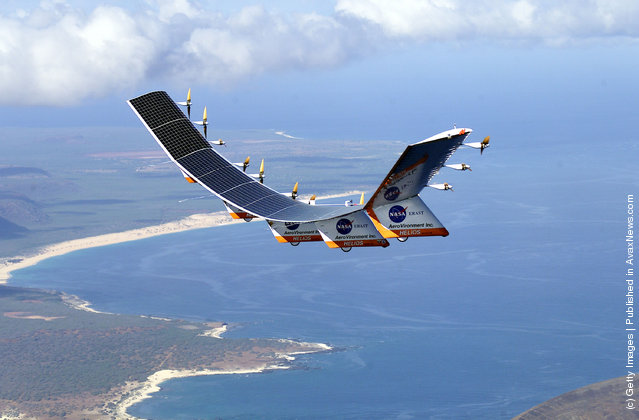
“NASA's Pathfinder, Pathfinder Plus, Centurion and Helios Prototype were an evolutionary series of solar- and fuel-cell-system-powered unmanned aerial vehicles. AeroVironment, Inc. developed the vehicles under NASA's Environmental Research Aircraft and Sensor Technology (ERAST) program. They were built to develop the technologies that would allow long-term, high-altitude aircraft to serve as “atmospheric satellites”, to perform atmospheric research tasks as well as serve as communications platforms”. – Wikipedia

Photo: The solar-electric Helios Prototype flying wing is flies over the Hawaiian islands of Niihau and Lehua during the first solar-powered test flight July 14, 2001 from the U.S. Navy's Pacific Missile Range Facility on Kauai, HI. The 18-hour flight was a functional checkout of the aircraft's systems and performance in preparation for an attempt to reach sustained flight at 100,000 feet altitude later in the summer. (Photo Courtesy of NASA/Getty Images)
Details
14 Jul 2011 09:24:00