British television, radio presenter and DJ Maya Jama arrives at The BRIT Awards 2022 at The O2 Arena on February 8, 2022 in London, England. (Photo by David M. Benett/Dave Benett/Getty Images)
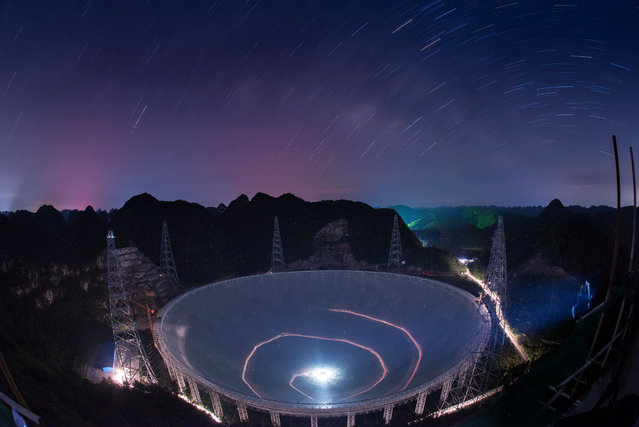
A vehicle leaves light trails in a long exposure photograph as it drives beneath the 500-metre Aperture Spherical Radio Telescope in Pingtang county, China. Construction on the device began in 2011 and is nearing completion. (Photo by Liu Xu/AP Photo)
Ashley Roberts in the last decade of October 2022 poses a pretty question as she models for online fashion site Quiz. The Pussycat Dolls singer and Heart Radio host, 41, is the new face of the brand and has collaborated on its partywear collection. (Photo by Quiz)
Khuong Nguyen is an editorial and commercial photographer and designer based in Paris. Some of his clients include Wallpaper, Christian Louboutin and Virgin Radio. This work is from his Tronified series for Amusement Magazine.
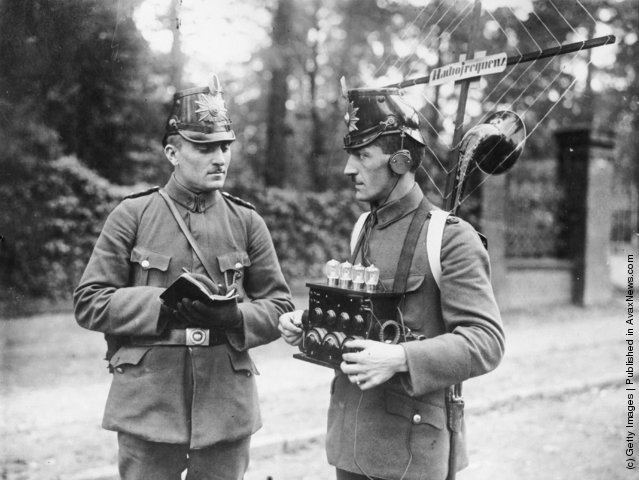
A member of the German wireless police picks up signals on the radio equipment he carries on his back, while his colleague takes notes. (Photo by General Photographic Agency/Getty Images). Circa 1925
A workman takes a siesta on a girder during the building of Radio City, the city of New York spread out below. (Photo by General Photographic Agency/Getty Images). Circa 1933
A man takes a photo of a radio antenna that's part of the Atacama Large Milimeter Array Observatory on March 12, 2013 at Llano de Chajnantor, about 43 miles (70 kilometers) from San Pedro de Atacama, Chile. The $1.5 billion ALMA facility, which had its official inauguration on March 13, is considered the world's most expensive ground-based observatory. (Photo by Felipe Trueba/EPA)
The Haʻikū Stairs, also known as the Stairway to Heaven or Haʻikū Ladder, is a steep hiking trail on the island of Oʻahu. The trail began as a wooden ladder spiked to the cliff on the south side of the Haʻikū Valley. It was installed in 1942 to enable antenna cables to be strung from one side of the cliffs above Haʻikū Valley to the other. A building to provide a continuous communication link between Wahiawā and Haʻikū Valley Naval Radio Station was constructed at the peak of Puʻukeahiakahoe, elevation about 2,800 feet (850 m). The antennae transmitted very low frequency radio signals from a 200,000-watt Alexanderson alternator in the center of Haʻikū valley. The signals could reach US Navy submarines as far away as Tokyo Bay while the submarines were submerged.