Loading...
Done
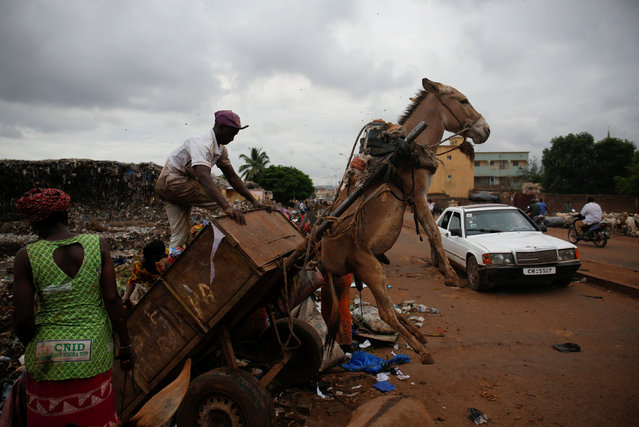
A waste picker unloads garbage at a waste transfer station in Bamako, Mali, August 19, 2018. In the Malian capital of Bamako, donkey carts driven by young men like 19-year-old Arouna Diabate play a vital role battling the fast-growing city's waste problem. Every morning before dawn, Diabate hitches his donkey to a cart and sets off on his rounds, going door-to-door to collect household garbage which he delivers to a local waste transfer station for a monthly salary of around $35. “I won't be picking up trash with a donkey cart for the rest of my life, but for now people appreciate us because we help clean up the homes of Bamako”, Diabate said. (Photo by Luc Gnago/Reuters)

A waste picker unloads garbage at a waste transfer station in Bamako, Mali, August 19, 2018. In the Malian capital of Bamako, donkey carts driven by young men like 19-year-old Arouna Diabate play a vital role battling the fast-growing city's waste problem. Every morning before dawn, Diabate hitches his donkey to a cart and sets off on his rounds, going door-to-door to collect household garbage which he delivers to a local waste transfer station for a monthly salary of around $35. “I won't be picking up trash with a donkey cart for the rest of my life, but for now people appreciate us because we help clean up the homes of Bamako”, Diabate said. (Photo by Luc Gnago/Reuters)
Details
18 Sep 2018 00:01:00
Francinaldo Carvalho has dated Elisany Da Silva for some time... (Photo by Barcroft Media)

Brazil's tallest teen is set marry her beau – despite him being over a foot smaller than her. Elisany da Cruz Silva (18) is a staggering 6ft 8ins (206 cm) tall while her compact fiancee Francinaldo da Silva Carvalho is only 5ft 4ins (162 cm). Despite a massive 1ft 4ins between them, Francinaldo had no problem increasing the distance by dropping to one knee after a romantic stroll along the beach. (Photo by Barcroft Media)
Details
22 May 2014 04:50:00
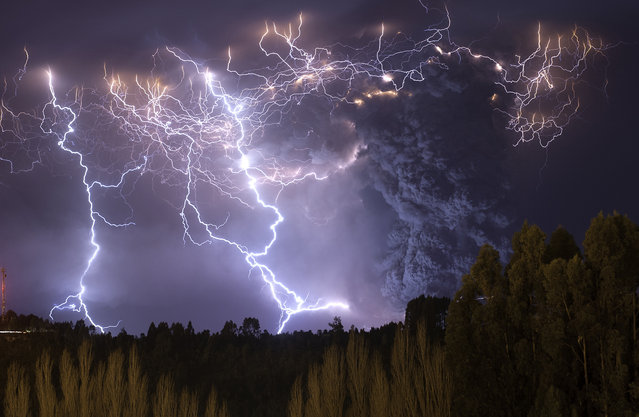
The eruption of Cordon Caulle began on June 4, 2011, located in the Region of Los Rios in Chile. For about 12 months, people and animals became accustomed to living with the daily fall of ash, which also caused problems in the air traffic in South America. The explosions and lightning during first days of the eruption could be seen from hundreds of miles around. This photograph was taken on the second night of eruption from the town of Lago Ranco. (Photo and caption by Francisco Negroni/National Geographic Traveler Photo Contest)

The eruption of Cordon Caulle began on June 4, 2011, located in the Region of Los Rios in Chile. For about 12 months, people and animals became accustomed to living with the daily fall of ash, which also caused problems in the air traffic in South America. The explosions and lightning during first days of the eruption could be seen from hundreds of miles around. This photograph was taken on the second night of eruption from the town of Lago Ranco. (Photo and caption by Francisco Negroni/National Geographic Traveler Photo Contest)

ATTENTION! All pictures are presented in high resolution. To see Hi-Res images – just TWICE click on any picture. In other words, click small picture – opens the BIG picture. Click BIG picture – opens VERY BIG picture.
Details
23 Jun 2013 11:24:00
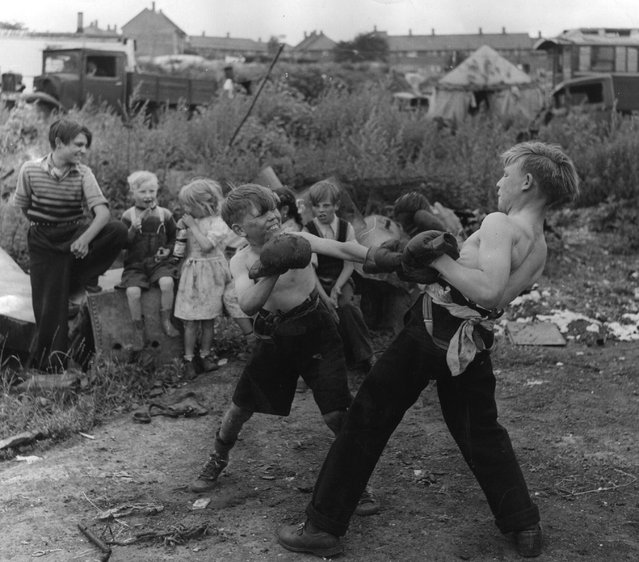
The unromantic gypsies. Children boxing in a gypsy camp in Kent, England on July 1, 1951. Like all boys these gypsy lads like to try their hand at boxing. Encouraged by their friends they fight it out on Corke's Meadow. Few Romanies now live a life of wandering romance. Most are like the three hundred squatters of Corke's Meadow, Kent, which is part of a “gypsy problem” that involves about 100,000 today. Of those about 25,000 can be rightly called gypsies, the rest are Mumpers and Posh-rats and Hobos. Corke's Meadow has both kinds. “Picture Post” cameraman Bert Hardy photographs the Corke's Meadow gypsies in their encampment. (Photo by Hulton-Deutsch Collection/Corbis via Getty Images)

The unromantic gypsies. Children boxing in a gypsy camp in Kent, England on July 1, 1951. Like all boys these gypsy lads like to try their hand at boxing. Encouraged by their friends they fight it out on Corke's Meadow. Few Romanies now live a life of wandering romance. Most are like the three hundred squatters of Corke's Meadow, Kent, which is part of a “gypsy problem” that involves about 100,000 today. Of those about 25,000 can be rightly called gypsies, the rest are Mumpers and Posh-rats and Hobos. Corke's Meadow has both kinds. “Picture Post” cameraman Bert Hardy photographs the Corke's Meadow gypsies in their encampment. (Photo by Hulton-Deutsch Collection/Corbis via Getty Images)
Details
12 Mar 2017 00:01:00
One of the worlds shortest models Mary Russell at 4 feet 1 inch with 6 foot model Georgia Meacham in London, UK on June 16, 2016. The 4ft1 beauty suffers with achondroplasia  a medical term for dwarfism, which means she has as average sized torso but short arms and short legs, with an oversized head. As well as stifled growth, Mary also suffers with sciatica and spinal stenosis, an abnormal narrowing of the spinal canal – which cause agonising nerve problems, leaving her in excruciating pain and unable to stand for long periods of time. The condition leaves Mary, 47, struggling with everyday tasks  things most people take for granted like going to the supermarket, getting cash from an ATM and ordering a drink at a bar become a challenge. (Photo by Simon Jacobs/Caters News Agency)

One of the worlds shortest models Mary Russell at 4 feet 1 inch with 6 foot model Georgia Meacham in London, UK on June 16, 2016. The 4ft1 beauty suffers with achondroplasia a medical term for dwarfism, which means she has as average sized torso but short arms and short legs, with an oversized head. As well as stifled growth, Mary also suffers with sciatica and spinal stenosis, an abnormal narrowing of the spinal canal – which cause agonising nerve problems, leaving her in excruciating pain and unable to stand for long periods of time. The condition leaves Mary, 47, struggling with everyday tasks things most people take for granted like going to the supermarket, getting cash from an ATM and ordering a drink at a bar become a challenge. (Photo by Simon Jacobs/Caters News Agency)
Details
28 Aug 2016 10:12:00
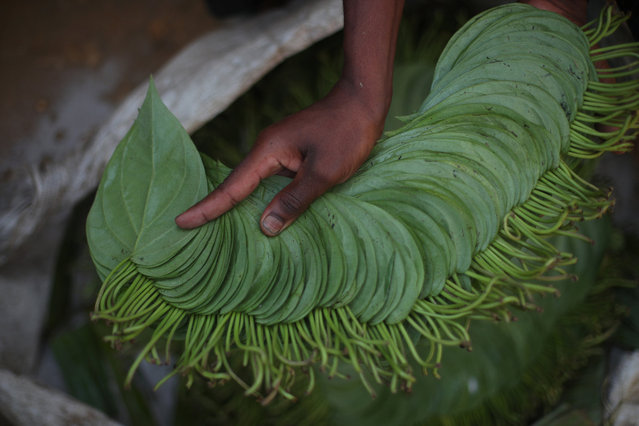
Faruk, 17, a Rohingya refugee trader holds betel leaves which are on sale at a stall in Palong Khali refugee camp near Cox's Bazar, Bangladesh, November 3, 2017. He left his village in Myanmar when the military opened fire towards the Rohingya. “I buy this betel leaf from Palong Khali market, in one bundle there are 160 pieces, I buy it for 80 taka and I sell it for 100 taka. Bangladeshi's and I sell for the same rate in the camp. Outside in the local market it is 80 taka per bundle. My problem is that I don't have money so I can't buy anything to eat, I can't buy fish to eat”, he said. (Photo by Hannah McKay/Reuters)

Faruk, 17, a Rohingya refugee trader holds betel leaves which are on sale at a stall in Palong Khali refugee camp near Cox's Bazar, Bangladesh, November 3, 2017. He left his village in Myanmar when the military opened fire towards the Rohingya. “I buy this betel leaf from Palong Khali market, in one bundle there are 160 pieces, I buy it for 80 taka and I sell it for 100 taka (1 Bangladeshi Taka = 0.012 US Dollar). Bangladeshi's and I sell for the same rate in the camp. Outside in the local market it is 80 taka per bundle. My problem is that I don't have money so I can't buy anything to eat, I can't buy fish to eat”, he said. (Photo by Hannah McKay/Reuters)
Details
27 Nov 2017 08:54:00
Chinese artist Kong Ning poses in a costume symbolizing a butterfly, which is decorated with 365 masks on its wings to represent the number of days in a year, during her performance art at the Badaling section of the Great Wall on the outskirts of Beijing January 1, 2015. (Photo by Kim Kyung-Hoon/Reuters)

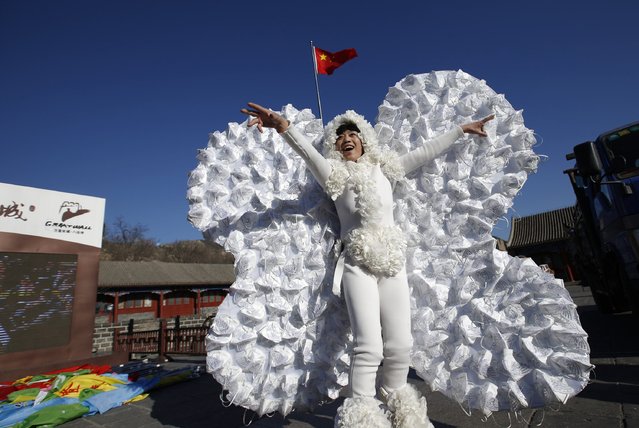
Chinese artist Kong Ning poses in a costume symbolizing a butterfly, which is decorated with 365 masks on its wings to represent the number of days in a year, during her performance art at the Badaling section of the Great Wall on the outskirts of Beijing January 1, 2015. Kong, whose works include themes related to China's air pollution problem, named her new performance art “Hua Die” (transforming into a butterfly) and performed it on the first day of the new year as she hopes that China has clean air for this year. (Photo by Kim Kyung-Hoon/Reuters)
Details
02 Jan 2015 12:24:00
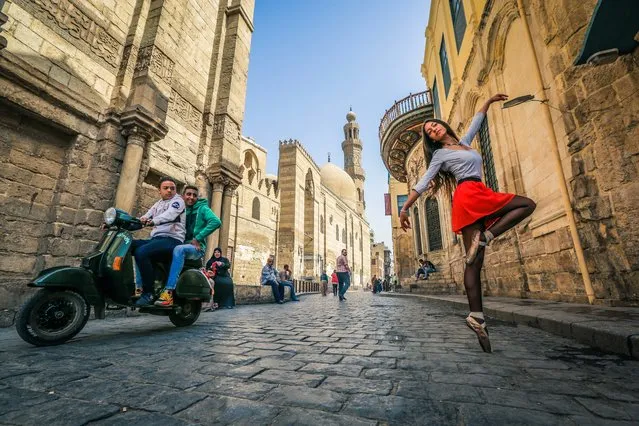
In his series “Ballerinas of Cairo”, photographer Mohamed Taher documents Egyptian dancers making the city streets their stage – pirouetting, leaping and posing their way through their country’s sprawling capital. The photos are, at first glance, stunning snapshots of a city’s vibrant culture in motion. But considering the dangers Egyptian women face for roaming these same streets on a daily basis, their impact is far deeper. Sexual harassment continues to present not just a possibility but a terrifying reality in present-day Egypt. A 2013 United Nations report calculated that 99.3 percent of women in the country have experienced sexual harassment on the streets, a problem that’s sparked initiatives giving women a way to fight back. The violence is rooted in an extreme conservative perspective encouraging women to stay in the home. (Photo by Mohamed Taher/Ballerinas of Cairo)

In his series “Ballerinas of Cairo”, photographer Mohamed Taher documents Egyptian dancers making the city streets their stage – pirouetting, leaping and posing their way through their country’s sprawling capital. The photos are, at first glance, stunning snapshots of a city’s vibrant culture in motion. (Photo by Mohamed Taher/Ballerinas of Cairo)
Details
17 Jan 2017 12:30:00