Loading...
Done
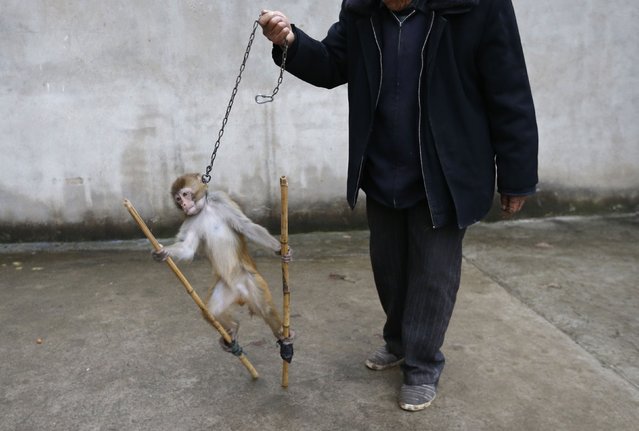
A monkey is led by its trainer Qi Defang during training for a circus in Suzhou, Anhui province, November 29, 2014. (Photo by William Hong/Reuters)

A monkey is led by its trainer Qi Defang during training for a circus in Suzhou, Anhui province, November 29, 2014. Suzhou is known as the hometown of circus troupes in China and has more than 300 circus troupes. (Photo by William Hong/Reuters)
Details
06 Dec 2014 12:21:00
Iraqi firefighters try to stop the fire of burning oil wells in Kirkuk, northern Iraq, 02 June 2016. Two Khabbaz oil field wells in Kirkuk Province, northern Iraq, exploded by suspected insurgents, a security official said. (Photo by EPA/Stringer)

Iraqi firefighters try to stop the fire of burning oil wells in Kirkuk, northern Iraq, 02 June 2016. Two Khabbaz oil field wells in Kirkuk Province, northern Iraq, exploded by suspected insurgents, a security official said. (Photo by EPA/Stringer)
Details
12 Nov 2016 10:42:00
Two female revelers engage in a beer drinking contest in the Hacker Pschorr tent on the first day of the 2017 Oktoberfest beer fest on September 16, 2017 in Munich, Germany. Oktoberfest is the world's largest beer celebration and typically draws over six million visitors over its three-week run. Oktoberfest includes massive beer tents, each run by a different Bavarian brewer, as well as amusement rides and activities. (Photo by Philipp Guelland/Getty Images)

Two female revelers engage in a beer drinking contest in the Hacker Pschorr tent on the first day of the 2017 Oktoberfest beer fest on September 16, 2017 in Munich, Germany. Oktoberfest is the world's largest beer celebration and typically draws over six million visitors over its three-week run. Oktoberfest includes massive beer tents, each run by a different Bavarian brewer, as well as amusement rides and activities. (Photo by Philipp Guelland/Getty Images)
Details
17 Sep 2017 07:57:00
People enjoy carnival while shouting slogans of female empowerment and anti harrassment in Sao Paulo, Brazil on January 28, 2018. The carnival is marked by a lot of fun, but also has space to talk about more serious things – without losing the good mood. Parading for the first time in São Paulo, the Vaca Profana block proposed a reflection on sieges and machismo. With the breasts on display singing not only frevos but, mainly, shouting words of disorder, in order to stimulate female empowerment and against harassment. Our body is our struggle. The preservation of our physical integrity, our freedom of choice. Nude or clothed, we demand respect. (Photo by Cris Faga/Rex Features/Shutterstock)

People enjoy carnival while shouting slogans of female empowerment and anti harrassment in Sao Paulo, Brazil on January 28, 2018. The carnival is marked by a lot of fun, but also has space to talk about more serious things – without losing the good mood. Parading for the first time in São Paulo, the Vaca Profana block proposed a reflection on sieges and machismo. (Photo by Cris Faga/Rex Features/Shutterstock)
Details
29 Jan 2018 08:29:00
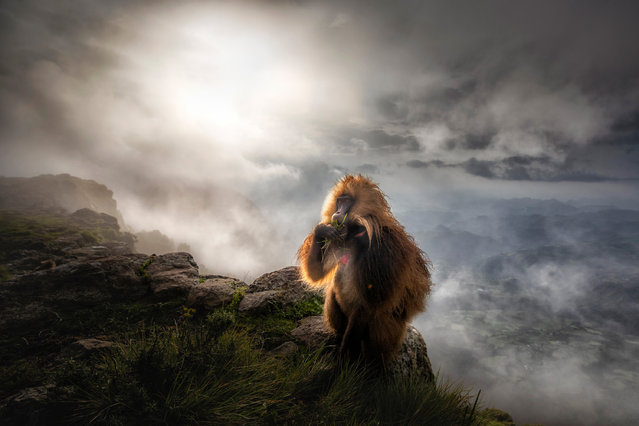
Highly commended, mammals: Gelada after the storm – Marco Gaiotti (Italy). “Gelada baboons are the only monkey species in the world that feed on grasses. They are native to the tableland of Ethiopia. Every morning large family groups wander from their sleeping places in the steep rock face, up to 1,000 metres high, to the feeding grounds at the tablelands. This image clearly depicts their feeding strategy: they pull out bunches of grass, sort the stalks and then lift them to their mouth. This shot was taken towards the end of the rainy season after a heavy storm”. (Photo by Marco Gaiotti/2019 GDT European Wildlife Photographer of the Year)

Highly commended, mammals: Gelada after the storm – Marco Gaiotti (Italy). “Gelada baboons are the only monkey species in the world that feed on grasses. They are native to the tableland of Ethiopia. Every morning large family groups wander from their sleeping places in the steep rock face, up to 1,000 metres high, to the feeding grounds at the tablelands. This image clearly depicts their feeding strategy: they pull out bunches of grass, sort the stalks and then lift them to their mouth. This shot was taken towards the end of the rainy season after a heavy storm”. (Photo by Marco Gaiotti/2019 GDT European Wildlife Photographer of the Year)
Details
31 Oct 2019 00:03:00
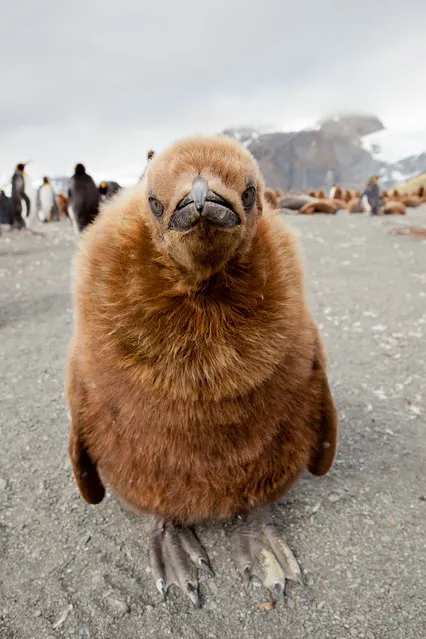
“Cub”. In the colony of penguins in South Georgia. (Photo and caption by Ondrej Zaruba/National Geographic Traveler Photo Contest)

“Cub”. In the colony of penguins in South Georgia. (Photo and caption by Ondrej Zaruba/National Geographic Traveler Photo Contest)

ATTENTION! All pictures are presented in high resolution. To see Hi-Res images – just TWICE click on any picture. In other words, click small picture – opens the BIG picture. Click BIG picture – opens VERY BIG picture.
Details
28 Jun 2013 12:32:00
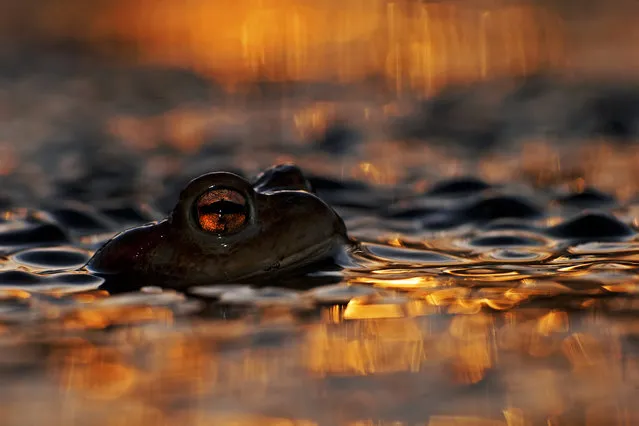
“Eye of a toad”. Animal Portraits, Łukasz Bożycki, Poland.  (Photo by Łukasz Bożycki)

“Eye of a toad”. Animal Portraits, Łukasz Bożycki, Poland. Early spring sees a pond near Łukasz’s home city of Warsaw, Poland, full of mating frogs and a few toads. On this March day, Łukasz shared the pond with them for an evening, sitting in the icy water in his chest-high waders, keeping as still as possible, despite the numbing cold, so that the amphibians could get used to him. “I wanted to find a fresh way of portraying the amphibians”, he says, “at water level”. Using a telephoto lens, he focused on one lone toad and waited for the sun to dip almost below the horizon before pressing the shutter, using flash to bring out the details in the shadow. His prize was “the glorious pool of sunset colour” and fiery glow of the toad’s eye. Nikon D80 + 70-300mm f4.5-5.6 lens + extension tube; 1/125 sec at f9 (-2.3 e/v); ISO 100; built-in flash. (Photo by Łukasz Bożycki)
Details
28 Aug 2013 11:45:00
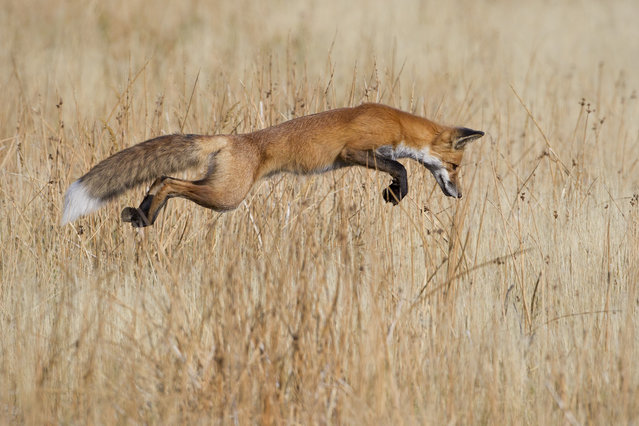
Canada: “Lucky pounce”. (Photo by Connor Stefanison/Wildlife Photographer of the Year 2013)

The winners of The London’s Natural History Museum's prestigious Wildlife Photographer of the Year for 2013 have finally been unveiled. Selected from almost 43,000 entries from 96 countries, the winners offer a glimpse of the stunning array of natural beauty on our planet. Photo: Canada: “Lucky pounce”. “Anticipating the pounce – that was the hardest part”, says Connor, who had come to Yellowstone National Park, Wyoming, USA, in search of wildlife as much as the spectacular landscape. He had found this fox, his first ever, on his last day in the park. It was so absorbed in hunting that Connor had plenty of time to get out of the car and settle behind a rock. It quartered the grassland, back and forth, and then started staring intently at a patch of ground, giving Connor just enough warning of the action to come. When it sprung up, Connor got his shot. And when it landed, the fox got his mouse. (Photo by Connor Stefanison/Wildlife Photographer of the Year 2013)

Details
17 Oct 2013 08:12:00