Loading...
Done
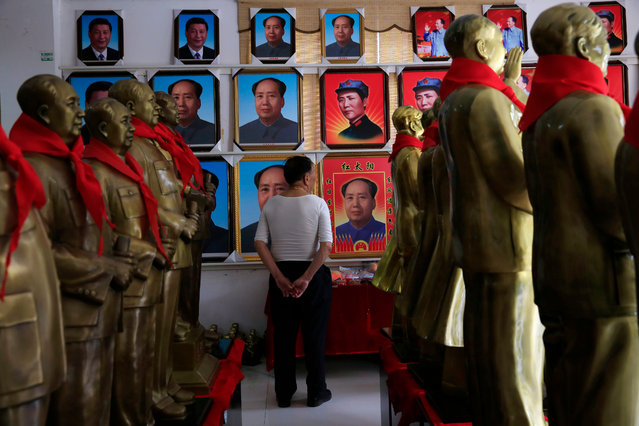
A visitor looks at portraits of Mao Zedong amid his statues on display at a wholesale souvenir store in Shaoshan, Hunan Province in central China, 28 April 2016. Shaoshan is the hometown of former Communist leader Mao Zedong, popularly known as Chairman Mao. Thousands of visitors descend on this small Chinese town burrowed in the hills of Central China's Hunan province to pay homage to the “Great Helmsman” everyday. (Photo by How Hwee Young/EPA)

A visitor looks at portraits of Mao Zedong amid his statues on display at a wholesale souvenir store in Shaoshan, Hunan Province in central China, 28 April 2016. Shaoshan is the hometown of former Communist leader Mao Zedong, popularly known as Chairman Mao. Thousands of visitors descend on this small Chinese town burrowed in the hills of Central China's Hunan province to pay homage to the “Great Helmsman” everyday. It is one of the core sites of the “Red Tourism” industry, where communist party cadres and ordinary Chinese tourists alike seek to relive the experiences and rekindle the spirit of the revolutionaries. (Photo by How Hwee Young/EPA)
Details
08 May 2016 11:19:00
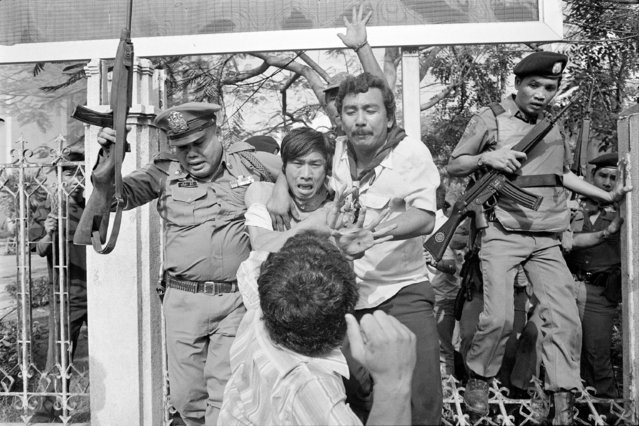
In this October 6, 1976, file photo, a right-wing student, center foreground, draws his arm back to strike a captured and wounded leftist student being taken by police to an ambulance in during a student massacre in Bangkok, Thailand. This year’s anti-government protests are seeking new elections, a more democratic constitution and an end to intimidation of political activists. Their speeches have repeatedly highlighted the 1976 tragedy, piquing the interest of the current generation in what their forebears faced. (Photo by Neal Ulevich/AP Photo/File)

In this October 6, 1976, file photo, a right-wing student, center foreground, draws his arm back to strike a captured and wounded leftist student being taken by police to an ambulance in during a student massacre in Bangkok, Thailand. This year’s anti-government protests are seeking new elections, a more democratic constitution and an end to intimidation of political activists. Their speeches have repeatedly highlighted the 1976 tragedy, piquing the interest of the current generation in what their forebears faced. (Photo by Neal Ulevich/AP Photo/File)
Details
30 Oct 2020 00:03:00
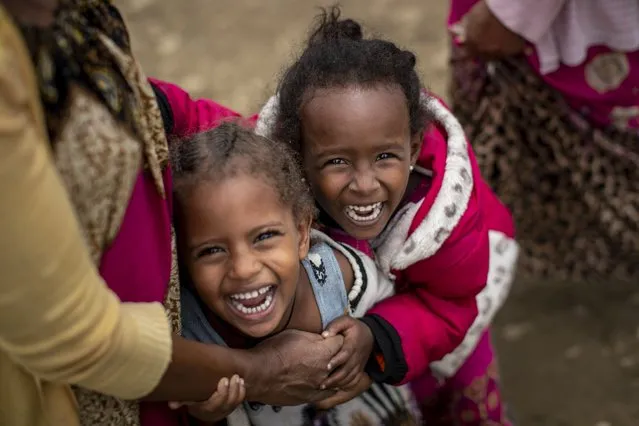
Two displaced Tigrayan girls giggle next to their mother, left, as their photograph is taken outside the Hadnet General Secondary School which has become a makeshift home to thousands displaced by the conflict, in Mekele, in the Tigray region of northern Ethiopia Wednesday, May 5, 2021. The Tigray conflict has displaced more than 1 million people, the International Organization for Migration reported in April, and the numbers continue to rise. (Photo by Ben Curtis/AP Photo)

Two displaced Tigrayan girls giggle next to their mother, left, as their photograph is taken outside the Hadnet General Secondary School which has become a makeshift home to thousands displaced by the conflict, in Mekele, in the Tigray region of northern Ethiopia Wednesday, May 5, 2021. The Tigray conflict has displaced more than 1 million people, the International Organization for Migration reported in April, and the numbers continue to rise. (Photo by Ben Curtis/AP Photo)
Details
15 May 2021 08:13:00
An infrared portrait from NASA's Spitzer Space Telescope which shows generations of stars is seen in this undated NASA handout image released February 14, 2013. In this wispy star-forming region, called W5, the oldest stars can be seen as blue dots in the centers of the two hollow cavities (other blue dots are background and foreground stars not associated with the region). Red shows heated dust that pervades the region's cavities, while green highlights dense clouds. (Photo by NASA/Reuters/JPL-Caltech/Harvard-Smithsonian/Handout)

An infrared portrait from NASA's Spitzer Space Telescope which shows generations of stars is seen in this undated NASA handout image released February 14, 2013. In this wispy star-forming region, called W5, the oldest stars can be seen as blue dots in the centers of the two hollow cavities (other blue dots are background and foreground stars not associated with the region). Red shows heated dust that pervades the region's cavities, while green highlights dense clouds. (Photo by NASA/Reuters/JPL-Caltech/Harvard-Smithsonian/Handout)
Details
03 Mar 2013 08:44:00
Bao Bao, the Giant Panda cub is seen by the media for the first time January 6, 2014 inside his glass enclosure at the Smithsonian's National Zoo in Washington, DC, a few days before going on display to the general public. Bao Bao was born at the Smithsonian's National Zoo August 2, 2013. (Photo by Paul J. Richards/AFP Photo)

Bao Bao, the Giant Panda cub is seen by the media for the first time January 6, 2014 inside his glass enclosure at the Smithsonian's National Zoo in Washington, DC, a few days before going on display to the general public. Bao Bao was born at the Smithsonian's National Zoo August 2, 2013. (Photo by Paul J. Richards/AFP Photo)
Details
07 Jan 2014 08:58:00
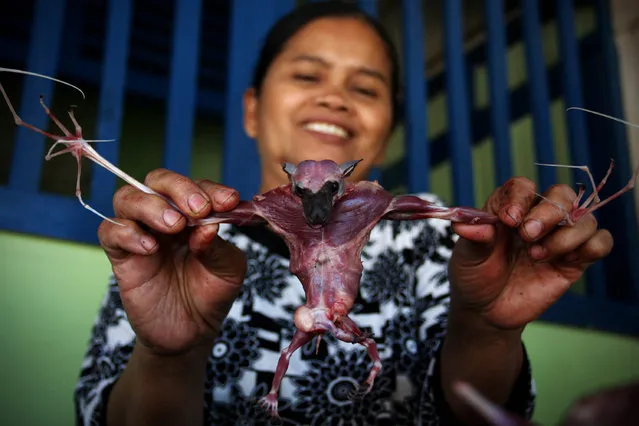
Bat seller Sukarwati shows a skinned bat on July 30, 2009 in Yogyakarta, Indonesia. Sukarwati and her family have hunted bats in the Imogiri region for generations, capturing more than 800 bats per month. The Sukarwati family believe that the meat from the bat heals asthma and respiratory problems and it is a great honour for them knowing that the meat that they provide will help ease people's health ailments

Bat seller Sukarwati shows a skinned bat on July 30, 2009 in Yogyakarta, Indonesia. Sukarwati and her family have hunted bats in the Imogiri region for generations, capturing more than 800 bats per month. The Sukarwati family believe that the meat from the bat heals asthma and respiratory problems and it is a great honour for them knowing that the meat that they provide will help ease people's health ailments. (Photo by Ulet Ifansasti)
Details
20 Sep 2012 08:57:00
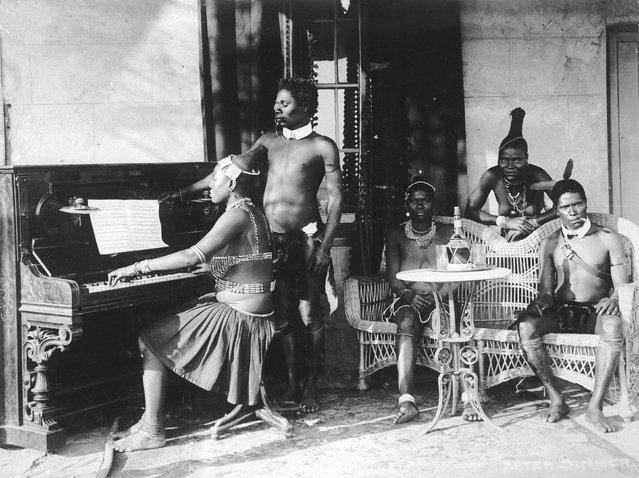
circa 1925:  A Zulu woman playing the piano while a group of others sit and listen.  (Photo by General Photographic Agency/Getty Images)

“The Zulu are the largest South African ethnic group, with an estimated 10–11 million people living mainly in the province of KwaZulu-Natal. Small numbers also live in Zimbabwe, Zambia, and Mozambique. Their language, Zulu, is a Bantu language; more specifically, part of the Nguni subgroup. The Zulu Kingdom played a major role in South African history during the 19th and 20th centuries. Under apartheid, Zulu people were classed as third-class citizens and suffered from state-sanctioned discrimination. They remain today the most numerous ethnic group in South Africa, and now have equal rights along with all other citizens”. – Wikipedia.

Photo: A Zulu woman playing the piano while a group of others sit and listen (to put it briefly, Englishmen scoff over Zulu). South Africa, circa 1925. (Photo by General Photographic Agency)

Details
03 Feb 2014 09:40:00
In this photo taken on July 19, 2014, a man looks at an excavation as an A.R.M.H., Association for the Recovery of Historical Memory, volunteer digs on the search for the body of Perfecto de Dios, in a hidden grave in Chaherrero, Spain. Across Spain, volunteer teams of archeologists, anthropologists and forensic scientists head out every year on expeditions to dig for suspected mass graves – a legacy of Spain's fascist past during the time of General Francisco Franco. (Photo by Daniel Ochoa de Olza/AP Photo)

In this photo taken on July 19, 2014, a man looks at an excavation as an A.R.M.H., Association for the Recovery of Historical Memory, volunteer digs on the search for the body of Perfecto de Dios, in a hidden grave in Chaherrero, Spain. Across Spain, volunteer teams of archeologists, anthropologists and forensic scientists head out every year on expeditions to dig for suspected mass graves – a legacy of Spain's fascist past during the time of General Francisco Franco. (Photo by Daniel Ochoa de Olza/AP Photo)
Details
26 Dec 2014 14:54:00