Loading...
Done
Afghans shout anti-U.S. slogans as they burn tires and block a highway during a protest in reaction to a small American church's plan to burn copies of the Quran, at Jalalabad, east of Kabul, Afghanistan, Friday, September 10, 2010. Religious and political leaders across the Muslim world welcomed a decision by the church to suspend its plans to torch copies of their holy book but some said Friday the damage has already been done. (Photo by Rahmat Gul/AP Photo)

Afghans shout anti-U.S. slogans as they burn tires and block a highway during a protest in reaction to a small American church's plan to burn copies of the Quran, at Jalalabad, east of Kabul, Afghanistan, Friday, September 10, 2010. Religious and political leaders across the Muslim world welcomed a decision by the church to suspend its plans to torch copies of their holy book but some said Friday the damage has already been done. (Photo by Rahmat Gul/AP Photo)
Details
07 Apr 2016 14:52:00
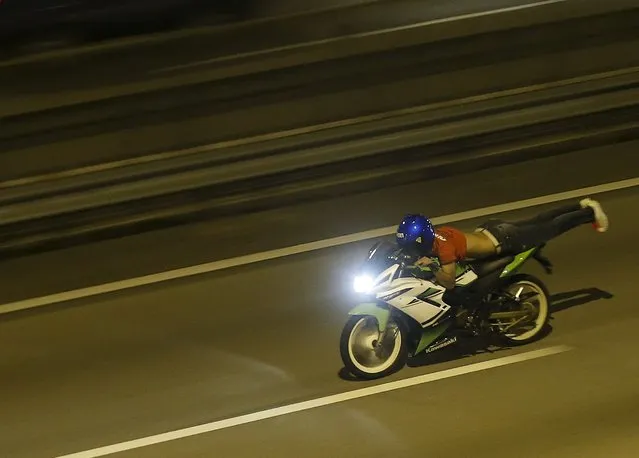
A motorcyclist performs the superman stunt on a highway in Kuala Lumpur, Malaysia, September 14, 2014. Crowds of small motorbikes ridden by racers – or “Mat Rempit”, as they are known in Malaysian slang – face off in impromptu races in the Malaysian capital after dark. The decades-old culture is widely frowned upon by largely conservative Malaysians, who fear its potential to encourage gambling, drug abuse, snatch thefts and sexual promiscuity. (Photo by Olivia Harris/Reuters)

A motorcyclist performs the superman stunt on a highway in Kuala Lumpur, Malaysia, September 14, 2014. Crowds of small motorbikes ridden by racers – or “Mat Rempit”, as they are known in Malaysian slang – face off in impromptu races in the Malaysian capital after dark. The decades-old culture is widely frowned upon by largely conservative Malaysians, who fear its potential to encourage gambling, drug abuse, snatch thefts and sexual promiscuity. (Photo by Olivia Harris/Reuters)
Details
09 Apr 2016 13:39:00
A visitor looks at portraits of Mao Zedong amid his statues on display at a wholesale souvenir store in Shaoshan, Hunan Province in central China, 28 April 2016. Shaoshan is the hometown of former Communist leader Mao Zedong, popularly known as Chairman Mao. Thousands of visitors descend on this small Chinese town burrowed in the hills of Central China's Hunan province to pay homage to the “Great Helmsman” everyday. (Photo by How Hwee Young/EPA)

A visitor looks at portraits of Mao Zedong amid his statues on display at a wholesale souvenir store in Shaoshan, Hunan Province in central China, 28 April 2016. Shaoshan is the hometown of former Communist leader Mao Zedong, popularly known as Chairman Mao. Thousands of visitors descend on this small Chinese town burrowed in the hills of Central China's Hunan province to pay homage to the “Great Helmsman” everyday. It is one of the core sites of the “Red Tourism” industry, where communist party cadres and ordinary Chinese tourists alike seek to relive the experiences and rekindle the spirit of the revolutionaries. (Photo by How Hwee Young/EPA)
Details
08 May 2016 11:19:00
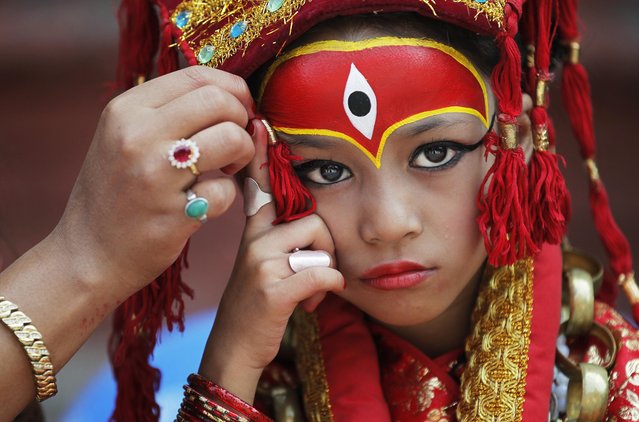
A Nepalese mother applies make up to her daughter dressed as the living goddess Kumari as they wait for Kumari puja to start at Hanuman Dhoka temple, in Kathmandu, Nepal, Wednesday, September 14, 2016. Girls under the age of nine gathered for the Kumari puja, a tradition of worshiping young prepubescent girls as manifestations of the divine female energy. The ritual holds a strong religious significance in the Newar community that seeks divine blessings to save small girls from diseases and bad luck in the years to come. (Photo by Niranjan Shrestha/AP Photo)

A Nepalese mother applies make up to her daughter dressed as the living goddess Kumari as they wait for Kumari puja to start at Hanuman Dhoka temple, in Kathmandu, Nepal, Wednesday, September 14, 2016. Girls under the age of nine gathered for the Kumari puja, a tradition of worshiping young prepubescent girls as manifestations of the divine female energy. The ritual holds a strong religious significance in the Newar community that seeks divine blessings to save small girls from diseases and bad luck in the years to come. (Photo by Niranjan Shrestha/AP Photo)
Details
15 Sep 2016 09:58:00
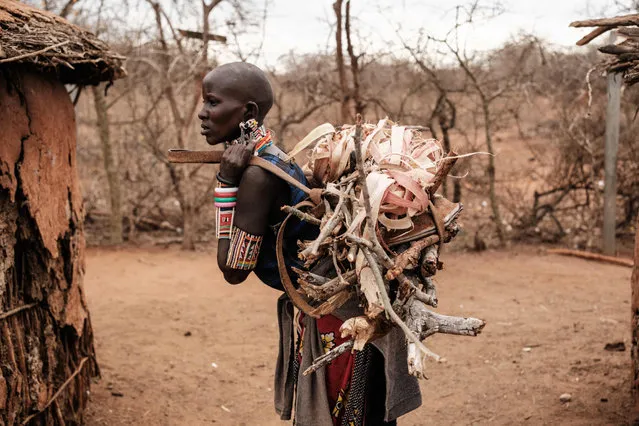
A Maasai woman arrives with collected firewoods at a village nearby Selenkay Conservancy, a community-owned conservation area running by a private company, in Amboseli, Kenya, on June 22, 2022. The camp's ten luxurious tents see tourists flocking again, after the shutdown linked to Covid-19. They observe in small groups elephants, giraffes, antelopes or lions on 5,000 hectares, located on the edge of Amboseli National Park, in the south of the country, and have a glimpse of the life of the Masai, the owners of the land. (Photo by Yasuyoshi Chiba/AFP Photo)

A Maasai woman arrives with collected firewoods at a village nearby Selenkay Conservancy, a community-owned conservation area running by a private company, in Amboseli, Kenya, on June 22, 2022. The camp's ten luxurious tents see tourists flocking again, after the shutdown linked to Covid-19. They observe in small groups elephants, giraffes, antelopes or lions on 5,000 hectares, located on the edge of Amboseli National Park, in the south of the country, and have a glimpse of the life of the Masai, the owners of the land. (Photo by Yasuyoshi Chiba/AFP Photo)
Details
22 Jul 2022 04:32:00
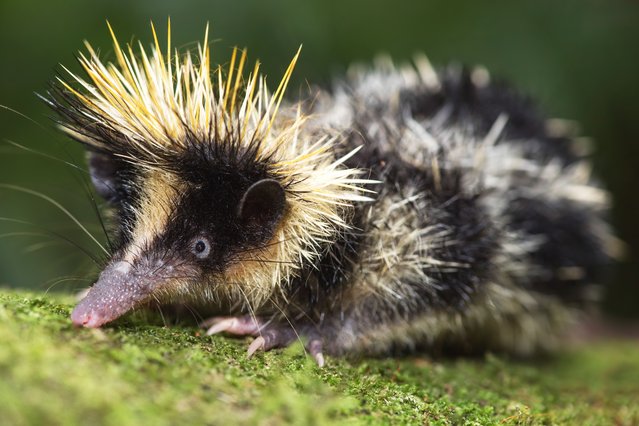
This spiky tenrec was spotted in Madagascar’s Mantadia National Park in the last decade of September 2025. Mostly nocturnal and rarely seen, it puffs out its spines when threatened. Spiky tenrecs are excellent swimmers — unlike most spiny mammals, some species of tenrec can forage in streams and rivers, using their spines for protection while hunting aquatic insects and small prey. (Photo by Dale Morris/Solent News & Photo Agency)

This spiky tenrec was spotted in Madagascar’s Mantadia National Park in the last decade of September 2025. Mostly nocturnal and rarely seen, it puffs out its spines when threatened. Spiky tenrecs are excellent swimmers — unlike most spiny mammals, some species of tenrec can forage in streams and rivers, using their spines for protection while hunting aquatic insects and small prey. (Photo by Dale Morris/Solent News & Photo Agency)
Details
05 Oct 2025 04:02:00
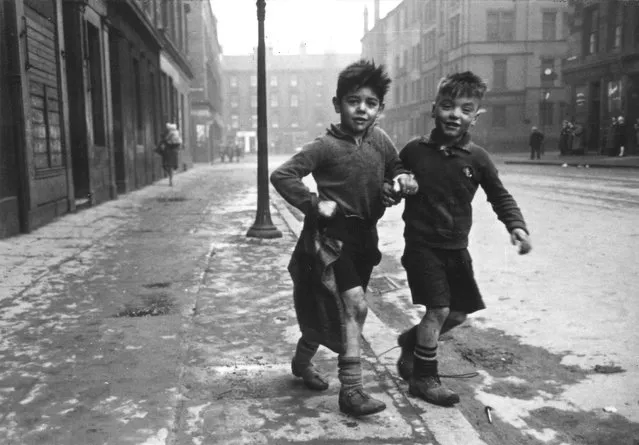
Two boys in the Gorbals area of Glasgow, UK on January 31, 1948. The Gorbals tenements were built quickly and cheaply in the 1840s, providing housing for Glasgow's burgeoning population of industrial workers. Conditions were appalling; overcrowding was standard and sewage and water facilities inadequate. The tenements housed about 40,000 people with up to eight family members sharing a single room, 30 residents sharing a toilet and 40 sharing a tap. By the time this photograph was taken 850 tenements had been demolished since 1920. Redevelopment of the area began in the late 1950s and the tenements were replaced with a modern tower block complex in the sixties. (Photo by Bert Hardy/Getty Images)

Two boys in the Gorbals area of Glasgow, UK on January 31, 1948. The Gorbals tenements were built quickly and cheaply in the 1840s, providing housing for Glasgow's burgeoning population of industrial workers. Conditions were appalling; overcrowding was standard and sewage and water facilities inadequate. The tenements housed about 40,000 people with up to eight family members sharing a single room, 30 residents sharing a toilet and 40 sharing a tap. By the time this photograph was taken 850 tenements had been demolished since 1920. Redevelopment of the area began in the late 1950s and the tenements were replaced with a modern tower block complex in the sixties. (Photo by Bert Hardy/Getty Images)
Details
09 Mar 2017 00:03:00
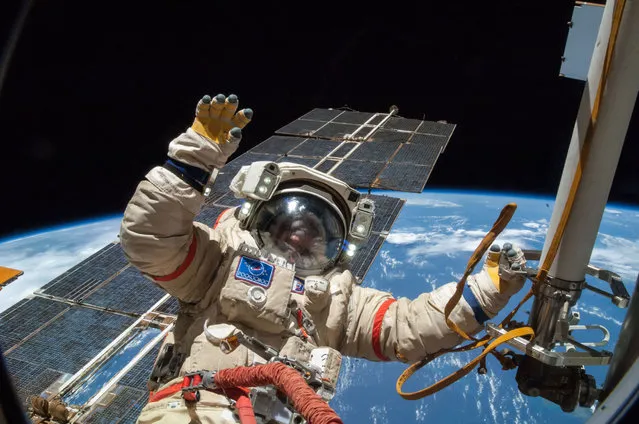
Russian cosmonaut Alexander Skvortsov, Expedition 40 flight engineer, attired in a Russian Orlan spacesuit, participates in a session of extravehicular activity (EVA) in support of science and maintenance on the International Space Station on August 18, 2014. During the five-hour, 11-minute spacewalk, Skvortsov and cosmonaut Oleg Artemyev (out of frame) deployed a small science satellite, retrieved and installed experiment packages and inspected components on the exterior of the orbital laboratory. (Photo by NASA)

Russian cosmonaut Alexander Skvortsov, Expedition 40 flight engineer, attired in a Russian Orlan spacesuit, participates in a session of extravehicular activity (EVA) in support of science and maintenance on the International Space Station on August 18, 2014. During the five-hour, 11-minute spacewalk, Skvortsov and cosmonaut Oleg Artemyev (out of frame) deployed a small science satellite, retrieved and installed experiment packages and inspected components on the exterior of the orbital laboratory. (Photo by NASA)
Details
13 Apr 2022 06:53:00