Loading...
Done
Deadly Insects Hornet

Hornets are insects that are the largest eusocial wasps. Some species can reach up to 5.5 cm (2.2 in) in length. The true hornets make up the genus Vespa and are distinguished from other vespines by the width of the vertex (part of the head behind the eyes), which is proportionally larger in Vespa and by the anteriorly rounded gasters (the section of the abdomen behind the wasp waist). The best known species is the European hornet (Vespa crabro), about 2–3.5 cm in length, widely distributed throughout Europe, Russia, North America and Northeast Asia.
Details
13 Oct 2014 10:17:00
An arrow-head discovered in 2006 by Archaeologists of the University of Cambridge Archaeological Unit, is displayed by one of the team uncovering Bronze Age wooden houses, preserved in silt, from a quarry near Peterborough, Britain, January 12, 2016. (Photo by Peter Nicholls/Reuters)

An arrow-head discovered in 2006 by Archaeologists of the University of Cambridge Archaeological Unit, is displayed by one of the team uncovering Bronze Age wooden houses, preserved in silt, from a quarry near Peterborough, Britain, January 12, 2016. Archaeologists said on Tuesday they had discovered what were believed to be the best-preserved Bronze Age dwellings ever found in Britain, providing an extraordinary insight into prehistoric life from 3,000 years ago. (Photo by Peter Nicholls/Reuters)
Details
14 Jan 2016 08:00:00
In this Friday, February 6, 2015 photo, sandhill cranes begin to stir after resting for the night at a roosting location along their winter migration route in Cecilia, Ky. According to counts made by biologists with the Kentucky Fish and Wildlife Resources, about 12,000 of the birds have stopped in Cecilia this week during their winter northward migration on their way to their nesting grounds in the Great Lakes region. (Photo by David Stephenson/AP Photo)

In this Friday, February 6, 2015 photo, sandhill cranes begin to stir after resting for the night at a roosting location along their winter migration route in Cecilia, Ky. According to counts made by biologists with the Kentucky Fish and Wildlife Resources, about 12,000 of the birds have stopped in Cecilia this week during their winter northward migration on their way to their nesting grounds in the Great Lakes region. (Photo by David Stephenson/AP Photo)
Details
23 Feb 2015 13:07:00
“Great White Shark of Guadalupe Island”. A great white shark very quiet under the boat and a lot of fish. The sun ray lighting the head of the shark. Location: Guadalupe Island, Mexico. (Photo and caption by Marc Henauer/National Geographic Traveler Photo Contest)

“Great White Shark of Guadalupe Island”. A great white shark very quiet under the boat and a lot of fish. The sun ray lighting the head of the shark. Location: Guadalupe Island, Mexico. (Photo and caption by Marc Henauer/National Geographic Traveler Photo Contest)

ATTENTION! All pictures are presented in high resolution. To see Hi-Res images – just TWICE click on any picture. In other words, click small picture – opens the BIG picture. Click BIG picture – opens VERY BIG picture.
Details
04 Jul 2013 09:49:00
“Double head vulture”. On the day of windy days during raptors migration some people in my country start to catch these tired raptors, so in this day we go to photograph some raptors and we saw these tow tired vultures, so we start to drag them away from the hunters until they reach a good hidden place, to make them safe until they start a new journey. Photo location: Kuwait. (Photo and caption by Mohd Khorshed/National Geographic Photo Contest)

“Double head vulture”. On the day of windy days during raptors migration some people in my country start to catch these tired raptors, so in this day we go to photograph some raptors and we saw these tow tired vultures, so we start to drag them away from the hunters until they reach a good hidden place, to make them safe until they start a new journey. Photo location: Kuwait. (Photo and caption by Mohd Khorshed/National Geographic Photo Contest)
Details
06 Nov 2014 09:40:00
“The Sunsetter”. An EF-4 tornado rips through the open space of farmland near Rozel, Kansas. This tornado moves slowly but powerful towards the setting sun an gets its beautiful color right before sunset. Storm Chasers are spotting on the left side. Photo location: Rozel, Kansas. (Photo and caption by Dennis Oswald/National Geographic Photo Contest)

“The Sunsetter”. An EF-4 tornado rips through the open space of farmland near Rozel, Kansas. This tornado moves slowly but powerful towards the setting sun an gets its beautiful color right before sunset. Storm Chasers are spotting on the left side. Photo location: Rozel, Kansas. (Photo and caption by Dennis Oswald/National Geographic Photo Contest)

ATTENTION! All pictures are presented in high resolution. To see Hi-Res images – just TWICE click on any picture. In other words, click small picture – opens the BIG picture. Click BIG picture – opens VERY BIG picture.
Details
01 Dec 2013 11:03:00
“The Independence day”. While on storm chasing expeditions in the Tornado Alley in USA I have encountered many photogenic supercell storms. This photograph was taken while we were approaching the storm near Julesburg, Colorado on My 28th, 2013. The storm was tornado warned for more than one hour, but stayed an LP storm through all its cycles and never produced a tornado, just occasional brief funnels, large hail and some rain. Photo location: Julesburg, Colorado, USA. (Photo and caption by Marko Korošec/National Geographic Photo Contest)

“The Independence day”. While on storm chasing expeditions in the Tornado Alley in USA I have encountered many photogenic supercell storms. This photograph was taken while we were approaching the storm near Julesburg, Colorado on My 28th, 2013. The storm was tornado warned for more than one hour, but stayed an LP storm through all its cycles and never produced a tornado, just occasional brief funnels, large hail and some rain. Photo location: Julesburg, Colorado, USA. (Photo and caption by Marko Korošec/National Geographic Photo Contest)
Details
24 Jun 2014 12:29:00
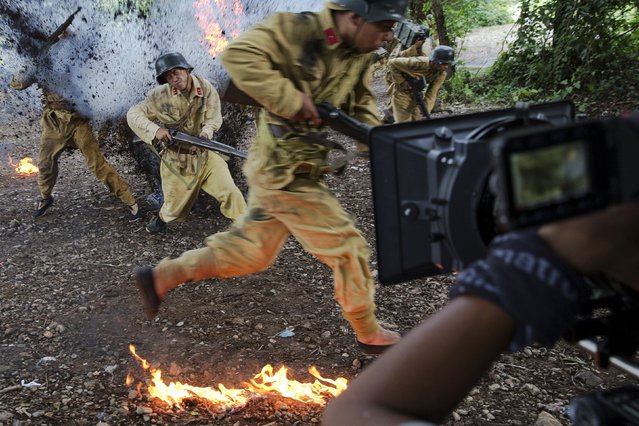
The camera rolls as actors dressed as historical Chinese soldiers act as though they have been hit by artillery, during filming of “The Last Prince” television series on location near Hengdian World Studios near Hengdian July 24, 2015. (Photo by Damir Sagolj/Reuters)

The camera rolls as actors dressed as historical Chinese soldiers act as though they have been hit by artillery, during filming of “The Last Prince” television series on location near Hengdian World Studios near Hengdian July 24, 2015. Hundreds of well-trained actors and other professionals are available at the Hengdian World Studios. The well-organised team coordinate complicated battle scenes to satisfy the huge appetite for productions about the war against Japan. (Photo by Damir Sagolj/Reuters)
Details
10 Aug 2015 08:06:00