Loading...
Done
Mount Sinabung is seen during an eruption from Surbakti village in Karo, North Sumatra, Indonesia, April 20, 2015. The local government is preparing the relocation of residents from three of the villages that were destroyed. (Photo by Tibta Pangin/Getty Images/Anadolu Agency)

Mount Sinabung is seen during an eruption from Surbakti village in Karo, North Sumatra, Indonesia, April 20, 2015. The local government is preparing the relocation of residents from three of the villages that were destroyed. (Photo by Tibta Pangin/Getty Images/Anadolu Agency)
Details
25 Apr 2015 09:21:00
1948年3月,外滩,便衣警察棒打偷拿棉花的老太。 (In March 1948, the Bund, plainclothes police officers wreck stole cotton Granny)

Photos from 虹桥故事's photostream. Attention! From Chinese to English translated by Google!

Photo: 1948年3月,外滩,便衣警察棒打偷拿棉花的老太。 (In March 1948, the Bund, plainclothes police officers wreck stole cotton Granny)
Details
12 Aug 2012 08:41:00
Supporters react as U.S. President Donald Trump walks from Marine One to the White House in Washington, U.S., October 3, 2019. (Photo by Tom Brenner/Reuters)

Supporters react as U.S. President Donald Trump walks from Marine One to the White House in Washington, U.S., October 3, 2019. (Photo by Tom Brenner/Reuters)
Details
06 Oct 2019 00:07:00
Dancers perform at the 130th Anniversary Le Moulin Rouge celebration on October 6, 2019 in Paris, France. (Photo by Pascal Le Segretain/Getty Images)

Dancers perform at the 130th Anniversary Le Moulin Rouge celebration on October 6, 2019 in Paris, France. (Photo by Pascal Le Segretain/Getty Images)
Details
08 Oct 2019 00:05:00
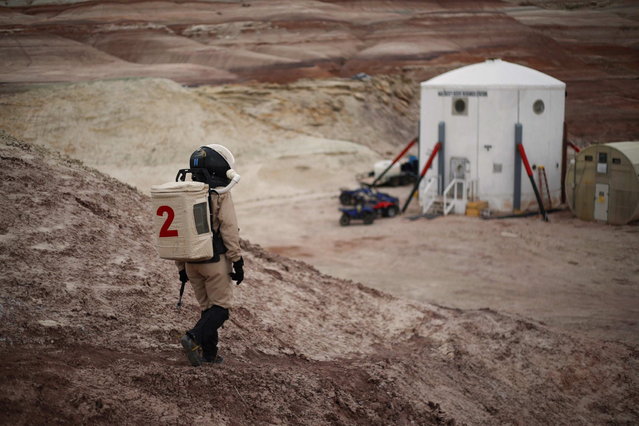
Csilla Orgel, a geologist of Crew 125 EuroMoonMars B mission, makes her way back to the Mars Desert Research Station (MDRS) in the Utah desert March 3, 2013. (Photo by Jim Urquhart/Reuters)

NASA says it could be another 20 years before humans touch down on Mars, but in a sense, the Mars Society has been exploring the red planet for more than a decade – in Utah. Photo: Csilla Orgel, a geologist of Crew 125 EuroMoonMars B mission, makes her way back to the Mars Desert Research Station (MDRS) in the Utah desert March 3, 2013. The MDRS aims to investigate the feasibility of a human exploration of Mars and uses the Utah desert's Mars-like terrain to simulate working conditions on the red planet. Scientists, students and enthusiasts work together developing field tactics and studying the terrain. All outdoor exploration is done wearing simulated spacesuits and carrying air supply packs and crews live together in a small communication base with limited amounts of electricity, food, oxygen and water. Everything needed to survive must be produced, fixed and replaced on site. (Photo by Jim Urquhart/Reuters)

Details
14 Mar 2013 12:11:00
Real-Life Tarzan DeWet Du Toit

South African-born DeWet du Toit once worked as a security guard at a Co-op shop in Manchester, but now he’s decided to live his dream by becoming a real-life Tarzan – all with the hope of one day making it to Hollywood to portray his hero.
Details
21 Mar 2013 12:10:00
Vandenberg Project by Andreas Franke

“24.27 N, 81.44 W. These coordinates mark the spot of the final resting place of an old brave soldier, the USS General Hoyt S. Vandenberg. In 2009 it underwent a complete change when the creaky steel monster became a mystical bearer of secrets. In May of that year, the Vandenberg was lowered down into the darkness of the ocean off the coast of Florida to become an artificial reef, where it would dwell in rigor mortis at a depth of 130 feet. This lively, animate, secretive nothingness, this menacing, wild emptiness would haunt and seduce the renowned Austrian photographer and passionate diver Andreas Franke...”. – The Sinking World (Photo by Andreas Franke)
Details
07 Apr 2013 09:50:00
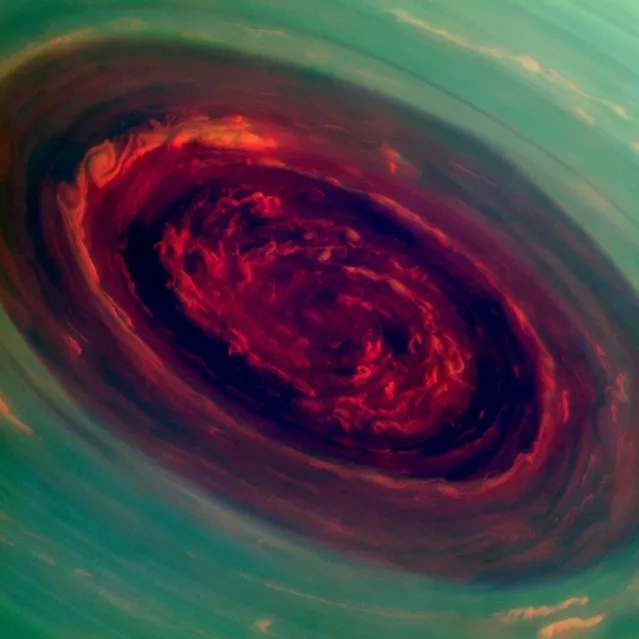
The spinning vortex of Saturn's north polar storm resembles a deep red rose of giant proportions surrounded by green foliage in this false-color image from NASA's Cassini spacecraft. (Photo by NASA/JPL-Caltech/SSI)

NASA's Cassini spacecraft has provided scientists the first close-up, visible-light views of a behemoth hurricane swirling around Saturn's north pole. In high-resolution pictures and video, scientists see the hurricane's eye is about 1,250 miles (2,000 kilometers) wide, 20 times larger than the average hurricane eye on Earth. Thin, bright clouds at the outer edge of the hurricane are traveling 330 mph(150 meters per second). The hurricane swirls inside a large, mysterious, six-sided weather pattern known as the hexagon. Photo: The spinning vortex of Saturn's north polar storm resembles a deep red rose of giant proportions surrounded by green foliage in this false-color image from NASA's Cassini spacecraft. (Photo by NASA/JPL-Caltech/SSI)
Details
31 May 2015 09:11:00