Loading...
Done


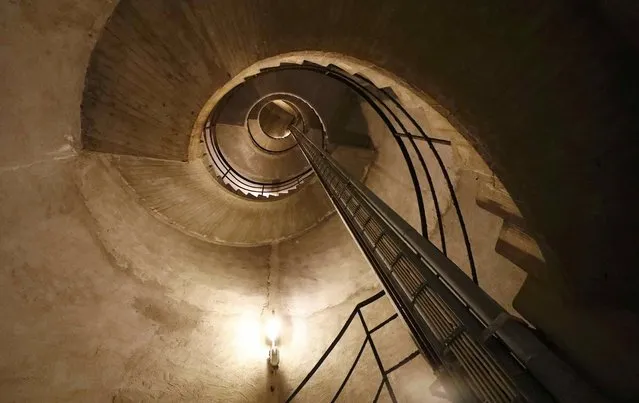
“Dover Castle is a medieval castle in the town of the same name in the English county of Kent. It was founded in the 12th century and has been described as the “Key to England” due to its defensive significance throughout history. It is the largest castle in England.

The outbreak of the Second World War in 1939 saw the tunnels converted first into an air-raid shelter and then later into a military command centre and underground hospital. In May 1940, Admiral Sir Bertram Ramsey directed the evacuation of French and British soldiers from Dunkirk, code-named Operation Dynamo, from his headquarters in the cliff tunnels”. – Wikipedia

Photo: The Repeater Station in the subterranean tunnels underneath Dover Castle, which has been restored by English Heritage for a public exhibition on June 3, 2011 in Dover, England. The evacuation of allied soldiers from Dunkirk was masterminded and co-ordinated from the secret command and control centre in the tunnels deep below the castle. (Photo by Matthew Lloyd/Getty Images)
Details
07 Jun 2011 09:26:00
Performers wearing 19th century French military uniforms fire their weapons as they attack Allied forces during a reenactment of the Battle of the Nations, in a field in the village of Markkleeberg near Leipzig October 20, 2013. (Photo by Fabrizio Bensch/Reuters)

Performers wearing 19th century French military uniforms fire their weapons as they attack Allied forces during a reenactment of the Battle of the Nations, in a field in the village of Markkleeberg near Leipzig October 20, 2013. The east German city of Leipzig commemorated the 200th anniversary of the largest battle of the Napoleonic Wars on Sunday by reenacting the Battle of the Nations, with 6,000 military-historic association enthusiasts from all over Europe. The decisive encounter in which tens of thousands of soldiers were killed, took place from October 17-19, 1813, just outside of Leipzig. At the height of the hostilities Napoleon fielded more than 200,000 men against an Allied force of some 360,000 soldiers which included troops from Russia, Austria, Prussia and Sweden. (Photo by Fabrizio Bensch/Reuters)
Details
21 Oct 2013 11:19:00
Retired builder Vasili Sidamonidze, 70, poses for a portrait at his home in Gori, Georgia, December 6, 2016. “Unfortunately, Stalin is not popular nowadays. Our people don't respect him. Only we, members of the (Communist) Party, respect him”, Sidamonidze said. “I always try to attend Stalin's birthday anniversaries in Gori. Unfortunately many people don't want to join us even if they live nearby. They look at us from their windows”. Stalin, who was born in Gori in 1878 and died in 1953, is largely reviled today in Georgia, which regained its independence during the 1991 collapse of the Soviet Union. Over the years, his memorials have been dismantled, most recently in 2010 when authorities removed a statue of the dictator from Gori's central square. But Stalin is still revered by a small group of mainly elderly supporters who stress his role in the industrialisation of the Soviet Union and in defeating Nazi Germany in World War Two. Each Dec. 21, a few dozen people mark his birthday by gathering outside a Gori museum dedicated to Stalin, where they make speeches and walk to the square where a 6-meter-high bronze statue of him once stood, calling for it to be reinstated. Opponents say it was a symbol of Moscow's still lingering shadow. In 2008, Russia fought a brief war with Georgia and recognised its breakaway regions of Abkhazia and South Ossetia as independent states. (Photo by David Mdzinarishvili/Reuters)

Retired builder Vasili Sidamonidze, 70, poses for a portrait at his home in Gori, Georgia, December 6, 2016. “Unfortunately, Stalin is not popular nowadays. Our people don't respect him. Only we, members of the (Communist) Party, respect him”, Sidamonidze said. “I always try to attend Stalin's birthday anniversaries in Gori. Unfortunately many people don't want to join us even if they live nearby. They look at us from their windows”. (Photo by David Mdzinarishvili/Reuters)
Details
17 Dec 2016 07:59:00
Vietnamese female traffic police officers march during a rehearsal for a military parade as part of the 40th anniversary of the fall of Saigon in southern Ho Chi Minh City (formerly Saigon City), Vietnam, on April 26, 2015. (Photo by Reuters/Kham)

Vietnamese female traffic police officers march during a rehearsal for a military parade as part of the 40th anniversary of the fall of Saigon in southern Ho Chi Minh City (formerly Saigon City), Vietnam, on April 26, 2015. Vietnam marks the 40th anniversary of the fall of Saigon on April 30, the event that ended a war that lasted over 30 years, killing up to four million Vietnamese, the Vietnamese government said, and more than 58,000 U.S troops, the U.S. Department of Defense has said. (Photo by Reuters/Kham)
Details
27 Apr 2015 10:11:00
Takeoka Chisaka, Hiroshima, Japan. “One morning in August 1945, I was walking home from the night shift at a factory in Hiroshima. As I reached my door, there was a huge explosion. When I came to, my head was bleeding and I had been blasted 30m away”. (Photo and caption by Sasha Maslov)

Takeoka Chisaka, Hiroshima, Japan. “One morning in August 1945, I was walking home from the night shift at a factory in Hiroshima. As I reached my door, there was a huge explosion. When I came to, my head was bleeding and I had been blasted 30m away. The atomic bomb had detonated. When I found my mother, her eyes were badly burned. A doctor said they had to come out, but he didn’t have the proper tools so used a knife instead. It was hellish. I became a peace-worker after the war. In the 1960s, at a meeting at the UN, I met one of the people who created the atomic bomb. He apologised”. (Photo and caption by Sasha Maslov)
Details
11 May 2015 11:56:00
Abandoned cars are seen around a cross in the village of Tbeti near Tskhinvali, the capital of the breakaway region of South Ossetia, Georgia, July 4, 2015. President Vladimir Putin signed a treaty with Georgia's rebel South Ossetia region on March 18 that almost completely integrates it with Russia, alarming Georgia and the West a year after Moscow took over Crimea. (Photo by Kazbek Basaev/Reuters)

Abandoned cars are seen around a cross in the village of Tbeti near Tskhinvali, the capital of the breakaway region of South Ossetia, Georgia, July 4, 2015. President Vladimir Putin signed a treaty with Georgia's rebel South Ossetia region on March 18 that almost completely integrates it with Russia, alarming Georgia and the West a year after Moscow took over Crimea. Russia won a five-day war with Georgia in 2008 over the fate of South Ossetia and another rebel region, Abkhazia. It formally recognizes both regions as independent states and signed a similar treaty with Abkhazia last year. (Photo by Kazbek Basaev/Reuters)
Details
09 Jul 2015 11:43:00
A rat being trained by the Cambodian Mine Action Centre (CMAC) is pictured on an inactive landmine field in Siem Reap province July 9, 2015. Gambian pouched rats were deployed to Cambodia from Tanzania in April by a Belgian non-profit organization, APOPO, to help clear mines. (Photo by Samrang Pring/Reuters)

A rat being trained by the Cambodian Mine Action Centre (CMAC) is pictured on an inactive landmine field in Siem Reap province July 9, 2015. Gambian pouched rats were deployed to Cambodia from Tanzania in April by a Belgian non-profit organization, APOPO, to help clear mines. They've been trained since they were 4 weeks old. Cambodia is still littered with landmines after emerging from decades of civil war, including the 1970s Khmer Rough “Killing Fields” genocide, leaving it with one of the world's highest disability rates. APOPO has used the rodents for mine-clearing projects in several countries, including Angola, Mozambique, Thailand, Laos, and Vietnam. (Photo by Samrang Pring/Reuters)
Details
14 Jul 2015 13:35:00
Girls, who are part of Afghan Mobile Mini Circus for Children (MMCC), participate in a juggling competition in Kabul, Afghanistan August 12, 2015. (Photo by Ahmad Masood/Reuters)

Girls, who are part of Afghan Mobile Mini Circus for Children (MMCC), participate in a juggling competition in Kabul, Afghanistan August 12, 2015. The MMCC, founded by David Mason from Denmark, teaches cooperation and creativity to children scarred by years of war in Afghanistan. Despite the dangers, the project has grown so popular that it now runs centres in ten provinces and has hundreds of regular students. The circus makes visits to internally displaced persons' camps, schools, orphanages, and holds annual festivals. The children are taught the skills of juggling clubs, walking on stilts and acrobatics. (Photo by Ahmad Masood/Reuters)
Details
01 Sep 2015 12:47:00