Loading...
Done
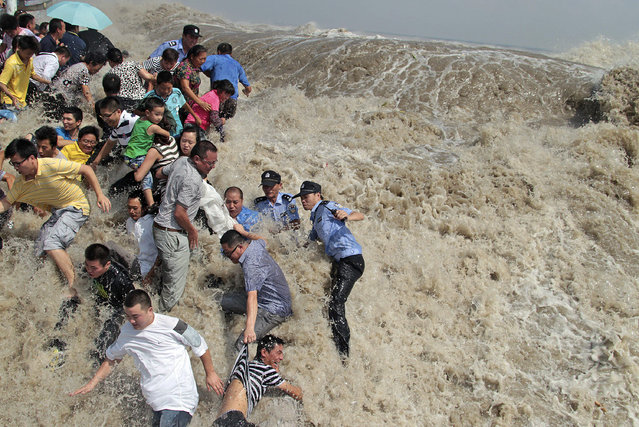
Policemen and residents run as waves from a tidal bore surge past a barrier on the banks of Qiantang River in Haining, Zhejiang province August 31, 2011. As Typhoon Nanmadol approaches eastern China, the tides and waves in Qiantang River recorded its highest level in 10 years, local media reported. (Photo by Reuters/China Daily)

Policemen and residents run as waves from a tidal bore surge past a barrier on the banks of Qiantang River in Haining, Zhejiang province August 31, 2011. As Typhoon Nanmadol approaches eastern China, the tides and waves in Qiantang River recorded its highest level in 10 years, local media reported. (Photo by Reuters/China Daily)
Details
30 Aug 2013 11:37:00
A model poses for a portrait backstage during Dakar Fashion Week July 10, 2011. (Photo by Finbarr O'Reilly/Reuters)

A model poses for a portrait backstage during Dakar Fashion Week July 10, 2011. (Photo by Finbarr O'Reilly/Reuters)
Details
20 May 2013 11:20:00
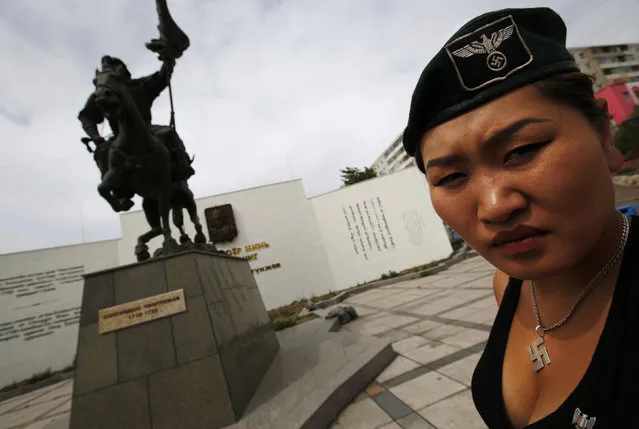
Uranjargal, a leader of the Mongolian neo-Nazi group Tsagaan Khass, stands next to a statue of Chingunjav, a Mongolian national hero, in Ulan Bator June 22, 2013. (Photo by Carlos Barria/Reuters)

Uranjargal, a leader of the Mongolian neo-Nazi group Tsagaan Khass, stands next to a statue of Chingunjav, a Mongolian national hero, in Ulan Bator June 22, 2013. The group has rebranded itself as an environmentalist organisation fighting pollution by foreign-owned mines, seeking legitimacy as it sends Swastika-wearing members to check mining permits. Over the past years, ultra-nationalist groups have expanded in the country and among those garnering attention is Tsagaan Khass, which has recently shifted its focus from activities such as attacks on women it accuses of consorting with foreign men to environmental issues, with the stated goal of protecting Mongolia from foreign mining interests. This ultra-nationalist group was founded in the 1990s and currently has 100-plus members. (Photo by Carlos Barria/Reuters)

Details
09 Jul 2013 07:23:00
Figures of Francois Fillon (L), former French prime minister, member of The Republicans political party and 2017 presidential candidate of the French centre-right, and French National Front leader Marine Le Pen are paraded through the crowd during the 133rd Carnival parade, the first major event since the city was attacked during Bastille Day celebrations last year in Nice, France, February 11, 2017. (Photo by Eric Gaillard/Reuters)

Figures of Francois Fillon (L), former French prime minister, member of The Republicans political party and 2017 presidential candidate of the French centre-right, and French National Front leader Marine Le Pen are paraded through the crowd during the 133rd Carnival parade, the first major event since the city was attacked during Bastille Day celebrations last year in Nice, France, February 11, 2017. (Photo by Eric Gaillard/Reuters)
Details
14 Feb 2017 00:02:00
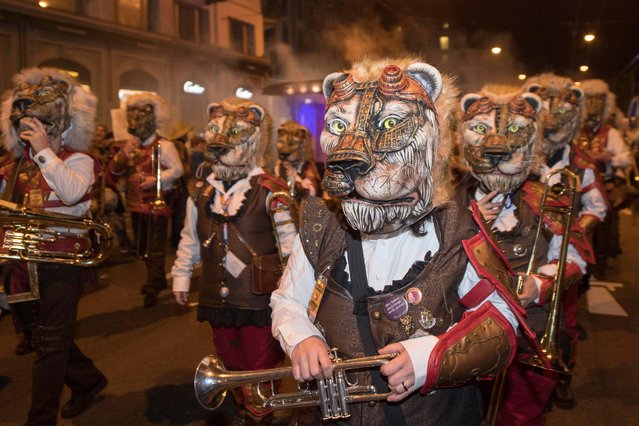
Masked Guggen music bands parade through the streets on the occasion of the beginning of the Fasnacht Carnival of Lucerne, Switzerland, early 23 February 2017. (Photo by Urs Flueeler/EPA)

Masked Guggen music bands parade through the streets on the occasion of the beginning of the Fasnacht Carnival of Lucerne, Switzerland, early 23 February 2017. (Photo by Urs Flueeler/EPA)
Details
25 Feb 2017 00:01:00
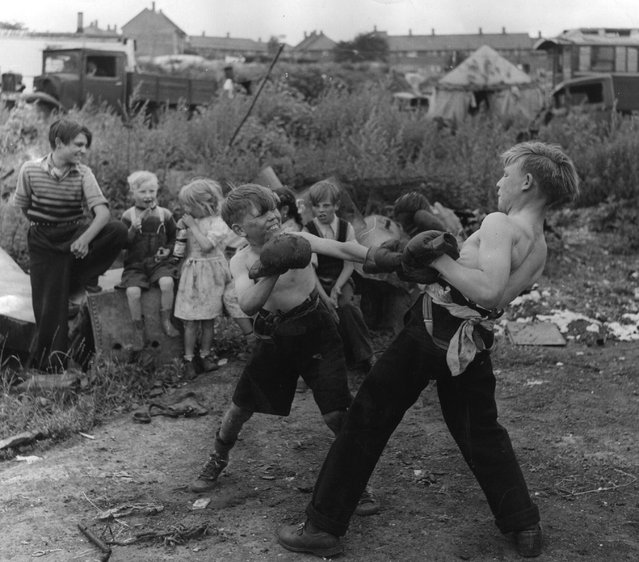
The unromantic gypsies. Children boxing in a gypsy camp in Kent, England on July 1, 1951. Like all boys these gypsy lads like to try their hand at boxing. Encouraged by their friends they fight it out on Corke's Meadow. Few Romanies now live a life of wandering romance. Most are like the three hundred squatters of Corke's Meadow, Kent, which is part of a “gypsy problem” that involves about 100,000 today. Of those about 25,000 can be rightly called gypsies, the rest are Mumpers and Posh-rats and Hobos. Corke's Meadow has both kinds. “Picture Post” cameraman Bert Hardy photographs the Corke's Meadow gypsies in their encampment. (Photo by Hulton-Deutsch Collection/Corbis via Getty Images)

The unromantic gypsies. Children boxing in a gypsy camp in Kent, England on July 1, 1951. Like all boys these gypsy lads like to try their hand at boxing. Encouraged by their friends they fight it out on Corke's Meadow. Few Romanies now live a life of wandering romance. Most are like the three hundred squatters of Corke's Meadow, Kent, which is part of a “gypsy problem” that involves about 100,000 today. Of those about 25,000 can be rightly called gypsies, the rest are Mumpers and Posh-rats and Hobos. Corke's Meadow has both kinds. “Picture Post” cameraman Bert Hardy photographs the Corke's Meadow gypsies in their encampment. (Photo by Hulton-Deutsch Collection/Corbis via Getty Images)
Details
12 Mar 2017 00:01:00
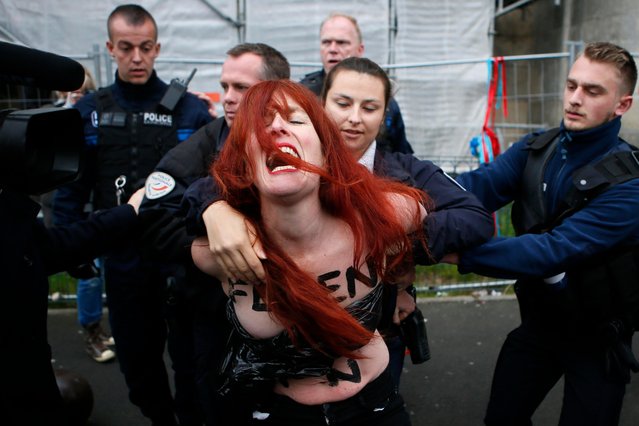
A Femen activist is led away by French police in Henin-beaumont, northern France, Sunday, May 7, 2017. Voters across France are choosing a new president in an unusually tense and important election that could decide Europe's future, making a stark choice between pro-business progressive candidate Emmanuel Macron and far-right populist Marine Le Pen. (Photo by Francois Mori/AP Photo)

A Femen activist is led away by French police in Henin-beaumont, northern France, Sunday, May 7, 2017. Voters across France are choosing a new president in an unusually tense and important election that could decide Europe's future, making a stark choice between pro-business progressive candidate Emmanuel Macron and far-right populist Marine Le Pen. (Photo by Francois Mori/AP Photo)
Details
07 May 2017 10:03:00
A group of colorful row houses are reflected on to the top of a black car parked on 3600 block of N street in  the Georgetown section of Washington DC, February 16, 2017. (Photo by John McDonnell/The Washington Post)

A group of colorful row houses are reflected on to the top of a black car parked on 3600 block of N street in the Georgetown section of Washington DC, February 16, 2017. (Photo by John McDonnell/The Washington Post)
Details
13 May 2017 09:28:00