Loading...
Done
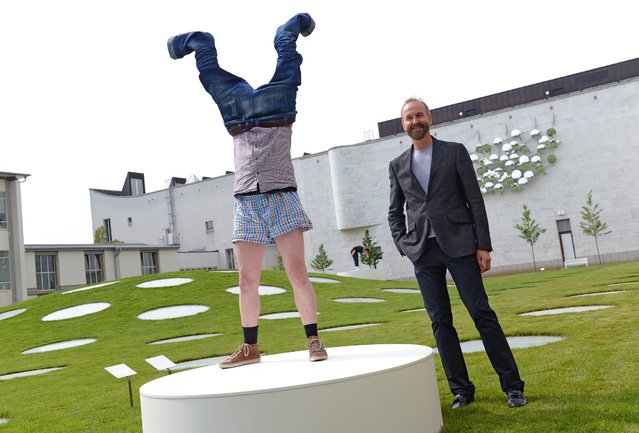
Austrian artist Erwin Wurm (R) stands next to an extra of his participation sculpture “Hose lueften, Haende hoch” (air out pants, hands high) at the garden of the Staedel Museum, in Frankfurt am Main, Germany, 06 May 2014. The series “Wurm: One Minute Sculptures” include painted or written instructions tell the person what they have to do and where for 60 seconds. The exhibition runs from 07 May to 13 July. (Photo by Arne Dedert/EPA)

Austrian artist Erwin Wurm (R) stands next to an extra of his participation sculpture “Hose lueften, Haende hoch” (air out pants, hands high) at the garden of the Staedel Museum, in Frankfurt am Main, Germany, 06 May 2014. The series “Wurm: One Minute Sculptures” include painted or written instructions tell the person what they have to do and where for 60 seconds. The exhibition runs from 07 May to 13 July. (Photo by Arne Dedert/EPA)
Details
08 May 2014 07:19:00
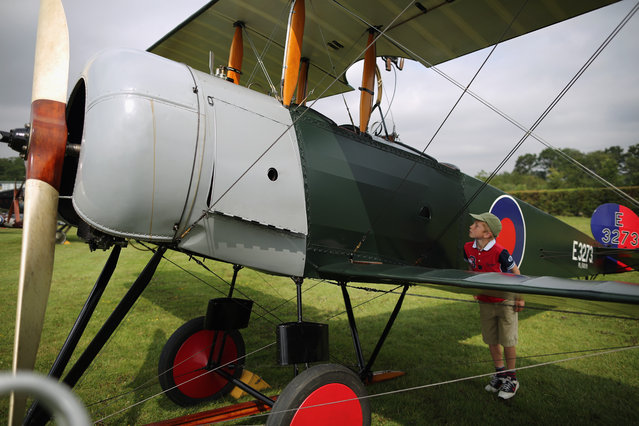
Aviation enthusiast Patrick Wilson 8, from Wetherby looks at  an Avro 504 k at “The Shuttlesworth Collection” at Old Warden on July 21, 2014 in Biggleswade, England. Of the 55,000 planes that were manufactured by the Royal Army Corps (RAC) during WWI, only around 20 remain in airworthy condition. (Photo by Dan Kitwood/Getty Images)

Aviation enthusiast Patrick Wilson 8, from Wetherby looks at an Avro 504 k at “The Shuttlesworth Collection” at Old Warden on July 21, 2014 in Biggleswade, England. Of the 55,000 planes that were manufactured by the Royal Army Corps (RAC) during WWI, only around 20 remain in airworthy condition. Six of these belong to The Shuttleworth Collection at Old Warden, Bedfordshire, making it the most complete collection of original airworthy WWI aircraft in the world. Amongst the collection is the SE5a. The SE5a is a single seater fighter aircraft. It is an original biplane designed by the Royal Aircraft Factory, with its engine built by Wolseley Motors Ltd, and it was issued to 84 Squadron in November 1918. The National Archive in Kew has recently verified that the plane saw action in France with 84 Squadron the day before Armistice, November 10, 1918. (Photo by Dan Kitwood/Getty Images)
Details
23 Jul 2014 10:00:00
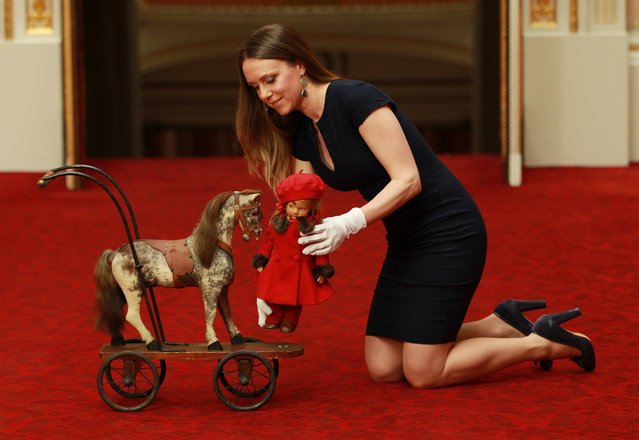
Curator Anna Reynolds with a doll called Pamela and a toy horse on wheels at the launch of the summer exhibition Royal Childhood at Buckingham Palace, London, which celebrates royal childhood with toys and family gifts belonging to the royal children when they were growing up, on April 2, 2014. (Photo by Sean Dempsey/PA Wire)

Curator Anna Reynolds with a doll called Pamela and a toy horse on wheels at the launch of the summer exhibition Royal Childhood at Buckingham Palace, London, which celebrates royal childhood with toys and family gifts belonging to the royal children when they were growing up, on April 2, 2014. (Photo by Sean Dempsey/PA Wire)
Details
03 Apr 2014 12:28:00
Angora rabbit Emilson sits next to its freshly shaved hair at Georgia Spausta's small farm in Herzogbirbaum, Austria March 10, 2015. (Photo by Heinz-Peter Bader/Reuters)

Angora rabbit Emilson sits next to its freshly shaved hair at Georgia Spausta's small farm in Herzogbirbaum, Austria March 10, 2015. Spausta produces hand-spun yarn from some 25 angora rabbits which is sold in small scale to enthusiasts or at local markets. The rabbits are clipped four times a year, each time giving some 300 grams of wool, about the amount needed to knit one pullover. (Photo by Heinz-Peter Bader/Reuters)
Details
26 Apr 2015 09:06:00
SoftBank's human-like robot named “Pepper” poses for pictures in its role as a PR manager of Tottori prefecture at the prefecture speciality store in Tokyo, Japan, July 1, 2015. Pepper will work at the store until July 2, as the first workplace venue for  its temporary staffing service. (Photo by Yuya Shino/Reuters)

SoftBank's human-like robot named “Pepper” poses for pictures in its role as a PR manager of Tottori prefecture at the prefecture speciality store in Tokyo, Japan, July 1, 2015. Pepper will work at the store until July 2, as the first workplace venue for its temporary staffing service. (Photo by Yuya Shino/Reuters)
Details
02 Jul 2015 13:53:00
A girl looks at other children practicing on a boxing ring during an exercise session at a boxing school, in the Mare favela of Rio de Janeiro, Brazil, June 2, 2016. (Photo by Nacho Doce/Reuters)

A girl looks at other children practicing on a boxing ring during an exercise session at a boxing school, in the Mare favela of Rio de Janeiro, Brazil, June 2, 2016. For many young residents the Luta Pela Paz (Fight For Peace) academy offers a glimpse of an alternative: a chance to build discipline and self-esteem through boxing and martial arts. (Photo by Nacho Doce/Reuters)
Details
19 Jun 2016 10:00:00
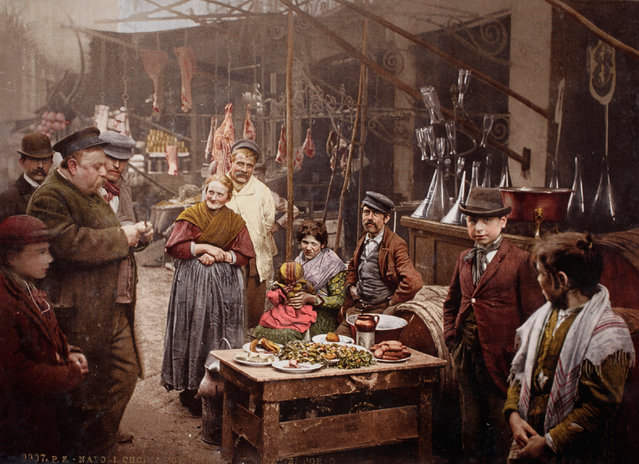
The finished photochromes were produced using at least six different tint stones, although many more were often used. Here: Street food in the Strada del Porto in Naples, Italy, 1899. (Photo by Swiss Camera Museum/The Guardian)

Photochromes are vibrant and nuanced prints hand-coloured from black-and-white negatives. Created using a process pioneered in the 1880s, these images offer a fascinating insight into the world when colour photography was still in its infancy. A Tour of the World in Photochromes is at the Swiss Camera Museum, Vevey, until 21 August. Here: Street food in the Strada del Porto in Naples, Italy, 1899. (Photo by Swiss Camera Museum/The Guardian)
Details
07 Jul 2016 10:56:00

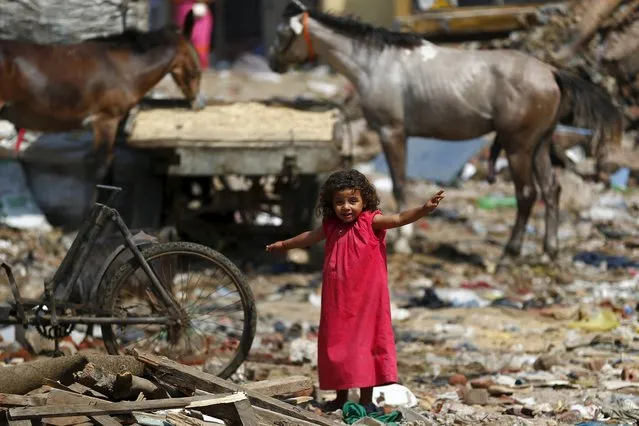
A girl plays in the Eshash el-Sudan slum in the Dokki neighbourhood of Giza, south of Cairo, Egypt September 2, 2015. (Photo by Amr Abdallah Dalsh/Reuters)

A girl plays in the Eshash el-Sudan slum in the Dokki neighbourhood of Giza, south of Cairo, Egypt September 2, 2015. Residents of the slum clashed with police in late August, when about 50 ramshackle huts were destroyed and at least 20 people were injured by teargas, local media reported, as authorities attempt to clear the area and rehouse residents. The slum dwellers, some of whom have called Eshash el-Sudan home for 50 years, say there are not enough apartments built nearby to house them. The residents of the slum eke out a living by disposing of rubbish or baking bread. Schooling is too expensive for most of their children, who play with salvaged rubbish amid shacks made out of discarded wood and leather. (Photo by Amr Abdallah Dalsh/Reuters)
Details
11 Sep 2015 12:47:00