Loading...
Done
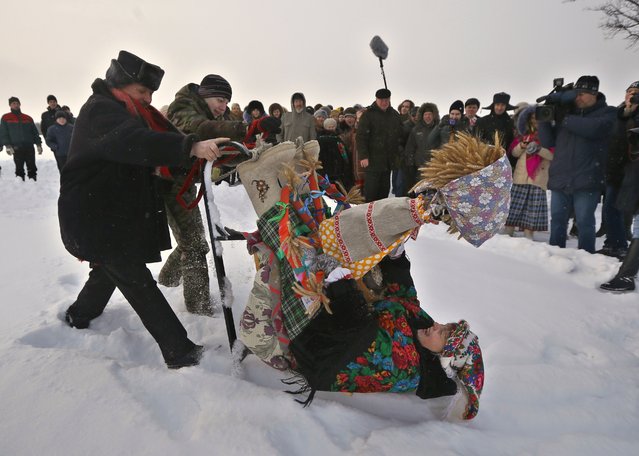
Belarusians wearing national costumes celebrate a Pull the Kolyada Up the Oak rite in the village of Martsiyanauka, some 77 km (48 miles) east of capital Minsk, Belarus, Thursday, January 21, 2016. (Photo by Sergei Grits/AP Photo)

Belarusians wearing national costumes celebrate a Pull the Kolyada Up the Oak rite in the village of Martsiyanauka, some 77 km (48 miles) east of capital Minsk, Belarus, Thursday, January 21, 2016. The merry ancient rite Pull the Kolyada Up the Oak marks the end of Orthodox Christmas celebrations in Belarus. On Jan. 21 a wheel, the so-called Kolyada, would be pulled up an oak or any old tree. The Belarusians believed that the ritual heralds a good harvest, luck and happiness for the entire year. (Photo by Sergei Grits/AP Photo)
Details
22 Jan 2016 10:13:00
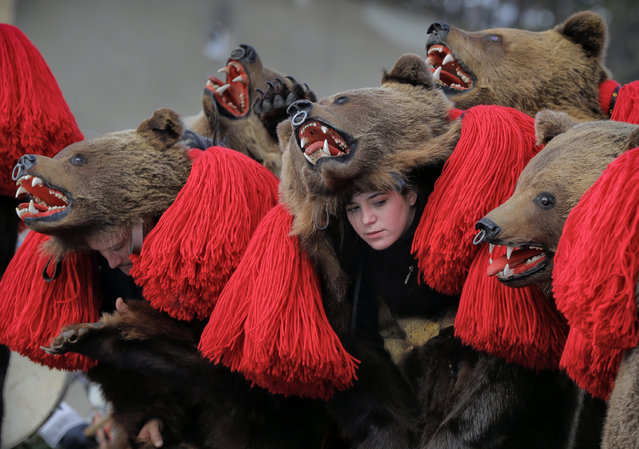
People wearing bear fur costumes dance during the annual bear ritual gathering in Comanesti, Romania, Friday, December 30, 2016. In pre-Christian rural traditions, dancers wearing colored costumes or animal furs, toured from house to house in villages singing and dancing to ward off evil, in the present the tradition has moved to Romania's cities too, where dancers travel to perform the ritual for money. (Photo by Vadim Ghirda/AP Photo)

People wearing bear fur costumes dance during the annual bear ritual gathering in Comanesti, Romania, Friday, December 30, 2016. In pre-Christian rural traditions, dancers wearing colored costumes or animal furs, toured from house to house in villages singing and dancing to ward off evil, in the present the tradition has moved to Romania's cities too, where dancers travel to perform the ritual for money. (Photo by Vadim Ghirda/AP Photo)
Details
31 Dec 2016 09:51:00
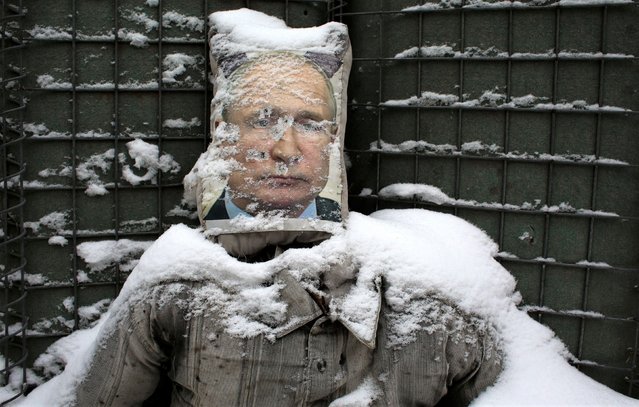
A poster of Russian President Vladimir Putin  is used as target practice along a trench on the frontline with Russia-backed separatists near Zolote village, in the Lugansk region, on January 21, 2022. Ukraine's Foreign Minister Dmytro Kuleba on January 22, 2022, slammed Germany for its refusal to supply weapons to Kyiv, urging Berlin to stop “undermining unity“ and “encouraging Vladimir Putin” amid fears of a Russian invasion. (Photo by Anatolii Stepanov/AFP Photo)

A poster of Russian President Vladimir Putin is used as target practice along a trench on the frontline with Russia-backed separatists near Zolote village, in the Lugansk region, on January 21, 2022. Ukraine's Foreign Minister Dmytro Kuleba on January 22, 2022, slammed Germany for its refusal to supply weapons to Kyiv, urging Berlin to stop “undermining unity“ and “encouraging Vladimir Putin” amid fears of a Russian invasion. (Photo by Anatolii Stepanov/AFP Photo)
Details
01 Feb 2022 07:16:00
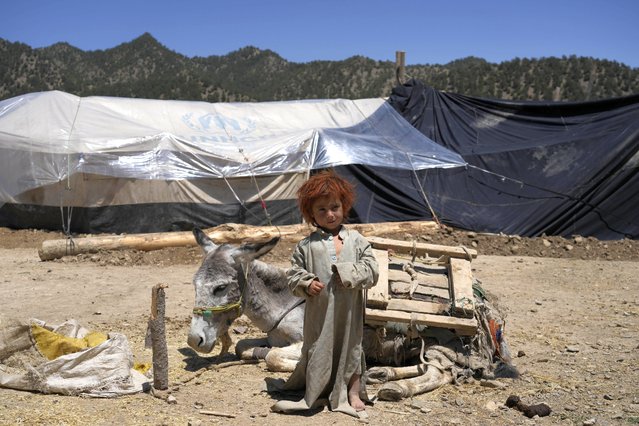
Afghan child stands in front of a makeshift shelter after an earthquake in Gayan village, in Paktika province, Afghanistan, Friday June 24, 2022. A powerful earthquake struck a rugged, mountainous region of eastern Afghanistan early Wednesday, flattening stone and mud-brick homes in the country's deadliest quake in two decades, the state-run news agency reported. (Photo by Ebrahim Nooroozi/AP Photo)

Afghan child stands in front of a makeshift shelter after an earthquake in Gayan village, in Paktika province, Afghanistan, Friday June 24, 2022. A powerful earthquake struck a rugged, mountainous region of eastern Afghanistan early Wednesday, flattening stone and mud-brick homes in the country's deadliest quake in two decades, the state-run news agency reported. (Photo by Ebrahim Nooroozi/AP Photo)
Details
22 Jul 2022 04:21:00
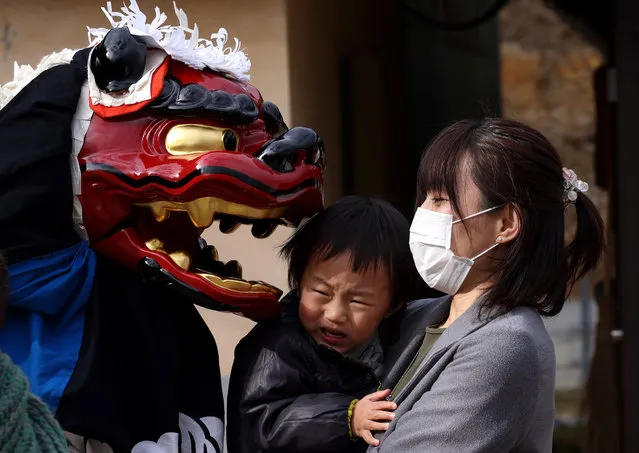
A performer wearing a lion mask performs the Ise Daikagura lion dance at the remote village of Yamanawa on February 08, 2021 in Ryuo, Japan. Ise Daikagura is a group of traditional Lion Dance performers who pray in front of farmers houses and businesses for good grain harvests and disease-free lives. Performers play sacred music using drums and flutes with two lion mask dancers. A lion mask is considered a symbol of God, who enters the house and performs in front of the Shinto God, a statue placed inside the house, mostly in the kitchen. These prayers are called “Kamodo Barai”. After the prayers, they are gifted with money, rice, sake and Japanese sweets from the householders. A group can travel for more than one hundred days to thousands of households and businesses throughout rural-villages in western Japan, and pray to those who are unable to visit the country’s most sacred shrine, the Grand Ise Shrine in Mie Prefecture. The group started its performance in the Edo era between 1603 to 1868 according to Japanese history. The Japanese government designated it as an important folk cultural national property in 1981. (Photo by Buddhika Weerasinghe/Getty Images)

A performer wearing a lion mask performs the Ise Daikagura lion dance at the remote village of Yamanawa on February 08, 2021 in Ryuo, Japan. Ise Daikagura is a group of traditional Lion Dance performers who pray in front of farmers houses and businesses for good grain harvests and disease-free lives. (Photo by Buddhika Weerasinghe/Getty Images)
Details
18 Feb 2021 09:27:00


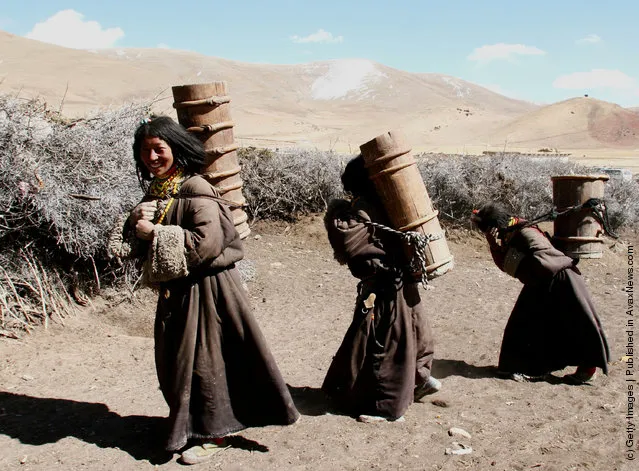
Kangba women carry barrels to fetch water at a village on April 10, 2005 in Zuogong County of Tibet, China. Kangba people began to fetch water with the traditional barrels hundreds of years ago. Kangba people are one of the Tibetan tribes living in Kangba Region, a juncture area of Sichuan and Yunnan Provinces and the Tibet Autonomous Region. Kangba people are famous for their beauty, toughness and straightforwardness. (Photo by China Photos/Getty Images)
Details
31 Mar 2011 10:31:00
Free Xiangnong Primary School At Ganzi Tibetan

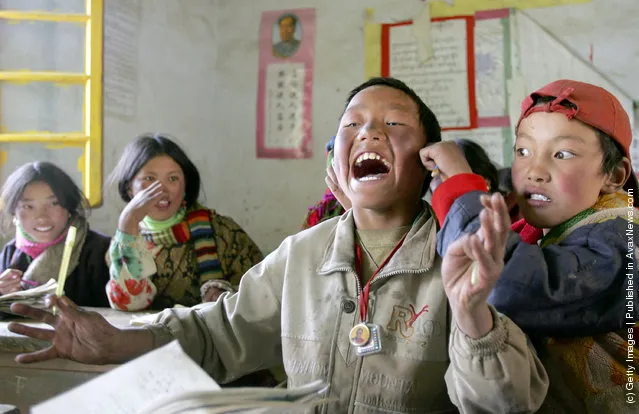
Tibetan students play at a class break at the Xiangnong primary school on April 15, 2005 in Kangding County of Ganzi Tibetan Autonomous Prefecture, Sichuan Province, southwest China. There is only one teahcer in the Tagong Village, 12 Tibetan students get free education from him in Xiangnong primary school. (Photo by China Photos/Getty Images)
Details
27 Aug 2011 14:40:00
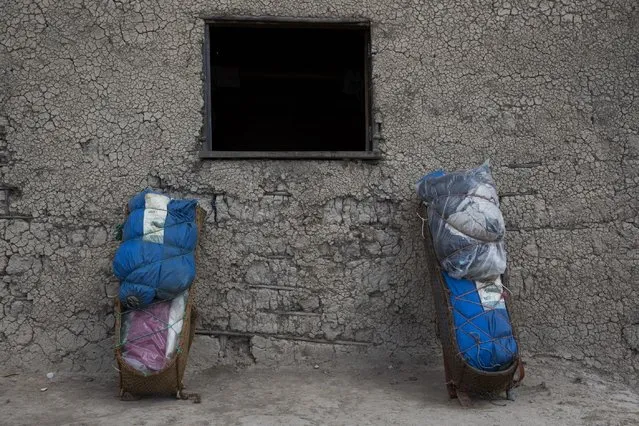
Indigenous woven backpacks called guayare are seen in front of a house in Paraitepui village, before a walking excursion to Mount Roraima, near Venezuela's border with Brazil January 13, 2015. A mysterious table-topped mountain on the Venezuela-Brazil border that perplexed 19th century explorers and inspired “The Lost World” novel is attracting ever more modern-day adventurers. (Photo by Carlos Garcia Rawlins/Reuters)

Indigenous woven backpacks called guayare are seen in front of a house in Paraitepui village, before a walking excursion to Mount Roraima, near Venezuela's border with Brazil January 13, 2015. A mysterious table-topped mountain on the Venezuela-Brazil border that perplexed 19th century explorers and inspired “The Lost World” novel is attracting ever more modern-day adventurers. (Photo by Carlos Garcia Rawlins/Reuters)
Details
04 Feb 2015 12:09:00