Loading...
Done
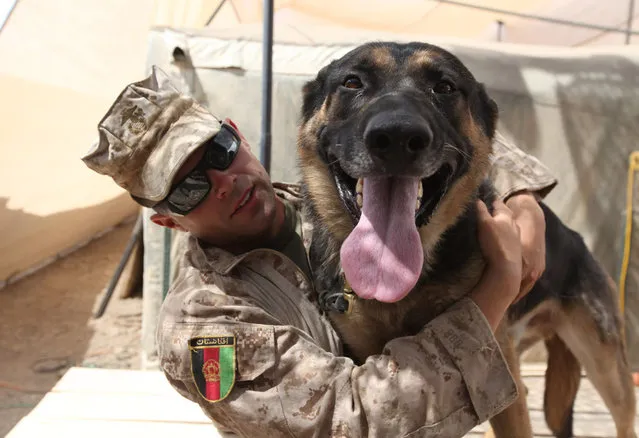
Afghanistan: Dogs of War Part 1

Throughout the course of the long war in Afghanistan, Coalition troops have relied on thousands of military working dogs to help keep them safe, and make their jobs easier. The dogs are trained to detect explosives, to find illegal drugs, to search for missing comrades, or target enemy combatants. Not only are they active on the front lines, but behind the lines they serve as therapy dogs, service dogs, and loyal companions. They also share the same risks as the ground troops, suffering injuries and sometimes death on the battlefields. Gathered here are images of these dogs and their handlers in Afghanistan and back home, from over the past several years, part of the ongoing series here on Afghanistan.
Details
03 Jun 2014 21:02:00


Director Lars Von Trier attends the “Melancholia” photocall at the Palais des Festivals during the 64th Cannes Film Festival on May 18, 2011 in Cannes, France. (Photo by Pascal Le Segretain/Getty Images)
Details
23 May 2011 09:52:00
Hurricane Irene

A local resident of Red Hook, Betty Walsh, crosses a flooded street in Red Hook August 28, 2011 in the Brooklyn borough of New York City. While Hurricane Irene has been downgraded to a tropical storm, it has knocked out power to more than 3 million people and is attributed to 15 deaths as it travels up the Eastern seaboard. (Photo by Robert Nickelsberg/Getty Images)
Details
30 Aug 2011 13:20:00
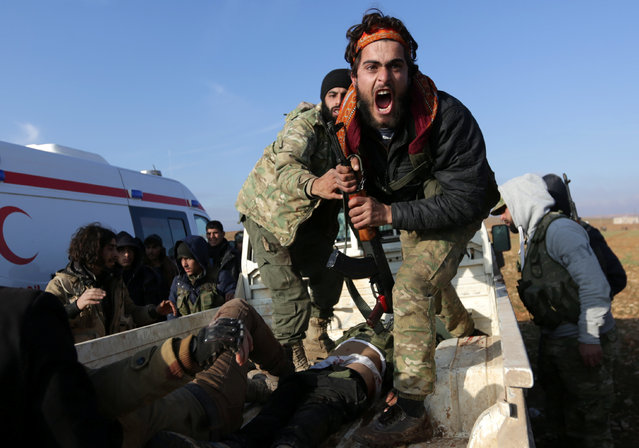
A Free Syrian Army (FSA) fighter reacts as he mourns near the body of his brother, who was an FSA fighter and died during an offensive against Islamic State fighters to take control of Qabasin town, on the outskirts of the northern Syrian town of al-Bab, Syria January 10, 2017. (Photo by Khalil Ashawi/Reuters)

A Free Syrian Army (FSA) fighter reacts as he mourns near the body of his brother, who was an FSA fighter and died during an offensive against Islamic State fighters to take control of Qabasin town, on the outskirts of the northern Syrian town of al-Bab, Syria January 10, 2017. (Photo by Khalil Ashawi/Reuters)
Details
11 Jan 2017 14:24:00
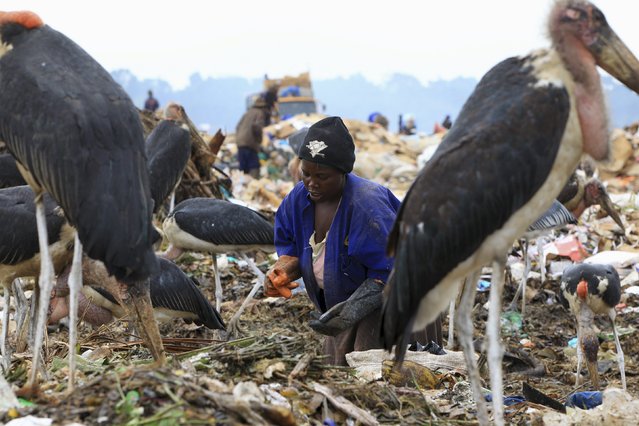
A woman whose livelihood depends on selling recyclable wastes collects trash from a dumping site while surrounded by Marabou storks on the outskirts of Uganda's capital Kampala March 31, 2015. (Photo by James Akena/Reuters)

A woman whose livelihood depends on selling recyclable wastes collects trash from a dumping site while surrounded by Marabou storks on the outskirts of Uganda's capital Kampala March 31, 2015. (Photo by James Akena/Reuters)
Details
04 Apr 2015 10:41:00
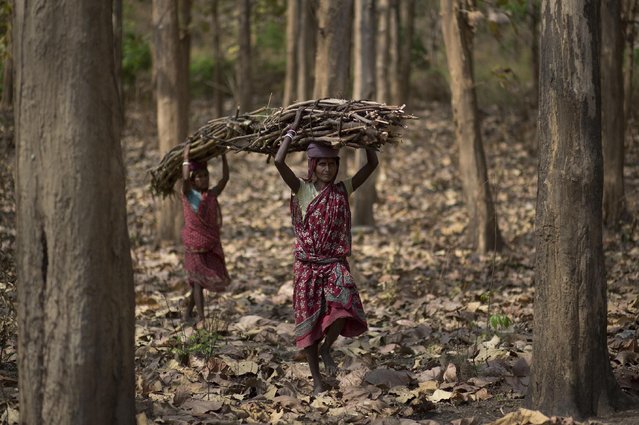
In this Tuesday, March 31, 2015 photo, Indian women walk carrying firewood they collected from a forest at Gobhali village on the outskirts of Gauhati, India. Every evening, hundreds of millions of Indian women hover over crude stoves making dinner for their families. They feed the flames with polluting fuels like kerosene or cow dung, and breathe the acrid smoke wafting from the fires. (Photo by Anupam Nath/AP Photo)

In this Tuesday, March 31, 2015 photo, Indian women walk carrying firewood they collected from a forest at Gobhali village on the outskirts of Gauhati, India. Every evening, hundreds of millions of Indian women hover over crude stoves making dinner for their families. They feed the flames with polluting fuels like kerosene or cow dung, and breathe the acrid smoke wafting from the fires. (Photo by Anupam Nath/AP Photo)
Details
16 Apr 2015 12:29:00
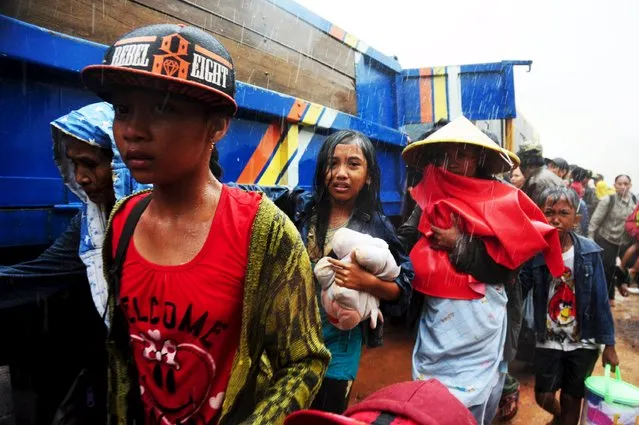
Members of the Gafatar sect walk in the rain as they evacuate their compound, which was later burned down by local villagers, in Antibar village, Mempawah Regency, Indonesia West Kalimantan Province, January 19, 2016 in this photo taken by Antara Foto. Local authorities and police moved the sect members to an army barracks located some 70 km (43 miles) away from Antibar for their safety following recent disputes between the sect and the villagers, Antara said on Tuesday. (Photo by Jessica Helena Wuysang/Reuters/Antara Foto)

Members of the Gafatar sect walk in the rain as they evacuate their compound, which was later burned down by local villagers, in Antibar village, Mempawah Regency, Indonesia West Kalimantan Province, January 19, 2016 in this photo taken by Antara Foto. Local authorities and police moved the sect members to an army barracks located some 70 km (43 miles) away from Antibar for their safety following recent disputes between the sect and the villagers, Antara said on Tuesday. (Photo by Jessica Helena Wuysang/Reuters/Antara Foto)
Details
20 Jan 2016 13:24:00
Emilia Pechinkova, a 24-years-old Bulgarian Pomak (Bulgarian speaking Muslims) bride poses for a photograph following the “gelina” or face painting ceremony carried out by female guests and relatives in preparation for her three-day wedding ceremony in the village of Draginovo, 100 kms southeast of Sofia on April 22, 2016. Bulgaria's Muslim population is one of the highest in the European Union. (Photo by Nikolay Doychinov/AFP Photo)

Emilia Pechinkova, a 24-years-old Bulgarian Pomak (Bulgarian speaking Muslims) bride poses for a photograph following the “gelina” or face painting ceremony carried out by female guests and relatives in preparation for her three-day wedding ceremony in the village of Draginovo, 100 kms southeast of Sofia on April 22, 2016. Bulgaria's Muslim population is one of the highest in the European Union. During the Communist regime religious rituals were not tolerated, and Muslims were forced to abandon wearing their traditional wedding outfits. Recently, more young Pomak women want to include traditional wedding customs that were forbidden during the regime, regardless of their secular lifestyles and the high cost of such a wedding. (Photo by Nikolay Doychinov/AFP Photo)
Details
25 Apr 2016 09:55:00