Melanie Chisholm, Emma Bunton, Melanie Brown and Geri Horner of the Spice Girls in concert at Wembley Stadium in London on Sunday, June 16, 2019. (Photo by Andrew Timms/PA Wire)
Traffic enforcer Ramiro Hinojas, 51, wears a Santa Claus costume while directing motorists through traffic at an intersection in Pasay City, Metro Manila, Philippines on November 28, 2017. (Photo by Romeo Ranoco/Reuters)
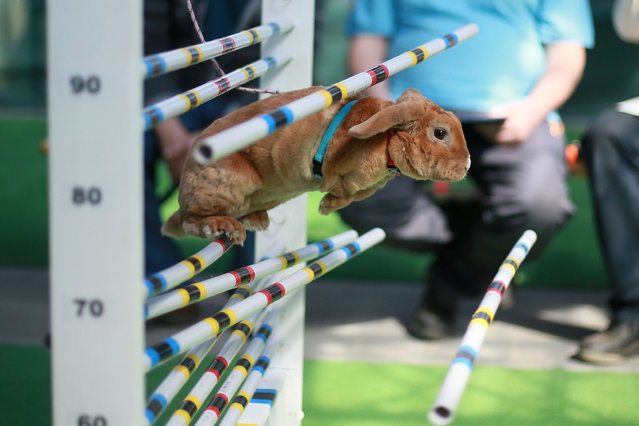
A rabbit fails to jump over an obstacle during a rabbit track and field competition on the sidelines of a hunting exhibition in Kromeriz, about 60 km east of Prague, on April 1, 2017. Circa 100 rabbits took part in the competition, including disciplines as long jump, high jump and running on a flat track. (Photo by Radek Mica/AFP Photo)
Emma Raducanu of the United Kingdom looks on during a women's singles match against Anna Kalinskaya on day 6 of the Mubadala Citi DC Open 2025 at William H.G. FitzGerald Tennis Center on July 26, 2025 in Washington, DC. (Photo by Scott Taetsch/Getty Images)
Invasion (laser girls) 2017. “I’m always thinking about my art practice, so any experience I have may spike a visual when I have an idea in mind. An example is that, when I was thinking about the Invasion series, I was inspired by Alfred Hitchcock’s movie The Birds (1963). I love Hitchcock’s other movies and have been contemplating a series based on Rear Window (1954). I also find inspiration outside the cinema in music clips and magazines”. (Photo by Michael Cook/Perimeter Books)
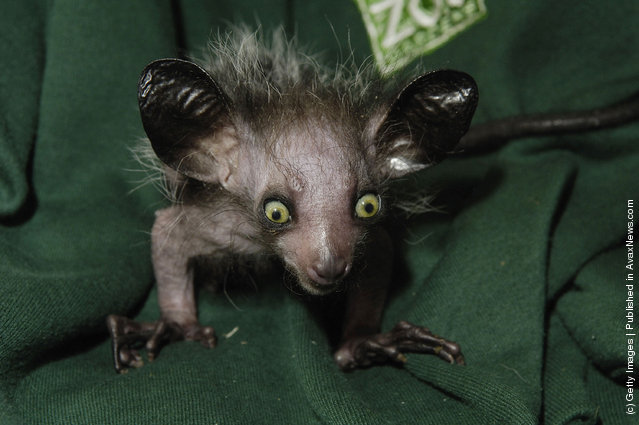
“The aye-aye (Daubentonia madagascariensis) is a lemur, a strepsirrhine primate native to Madagascar that combines rodent-like teeth and a special thin middle finger to fill the same ecological niche as a woodpecker. It is the world's largest nocturnal primate, and is characterized by its unusual method of finding food; it taps on trees to find grubs, then gnaws holes in the wood and inserts its narrow middle finger to pull the grubs out. The only other animal species known to find food in this way is the striped possum. From an ecological point of view the aye-aye fills the niche of a woodpecker as it is capable of penetrating wood to extract the invertebrates within”. – Wikipedia
Photo: In this handout image from Bristol Zoo is seen the first captive bred aye-aye in the UK named “Kintana” (meaning star in Malagasy) April 15, 2005 at Bristol Zoo Gardens, England. The zoo announced today only the second baby aye-aye to be hand-reared in the world (the first was in Jersey Zoo) and has now made his first public appearance since his birth on 11 February 2005. (Photo by Rob Cousins/Bristol Zoo via Getty Images)
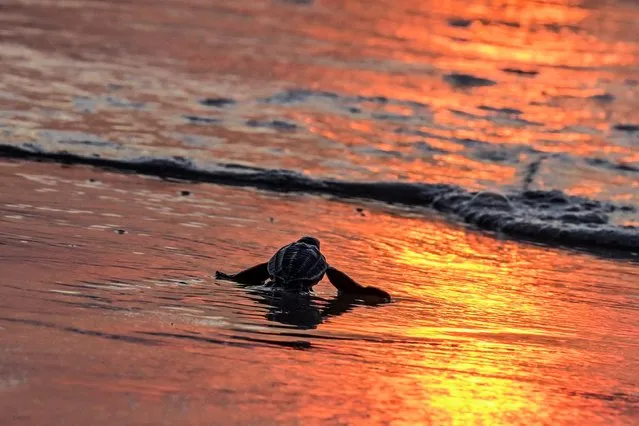
An Olive Ridley sea turtle hatchling releases into the sea at Lhoknga beach, Indonesia's Aceh province on January 16, 2024. (Photo by Chaideer Mahyuddin/AFP Photo)