Loading...
Done
A woman receives a traditional cleansing in the church of San Simon in Iztapa, Chimaltenango, Guatemala, October 28, 2015. (Photo by Jorge Dan Lopez/Reuters)

A woman receives a traditional cleansing in the church of San Simon in Iztapa, Chimaltenango, Guatemala, October 28, 2015. People in Guatemala revere San Simon, also known by his Mayan name Maximon o Ry Laj Man, on October 28 annually. For some devotees, San Simon is synonymous with prosperity and happiness, while others associate him with witchcraft, paganism and a protector for drunkards. Since the 19th century, devotees have offered money, liquor or tobacco in exchange for his blessings. (Photo by Jorge Dan Lopez/Reuters)
Details
01 Nov 2015 08:03:00
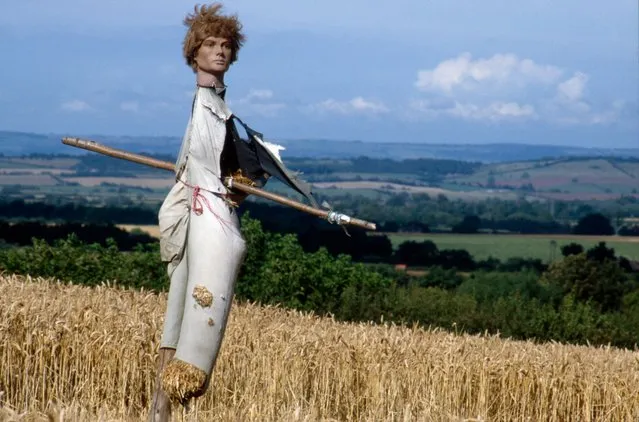
“The ripening crops eloquently signify that the scarecrow’s work is done. Few remain to see their task fulfilled because if they become entangled in the harvesting machinery it causes serious damage”. (Photo by Colin Garratt)

When Colin Garratt went to photograph the traditional sentinels of the British countryside, he found they ranged from the dapper to the downright sinister. “They are not from the anaesthetised world of the craft fair”, says Colin Garratt, “but are the direct descendants of the ancient spectres which have haunted the landscape for centuries”. The Scarecrow Exhibition is at Geddes Gallery, London, from 25 to 30 March. (Photo by Colin Garratt)
Details
29 Mar 2016 11:46:00
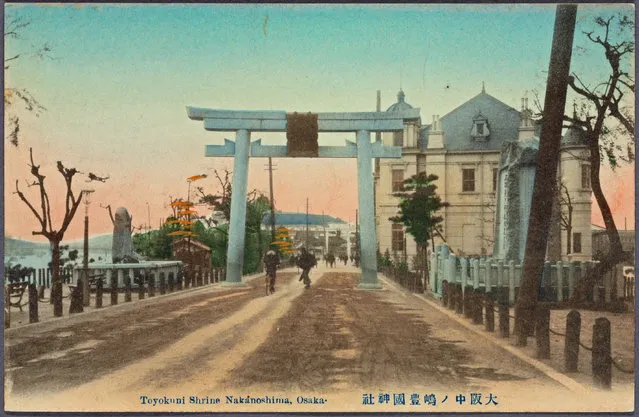
Toyokuni Shrine Nakanoshima, Osaka, Japan. (Photo by New York Public Library/Caters News)

These timeless postcards offer an eye-opening glimpse into life in Japan in the early 20th century. Taken from hand-colored photographs, the postcards showcase the still beauty of the country, depicting a nation on the cusp of modernization. The images feature solemn fishermen, bustling streets, temples and shrines: a country yet to be influenced by Western culture. The tinting effect brings out the rich colors of the natural surroundings, with trees, flowers and cherry blossoms jumping from the original black-and-white images. Here: Toyokuni Shrine Nakanoshima, Osaka, Japan. (Photo by New York Public Library/Caters News)
Details
02 Apr 2016 09:33:00
Anti-Putin Protestors Clash With Police In Moscow

Russian riot policemen beat young PREGNANT female anti-Putin activist during a protest rally against the Presidential inauguration of Vladimir Putin on May 6, 2012 in Moscow, Russia.
Details
10 May 2012 08:57:00


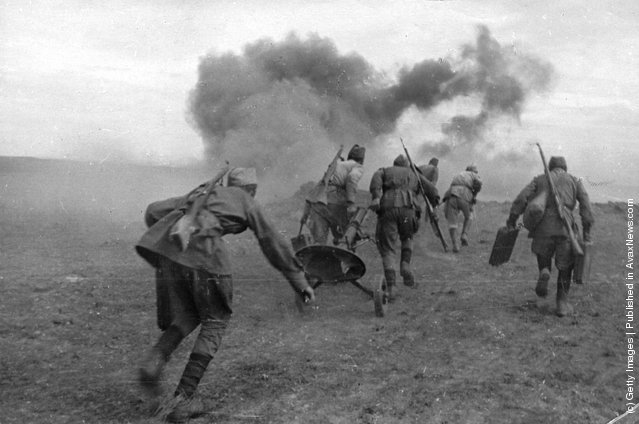
A Russian trenchmortar crew run to take up a new firing position in the Stalingrad area during the Great Patriotic War. (Photo by Keystone/Getty Images). October 1942
Details
25 May 2011 09:25:00
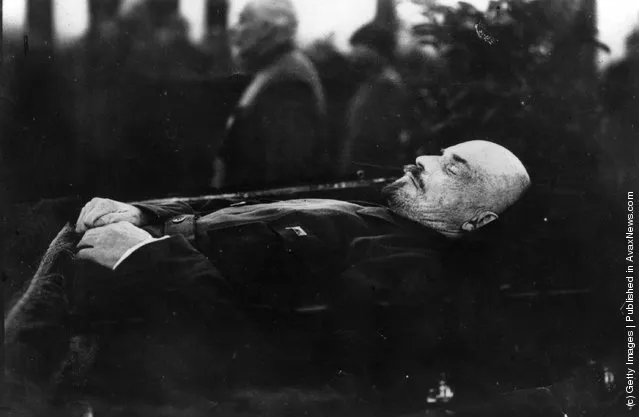
1924:  Vladimir Ilyich Lenin lying in state in the Kremlin

Photo: Vladimir Ilyich Lenin (1870 – 1924) lying in state in the Kremlin. (Photo by Hulton Archive/Getty Images). 1924

Important! For the same article in Russian language click here.

Something quite intriguing is happening within Russian-speaking internet during the last few – should you type a fully academic inquiry (at least, according to Russian academic requirements) in national search engines for "Lenin's mausoleum" – the first thing you get (even in top 10 searches) is website pages talking about black magic and occult. Website authors view this construction differently, but unconditionally agree on one thing: the mausoleum of the "leader of the world proletariat” – the essence of a magical artifact, a sort of “energy vampire”. It was built with a certain purpose: to drain the energy out of miserable Soviet citizens on one hand; and to poison the anthroposphere of one-sixth part of the earth with its vibes (the exact territory that was occupied by the former Soviet Union), depriving the Russian people of will to resist on the other hand. Complete nonsense? No doubt. Nevertheless, an intriguing one. Well, probably because some oddities do exist in mausoleum's history. These oddities are the thing we are going to discuss this time. First, let me refresh you memory on the subject.
Details
16 Oct 2011 11:27:00
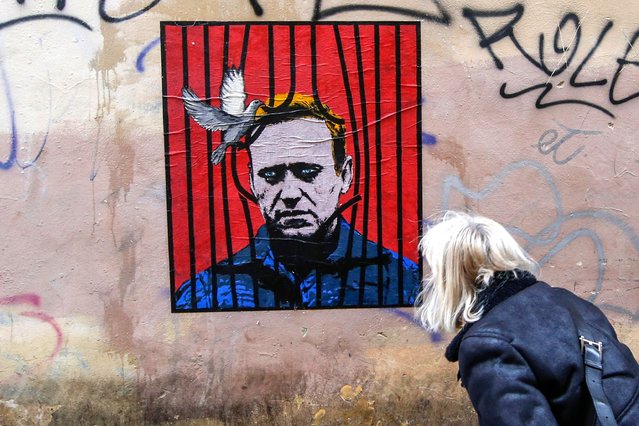
A view of a large poster depicting Russian opposition leader Alexei Navalny behind bars with a dove freeing him from detention, by an unidentified street artist known as Harry Greb, in downtown Rome, Italy, 25 January 2021. Navalny was detained after his arrival to Moscow from Germany on 17 January 2021. A Moscow judge on 18 January ruled that he will remain in custody for 30 days following his airport arrest. Navalny urged Russians to take to the streets to protest against President Putin's rule. (Photo by Fabio Frustaci/EPA/EFE)

A view of a large poster depicting Russian opposition leader Alexei Navalny behind bars with a dove freeing him from detention, by an unidentified street artist known as Harry Greb, in downtown Rome, Italy, 25 January 2021. Navalny was detained after his arrival to Moscow from Germany on 17 January 2021. A Moscow judge on 18 January ruled that he will remain in custody for 30 days following his airport arrest. Navalny urged Russians to take to the streets to protest against President Putin's rule. (Photo by Fabio Frustaci/EPA/EFE)
Details
11 Feb 2021 09:45:00
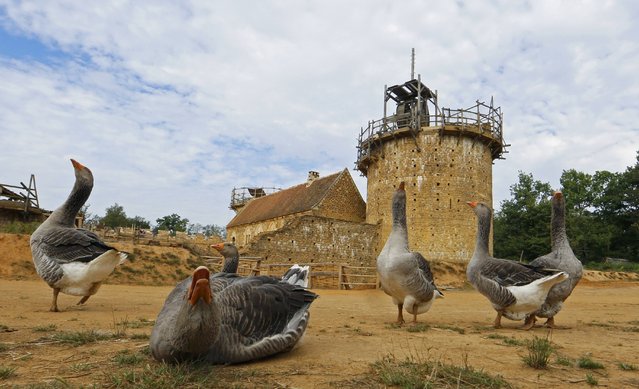
A view of the construction site of the Chateau de Guedelon near Treigny in the Burgundy region of France, September 13, 2016. Blacksmiths, stonemasons and quarry men are hard at work in a Burgundy forest building a 13th-century-style castle using the most basic tools and materials, replicating the methods used hundreds of years ago to better understand them. Forgoing all modern technology, workers use hammers to break stones and forge iron, operate wooden wheels to hoist their materials up to where they are needed, and rely on a quarry for stone, clay and sand as they build up a castle from scratch. Construction on Guedelon Castle in central France began in 1997 after an archaeological survey revealed a medieval fortress hidden inside the walls of nearby Chateau de Saint-Fargeau. Those behind the project hope to answer questions about medieval construction and provide lessons on sustainable building. (Photo by Jacky Naegelen/Reuters)

A view of the construction site of the Chateau de Guedelon near Treigny in the Burgundy region of France, September 13, 2016. Blacksmiths, stonemasons and quarry men are hard at work in a Burgundy forest building a 13th-century-style castle using the most basic tools and materials, replicating the methods used hundreds of years ago to better understand them. (Photo by Jacky Naegelen/Reuters)
Details
15 Sep 2016 09:43:00