Loading...
Done
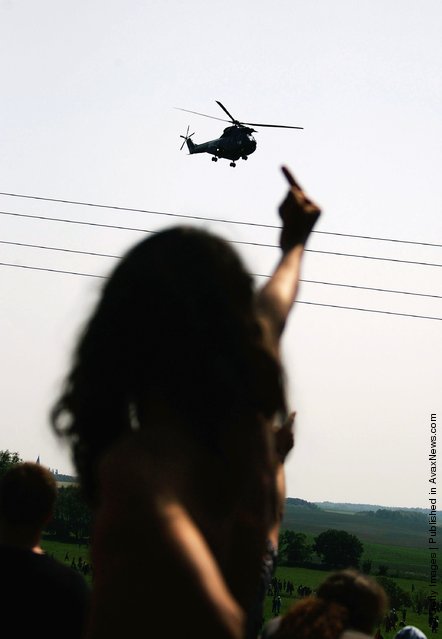
An activist of the anti-G8 forum 'Block G8' shows his middle finger to a police helicopter passing overhead

An activist of the anti-G8 forum “Block G8” shows his middle finger to a police helicopter passing overhead June 07, 2007 at Bollhagen, near Heiligendamm, Germany. (Photo by Carsten Koall/Getty Images)
Details
27 Dec 2011 15:40:00
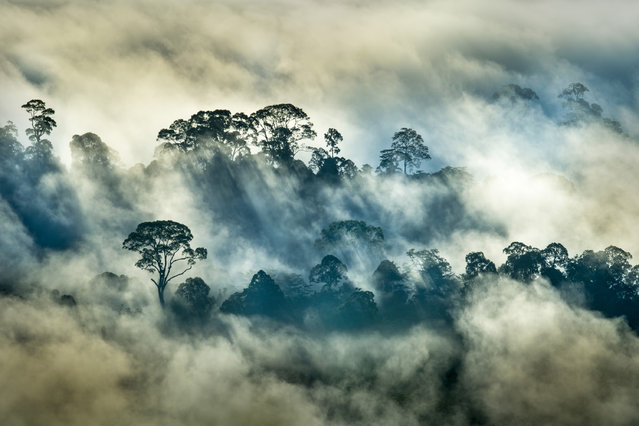
Landscapes, second place: Florian Smit, “Rainforest” (Danum valley, Borneo). (Photo by Florian Smit/2019 GDT Nature Photographer of the Year)

Run by the Society of German Nature Photographers (Gesellschaft Deutscher Tierfotografen), the prestigious annual contest celebrates the best wildlife photography from members in Germany. Here: Landscapes, second place: Florian Smit, “Rainforest” (Danum valley, Borneo). (Photo by Florian Smit/2019 GDT Nature Photographer of the Year)
Details
11 May 2019 00:03:00
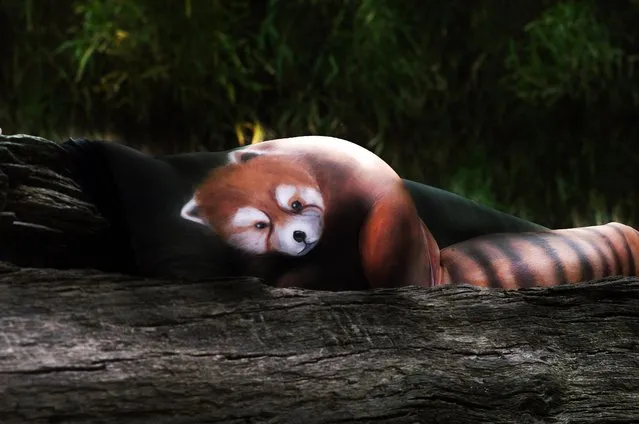
Using body paint and a woodland like location, Gesine appears to have created a model to look just like a red panda, Dortmund, Germany, October, 2016. An artist brings animals to life using body paint and contorted models. At first glance, these images could be mistaken for portraits of wildlife in their natural habitat were created with paper and paint. However, they are actually the incredible works of illusion by talented body painter Gesine Marwedel, who paints models to creates realistic animals. Marwedel, 29, from Dortmund, Germany has always been fascinated by the concept of transferring her designs to human bodies and her latest project features models posing in contorted positions. One image appears to show an elegant swan in a park pond, whilst another picture shows a mother penguin and its chick in a snowy landscape. (Photo by Gesine Marwedel/Barcroft Images)

Using body paint and a woodland like location, Gesine appears to have created a model to look just like a red panda, Dortmund, Germany, October, 2016. An artist brings animals to life using body paint and contorted models. At first glance, these images could be mistaken for portraits of wildlife in their natural habitat were created with paper and paint. However, they are actually the incredible works of illusion by talented body painter Gesine Marwedel, who paints models to creates realistic animals. (Photo by Gesine Marwedel/Barcroft Images)
Details
20 Dec 2016 12:53:00
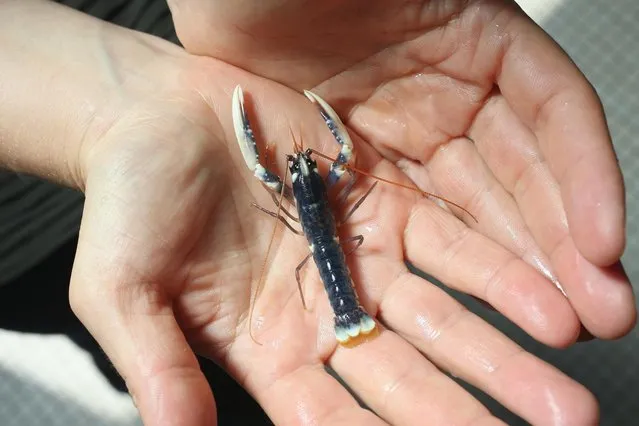
Isabel Schmalenbach, an environmental scientist with the Helgoland Biological Institute (Biologische Anstalt Helgoland), part of the Alfred Wegener Institute for Polar and Marine Research, holds a one-year old baby European lobster (Homarus gammarus) raised at the institute on August 3, 2013 on Helgoland Island, Germany. (Photo by Sean Gallup/Getty Images)

Isabel Schmalenbach, an environmental scientist with the Helgoland Biological Institute (Biologische Anstalt Helgoland), part of the Alfred Wegener Institute for Polar and Marine Research, holds a one-year old baby European lobster (Homarus gammarus) raised at the institute on August 3, 2013 on Helgoland Island, Germany. Later in the day Schmalenbach and her colleagues released a total of 415 one-year old lobsters into the North Sea as part of an effort to repopulate the lobster population around Helgoland (also called Heligoland). In the 19th century local fishermen caught up to 80,000 lobsters a year in the surrounding waters, combined with the heavy allied bombing of the island during and after World War II, as well as other environmental factors, decimated the lobster population. (Photo by Sean Gallup)
Details
05 Aug 2013 08:39:00
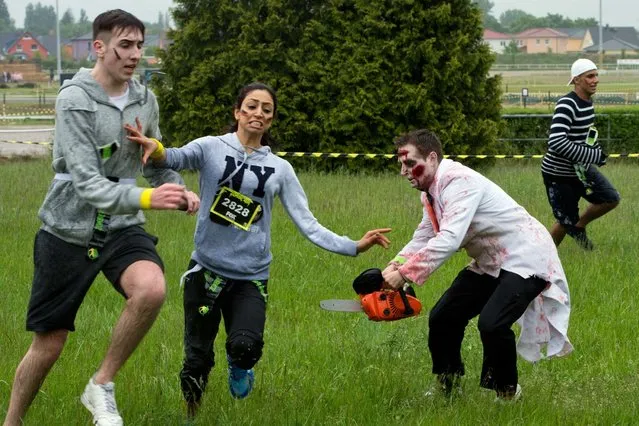
Participants costumed as zombies try to catch hobby runners during the so-called Zombie-Run at the harness racing track Karlshorst in Berlin, Germany, 18 May 2014. The runners carry small flags in their belts which they have to get safely across the finishing line while the zombies try to steal them. The sporting event is based on the US television series “The Walking Dead”. (Photo by Soeren Stache/DPA)

Participants costumed as zombies try to catch hobby runners during the so-called Zombie-Run at the harness racing track Karlshorst in Berlin, Germany, 18 May 2014. The runners carry small flags in their belts which they have to get safely across the finishing line while the zombies try to steal them. The sporting event is based on the US television series “The Walking Dead”. (Photo by Soeren Stache/DPA)
Details
24 May 2014 13:00:00
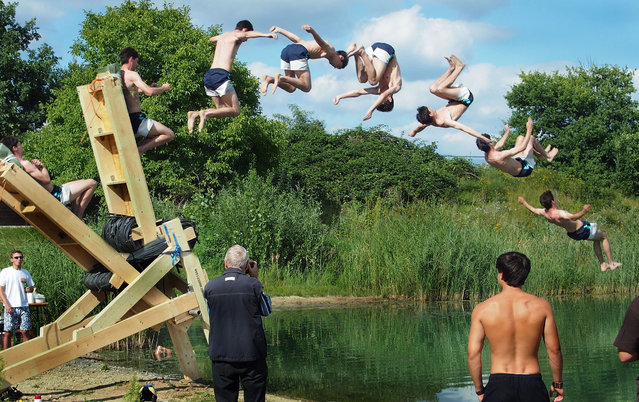
Two brothers have built a human catapult to fly into a lake. Johannes Schrieber, 26, and his brother Daniel, 28, from Frankfurt, Germany built the wooden contraption, which can fire people five metres into the sky and 12 metres away. The brothers raised more than £700 through crowdfunding to buy the materials, with every penny well spent as nobody has died yet! (Photo by Caters News)

Two brothers have built a human catapult to fly into a lake. Johannes Schrieber, 26, and his brother Daniel, 28, from Frankfurt, Germany built the wooden contraption, which can fire people five metres into the sky and 12 metres away. The brothers raised more than £700 through crowdfunding to buy the materials, with every penny well spent as nobody has died yet! (Photo by Caters News)
Details
31 Aug 2014 08:37:00
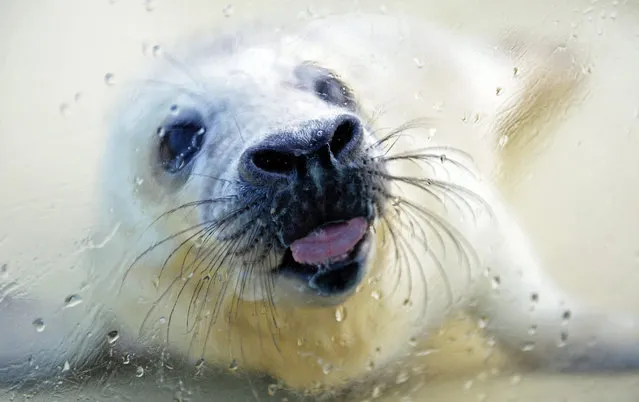
Grey seal pup “Nikolaus” licks a window at the seal enclosure in Friedrichskoog, Germany, 19 December 2014. The pup was abandoned by his mother and would not have a chance at survival without human help. Nikolaus will be fed at the enclosure for two to three months until he has reached the minimum weight of 45 kilograms for being released. (Photo by Daniel Reinhardt/EPA)

Grey seal pup “Nikolaus” licks a window at the seal enclosure in Friedrichskoog, Germany, 19 December 2014. The pup was abandoned by his mother and would not have a chance at survival without human help. Nikolaus will be fed at the enclosure for two to three months until he has reached the minimum weight of 45 kilograms for being released. (Photo by Daniel Reinhardt/EPA)
Details
20 Dec 2014 12:18:00


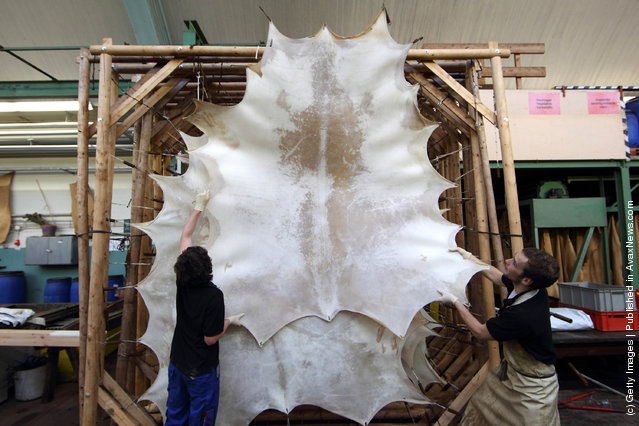
REUTLINGEN, GERMANY - NOVEMBER 17: Students hang out finished parchment leather at the LGR (Lederinstitut Gerberschule Reutlingen) tannery school on November 17, 2010 in Reutlingen, Germany. Even in early antiquity and up their hair or dried goat and sheep skins were used as material for documents. In the small Asian city Pergamon these skins were processed in large quantities for this purpose, so they formed the main trading arm of the city, of which the name is parchment is derived. In medieval times, reached the parchment is of great importance, it was such as France's production under the supervision of the University of Paris. Even now, important documents, placed on their unlimited shelf life as possible large value (eg diplomas, addresses, memory, writings, documents for primary and keystones) written on parchment...
Details
20 Nov 2011 18:17:00