Loading...
Done
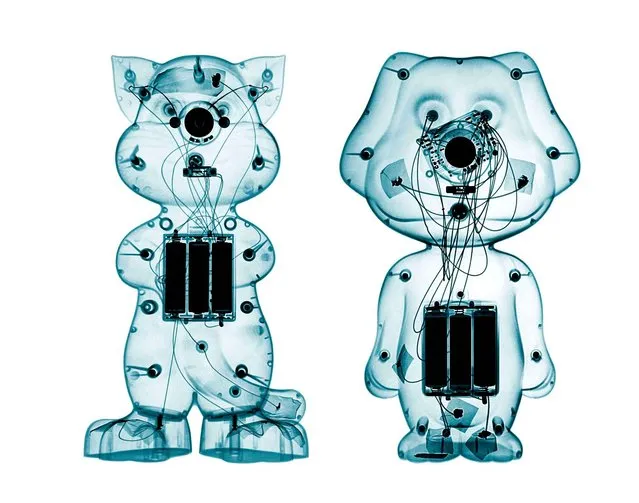
Australian photographer Brendan Fitzpatrick’s X-ray photographs expose the inner workings of toys. Fitzpatrick’s photographs are both whimsical and mechanical, evoking the curiosity of childhood and the desire to discover how things look and work from other perspectives. (Photo by Brendan Fitzpatrick)

Australian photographer Brendan Fitzpatrick’s X-ray photographs expose the inner workings of toys. Fitzpatrick’s photographs are both whimsical and mechanical, evoking the curiosity of childhood and the desire to discover how things look and work from other perspectives. The strategic placement of wires, batteries, and screws are revealed, the complexity of the inside contrasting with the seemingly simplistic design of the outside. Fitzpatrick uses chest X-ray and mammogram machines to photograph flowers, toys, and creatures, then enhances the color in the images in order to more effectively distinguish the various parts that have been exposed. This photographs are part of series he calls “Invisible Light”. (Photo by Brendan Fitzpatrick)
Details
08 Aug 2014 10:59:00
Art By Hepburn Wind

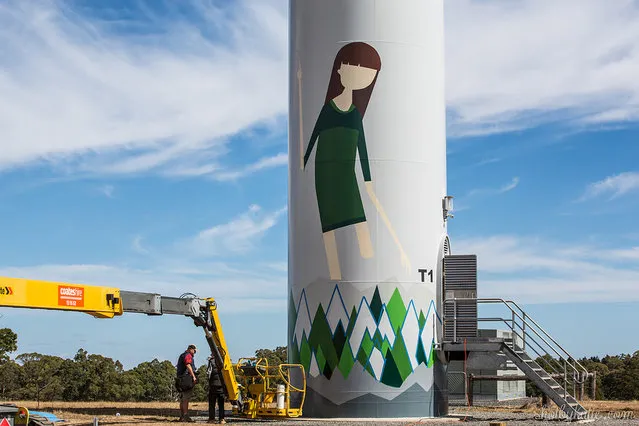
Sleep under the Stars, hosted by Hepburn Wind, has given us an opportunity to enrich our daily life with art. Thanks to this festival, a regular wind turbine was turned into a marvelous peace of art. The artwork is especially noticeable, since its theme greatly contrasts with the background behind the wind turbine. Moreover, the idea of drawing a woman-giantess walking over the mountain tops on a large conical object is quite extraordinary. Nevertheless, the grey and green colors of the picture were very well chosen for this particular image. You can only imagine the obstacles that the artists had to face when making a picture on such a large object. However, nowadays, people never cease to amaze with their ingenuity, leaving us gaping in awe at their creations.
Details
08 Jan 2015 14:41:00
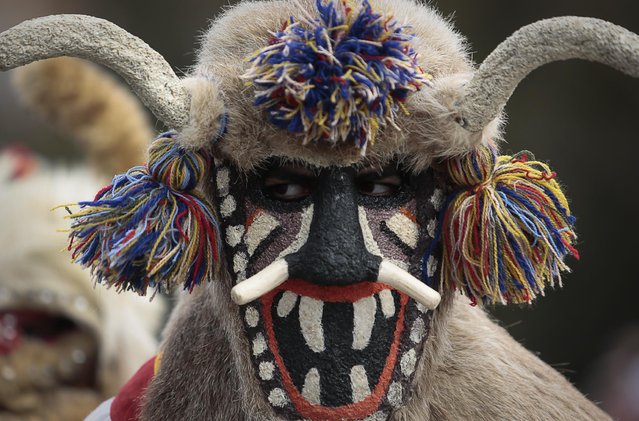
A masked Bulgarian dancer takes part in the second competition day of the 24th International Festival of Masquerade Games “Surva” in the town of Pernik, Bulgaria Saturday, January 31, 2015. (Photo by Valentina Petrova/AP Photo)

A masked Bulgarian dancer takes part in the second competition day of the 24th International Festival of Masquerade Games “Surva” in the town of Pernik, Bulgaria Saturday, January 31, 2015. Some 5,000 people are expected to take part in the three-day festival devoted to an ancient Bulgarian pagan rite. Surva is performed by costumed men, some in sheepskin, or other colorful garments, bells and masks, who walk around and dance to scare away the evil spirits, in hope to provide a good harvest, health, fertility, and happiness. (Photo by Valentina Petrova/AP Photo)
Details
01 Feb 2015 11:14:00
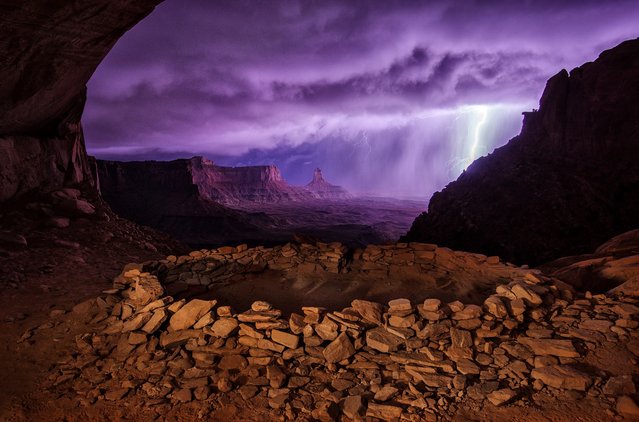
Second Place Winner: “Thunderstorm at False Kiva”. I hiked out to these ruins at night hoping to photograph them with the Milky Way, but instead a thunderstorm rolled through, creating this dramatic image. – Max Seigal. (Photo and caption by Max Seigal/National Geographic Traveler Photo Contest)

Second Place Winner: “Thunderstorm at False Kiva”. I hiked out to these ruins at night hoping to photograph them with the Milky Way, but instead a thunderstorm rolled through, creating this dramatic image. – Max Seigal. National Geographic Traveler Director of Photography Dan Westergren, one of this year's judges, shares his thoughts on the second place winner: “This photo combines two different scenes into one: the small kiva in a cliff dwelling and the grand vista of Canyonlands National Park across the valley. I really like the two different color palettes – warm inside and purple outside. This two-for-one scene was caused by the lightning storm outside the dwelling, which lit up the landscape like it was a huge electronic flash. Looking at this picture I can imagine what a wonderful sight it must have been for the ancient people who lived here. It doesn't seem too amazing now in our modern world, but might have been mind-blowing for the prehistoric residents”. Location: Utah. (Photo and caption by Max Seigal/National Geographic Traveler Photo Contest)
Details
02 Aug 2013 06:16:00
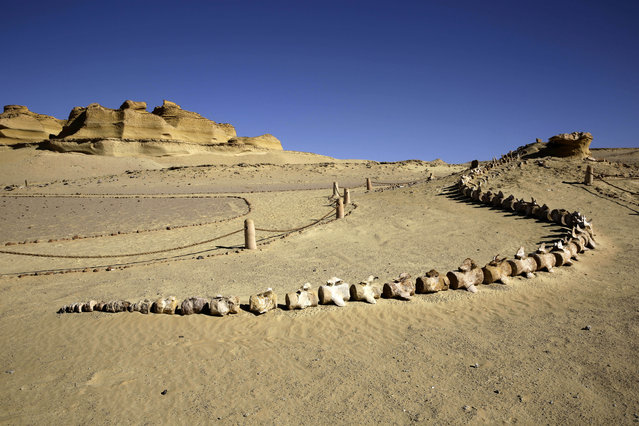
Fossilized whale bones are on display  outside the Wati El Hitan Fossils and Climate Change Museum, a UNESCO natural World Heritage site, on the opening day, in the Fayoum oasis, Egypt, Thursday, January 14, 2016. Egypt has cut the ribbon on the Middle East's first fossil museum housing the world's largest intact skeleton of a "walking whale" in an attempt to attract much-needed tourists driven off by recent militant attacks. The construction of the much-hyped Fossils and Climate Change Museum was covered a 2 billion euros (2. 17 billion dollars) grant from Italy, according to Italian Ambassador Maurizio Massari. (Photo by Thomas Hartwell/AP Photo)

Fossilized whale bones are on display outside the Wati El Hitan Fossils and Climate Change Museum, a UNESCO natural World Heritage site, on the opening day, in the Fayoum oasis, Egypt, Thursday, January 14, 2016. Egypt has cut the ribbon on the Middle East's first fossil museum housing the world's largest intact skeleton of a "walking whale" in an attempt to attract much-needed tourists driven off by recent militant attacks. The construction of the much-hyped Fossils and Climate Change Museum was covered a 2 billion euros (2. 17 billion dollars) grant from Italy, according to Italian Ambassador Maurizio Massari. Its centerpiece is an intact, 37-million-year-old and 20-meter-long skeleton of a legged form of whale that testifies to how modern-day whales evolved from land mammals. The sand-colored, dome-shaped museum is barely discernible in the breathtaking desert landscape that stretches all around. (Photo by Thomas Hartwell/AP Photo)
Details
16 Jan 2016 08:06:00
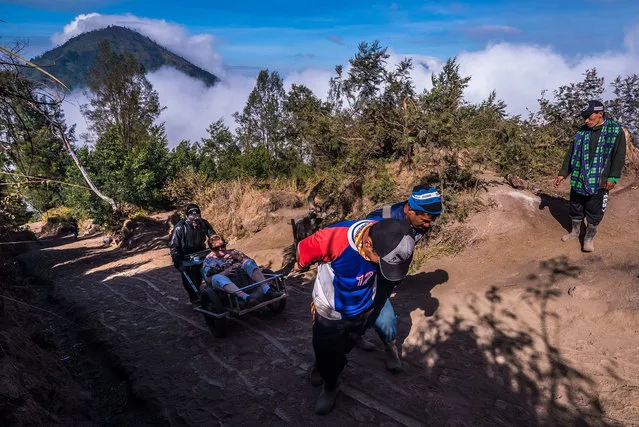
Miners pulling up lazy tourists to the rim of Kawah Ijen (Ijen Volcano), East Java, Indonesia on September 21, 2017. They will earn as much as they would bring down a load of sulfur. Nomadic Explorer, Cultural Lifestyle Photographer Claudio Sieber captured striking images of miners working at Ijen volcanic range in East Java, Indonesia. The sulphur miners risk their lives daily as they climb the active volcano carrying heavy loads, which they sell to sugar refineries. Shortly after midnight curious tourists are flocking in hundreds through the gate of Ijen's foothills to be right on time, driven by the images others took before them. Kawah Ijen is the one of the world's largest acidic volcanic crater lake; famous for its turquoise color as well as the unreal atmosphere it offers during darkness. A dusty path zigzags 3 kilometers up to the crater rim. This doesn't mean anything challenging; in particular, special sights have to be deserved anyway. The irritating smell of sulfur announces the near of the crater's existence. Arriving on the crater's rim the reward for the torture becomes visible. Blue fire darts its tongues through the fumes of sulfur dioxide. Somehow, the spectacle isn't as romantic as expected, since it is also the rough working space of approx. 150 sulfur miners who start their shift at 1 am. Lately, harvesting the abundance of devil's gold received international attention. This did obviously not really improve a miner's lifestyle; neither did it contribute to a better wage. (Photo by Claudio Sieber/Barcroft Images)

Miners pulling up lazy tourists to the rim of Kawah Ijen (Ijen Volcano), East Java, Indonesia on September 21, 2017. They will earn as much as they would bring down a load of sulfur. Nomadic Explorer, Cultural Lifestyle Photographer Claudio Sieber captured striking images of miners working at Ijen volcanic range in East Java, Indonesia. The sulphur miners risk their lives daily as they climb the active volcano carrying heavy loads, which they sell to sugar refineries. (Photo by Claudio Sieber/Barcroft Images)
Details
02 Oct 2017 08:31:00
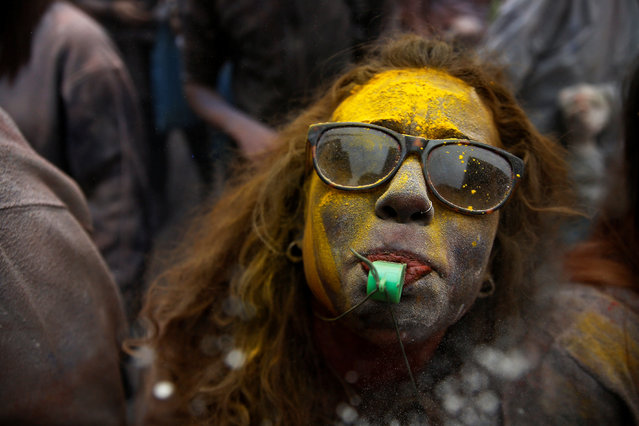
Revellers celebrate “Ash Monday” by participating in a colourful “flour war”, a traditional festivity marking the end of the carnival season and the start of the 40-day Lent period until the Orthodox Easter, in Galaxidi, Greece February 19, 2018. (Photo by Alkis Konstantinidis/Reuters)

Revellers celebrate “Ash Monday” by participating in a colourful “flour war”, a traditional festivity marking the end of the carnival season and the start of the 40-day Lent period until the Orthodox Easter, in Galaxidi, Greece February 19, 2018. (Photo by Alkis Konstantinidis/Reuters)
Details
21 Feb 2018 00:02:00
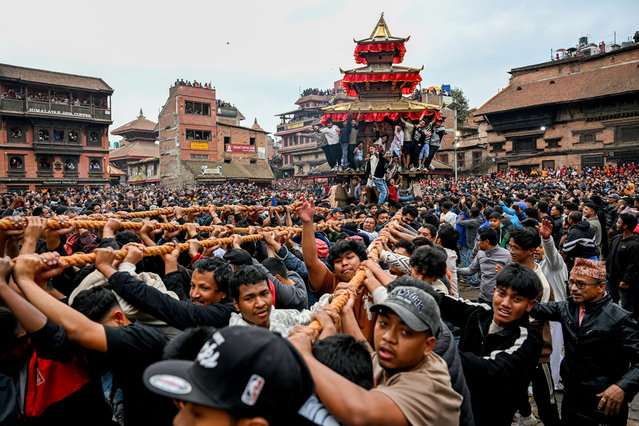
Devotees pull a wooden chariot carrying an idol of the Hindu deity Bhairav during 'Bisket Jatra' festival to mark the Nepali New Year, in Bhaktapur, on the outskirts of Kathmandu, on April 10, 2025. (Photo by Prakash Mathema/AFP Photo)

Devotees pull a wooden chariot carrying an idol of the Hindu deity Bhairav during 'Bisket Jatra' festival to mark the Nepali New Year, in Bhaktapur, on the outskirts of Kathmandu, on April 10, 2025. (Photo by Prakash Mathema/AFP Photo)
Details
26 Apr 2025 02:12:00