Loading...
Done
A student attending a winter military camp reacts during a training session in Ansan, south of Seoul January 3, 2013. Hundreds of students between 11 and 17 years old attend winter boot camp training courses every year. The winter courses range from 4 to 14 days at the Blue Dragon Camp run by retired marines, which also offers summer boot camp for students

A student attending a winter military camp reacts during a training session in Ansan, south of Seoul January 3, 2013. Hundreds of students between 11 and 17 years old attend winter boot camp training courses every year. The winter courses range from 4 to 14 days at the Blue Dragon Camp run by retired marines, which also offers summer boot camp for students. (Photo by Kim Hong-Ji/Reuters)
Details
03 Jan 2013 12:28:00
Isabel Schmalenbach, an environmental scientist with the Helgoland Biological Institute (Biologische Anstalt Helgoland), part of the Alfred Wegener Institute for Polar and Marine Research, holds a one-year old baby European lobster (Homarus gammarus) raised at the institute on August 3, 2013 on Helgoland Island, Germany. (Photo by Sean Gallup/Getty Images)

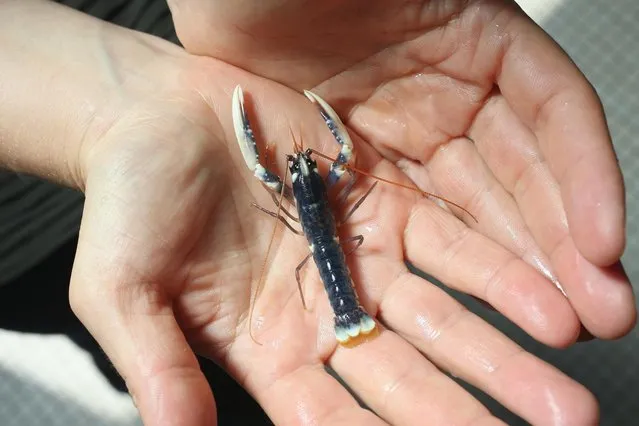
Isabel Schmalenbach, an environmental scientist with the Helgoland Biological Institute (Biologische Anstalt Helgoland), part of the Alfred Wegener Institute for Polar and Marine Research, holds a one-year old baby European lobster (Homarus gammarus) raised at the institute on August 3, 2013 on Helgoland Island, Germany. Later in the day Schmalenbach and her colleagues released a total of 415 one-year old lobsters into the North Sea as part of an effort to repopulate the lobster population around Helgoland (also called Heligoland). In the 19th century local fishermen caught up to 80,000 lobsters a year in the surrounding waters, combined with the heavy allied bombing of the island during and after World War II, as well as other environmental factors, decimated the lobster population. (Photo by Sean Gallup)
Details
05 Aug 2013 08:39:00
Women take photos on Lake Salt, which is on the UNESCO World Heritage Tentative List, during the sunset in Ankara, Turkiye on July 3, 2023. Lake Salt, which is one of the important wetlands of Turkiye and is of great importance for the protection of biological diversity in our country, also attracts the attention of visitors. (Photo by Aytac Unal/Anadolu Agency via Getty Images)

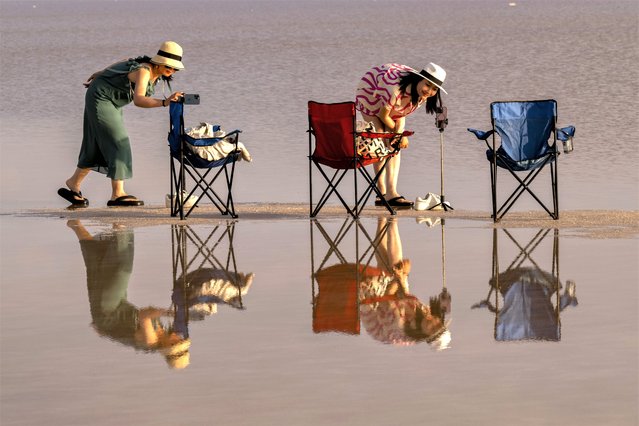
Women take photos on Lake Salt, which is on the UNESCO World Heritage Tentative List, during the sunset in Ankara, Turkiye on July 3, 2023. Lake Salt, which is one of the important wetlands of Turkiye and is of great importance for the protection of biological diversity in our country, also attracts the attention of visitors. (Photo by Aytac Unal/Anadolu Agency via Getty Images)
Details
15 Jul 2023 01:48:00
A golden snub-nosed monkeys (Rhinopitheque de Roxelane) looks through its enclosure after quarantine during its presentation at the Beauval Zoopark in Saint-Aignan Central France, on May 7, 2025. ZooParc de Beauval (Loir-et-Cher) welcomed three golden snub-nosed monkeys on April 3, 2025, an endangered species from China, as part of a conservation program, becoming the first zoo outside Asia to house these long-haired, red-furred primates with bluish faces. (Photo by Guillaume Souvant/AFP Photo)

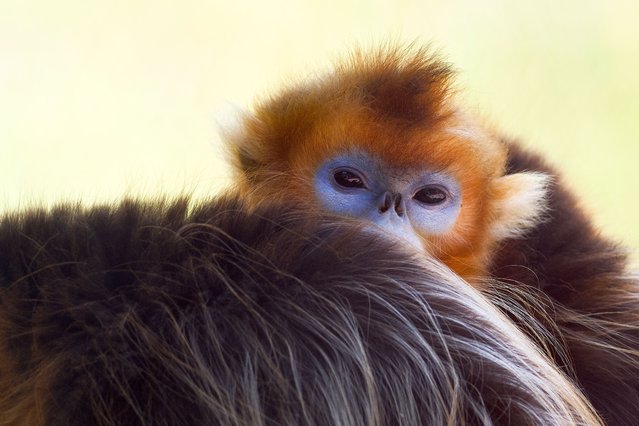
A golden snub-nosed monkeys (Rhinopitheque de Roxelane) looks through its enclosure after quarantine during its presentation at the Beauval Zoopark in Saint-Aignan Central France, on May 7, 2025. ZooParc de Beauval (Loir-et-Cher) welcomed three golden snub-nosed monkeys on April 3, 2025, an endangered species from China, as part of a conservation program, becoming the first zoo outside Asia to house these long-haired, red-furred primates with bluish faces. (Photo by Guillaume Souvant/AFP Photo)
Details
18 May 2025 02:44:00
Maudy – Kalulushi, Zambia. Maudy was born in a hut in a small village close to Kalulushi, in Zambia. She grew up playing in the street with the other children in the village, who all attend the same school, where students ages 3 to 10 years old are in the same class. The village has no shops, restaurants or hotels, and just a few children are lucky enough to have toys. Maudy and her friends found a box full of sunglasses on the street, which quickly became their favorite toys. “Toy Stories” project. (Gabriele Galimberti)

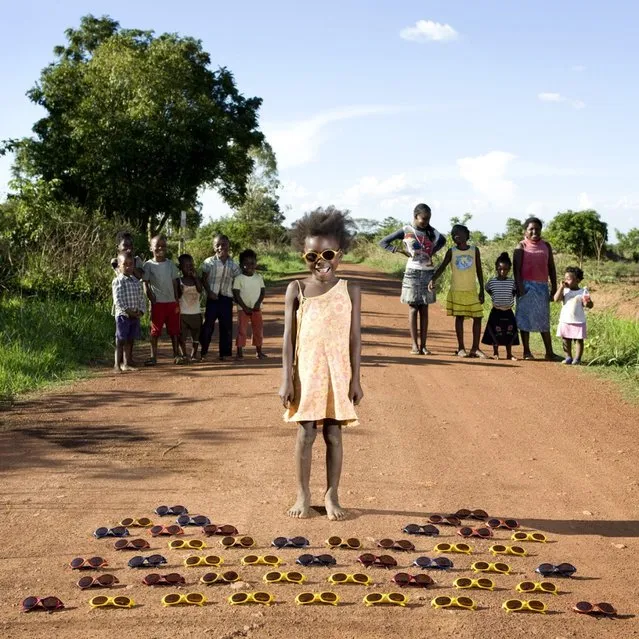
Maudy – Kalulushi, Zambia. Maudy was born in a hut in a small village close to Kalulushi, in Zambia. She grew up playing in the street with the other children in the village, who all attend the same school, where students ages 3 to 10 years old are in the same class. The village has no shops, restaurants or hotels, and just a few children are lucky enough to have toys. Maudy and her friends found a box full of sunglasses on the street, which quickly became their favorite toys. “Toy Stories” project. (Photo and caption by Gabriele Galimberti)
Details
05 Dec 2013 07:54:00
On August 31, 2012, a long filament of solar material that had been hovering in the sun's atmosphere, the corona, erupted out into space at 4:36 p.m. EDT. The coronal mass ejection, or CME, traveled at over 900 miles per second. The CME did not travel directly toward Earth, but did connect with Earth's magnetic environment, or magnetosphere, causing aurora to appear on the night of Monday, September 3. (Photo by NASA/GSFC/SDO)

On August 31, 2012, a long filament of solar material that had been hovering in the sun's atmosphere, the corona, erupted out into space at 4:36 p.m. EDT. The coronal mass ejection, or CME, traveled at over 900 miles per second. The CME did not travel directly toward Earth, but did connect with Earth's magnetic environment, or magnetosphere, causing aurora to appear on the night of Monday, September 3. (Photo by NASA/GSFC/SDO via The Atlantic)
Details
14 Sep 2012 09:01:00
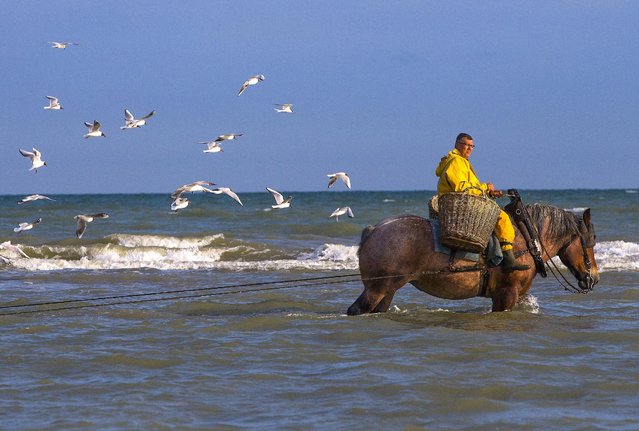
A Belgian shrimp fisherman rides a carthorse to haul a net out in the sea to catch shrimps during low tide at the coastal town of Oostduinkerke, Belgium July 3, 2015. (Photo by Yves Herman/Reuters)

A Belgian shrimp fisherman rides a carthorse to haul a net out in the sea to catch shrimps during low tide at the coastal town of Oostduinkerke, Belgium July 3, 2015. At the end of each fishing session, the fishermen and their mounts leave the water to empty the net's contents into two wicker baskets fixed on each side of the horse. This traditional method of catching shrimps along the North Sea coast, which dates back to some 500 years, attracts tourists every summer. In 2013, Unesco recognized shrimp fishing on horseback as an intangible cultural heritage. (Photo by Yves Herman/Reuters)
Details
04 Jul 2015 11:29:00
“Business-class” cabins are seen at First Cabin hotel, which was converted from an old office building, in Tokyo, July 3, 2015. Record tourists to Japan are stretching the ability of hotels to accommodate them in a sector constrained by high costs, forcing developers to think out of the box for means to quickly increase lodging options without breaking the bank. (Photo by Toru Hanai/Reuters)

“Business-class” cabins are seen at First Cabin hotel, which was converted from an old office building, in Tokyo, July 3, 2015. Record tourists to Japan are stretching the ability of hotels to accommodate them in a sector constrained by high costs, forcing developers to think out of the box for means to quickly increase lodging options without breaking the bank. (Photo by Toru Hanai/Reuters)
Details
31 Jul 2015 10:57:00