Loading...
Done


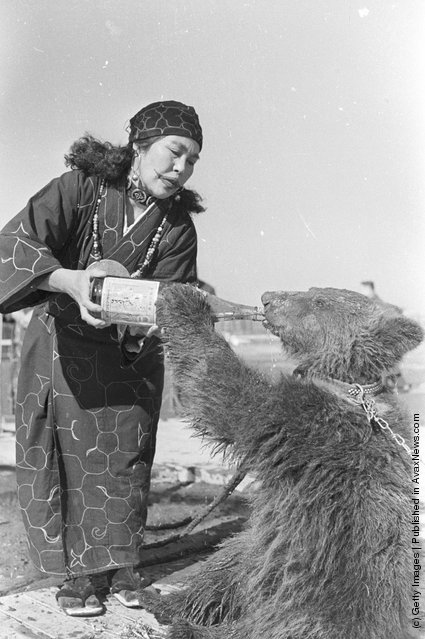
“The Ainu (アイヌ?), also called Aynu, Aino (アイノ), and in historical texts Ezo (蝦夷), are indigenous people or groups in Japan and Russia. Historically they spoke the Ainu language and related varieties and lived in Hokkaidō, the Kuril Islands, and much of Sakhalin. Most of those who identify themselves as Ainu still live in this same region, though the exact number of living Ainu is unknown. This is due to ethnic issues in Japan resulting in those with Ainu backgrounds hiding their identities and confusion over mixed heritages. In Japan, because of intermarriage over many years with Japanese, the concept of a 'pure Ainu' ethnic group is no longer feasible. Official estimates of the population are of around 25,000, while the unofficial number is upwards of 200,000 people”. – Wkipedia

Photo: A captive bear drinking from a large bottle held by an Ainu tribeswoman. (Photo by Evans/Three Lions/Getty Images). Circa 1955
Details
24 Mar 2011 14:01:00
Russian soldiers are pictured next to the Reichstag building in this undated photo taken May 1945 in Berlin. Some 70 years on from the Battle for Berlin, instrumental in the end of World War II, Reuters photographer Fabrizio Bensch unearthed pictures by Red Army photographer Georgiy Samsonov, showing his portrayal of a city laid siege. (Photo by Georgiy Samsonov/Reuters/MHM)

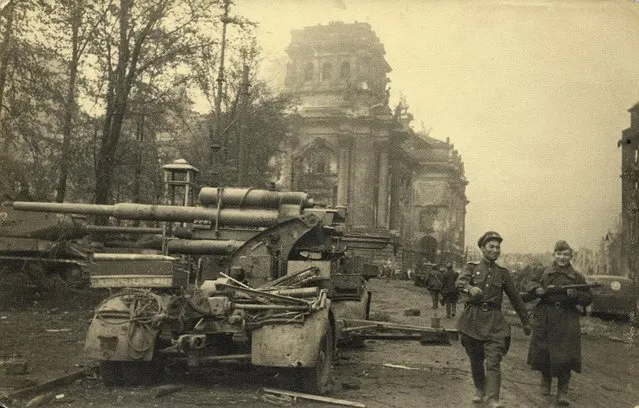
Russian soldiers are pictured next to the Reichstag building in this undated photo taken May 1945 in Berlin. Some 70 years on from the Battle for Berlin, instrumental in the end of World War II, Reuters photographer Fabrizio Bensch unearthed pictures by Red Army photographer Georgiy Samsonov, showing his portrayal of a city laid siege. Bensch bought an exactly equivalent FED camera, a Soviet copy of the German-made Leica II, choosing to use black and white film to capture images of the self-same locations he detected his way to in modern-day Berlin. (Photo by Georgiy Samsonov/Reuters/MHM)
Details
07 May 2015 12:01:00
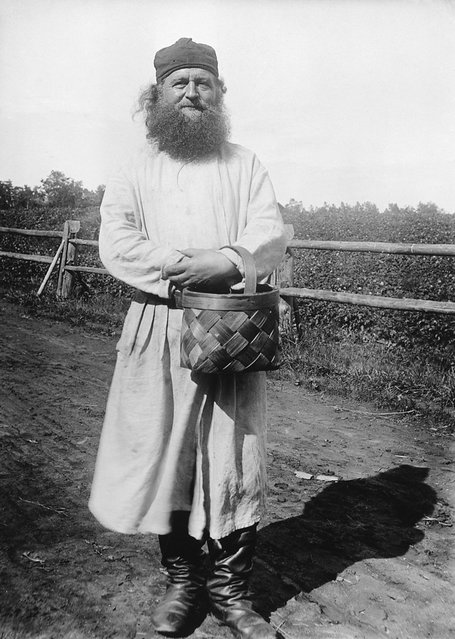
Priest, Valamo Monastery, Karelia, Russia (then Finland), 1930s. Father Venerius with a birchbark basket. (Photo by Einar Erici)

“Einar Erici (1885–1965) was a physician by profession, working at a tuberculosis hospital in Stockholm, even running a private medical practice. He was by then the most renowned Swedish expert of church organs and organ builders, and his archival collection is today held by the Swedish National Heritage Board. This archive includes mostly writings, such as letters and manuscripts for published articles and essays, but also more than 2 000 black and white photos – original prints, glass plates and film negatives”. – Swedish National Heritage Board

Photo: Priest, Valamo Monastery, Karelia, Russia (then Finland), 1930s. Father Venerius with a birchbark basket. (Photo by Einar Erici)
Details
09 Dec 2012 11:41:00
Workers collect fish inside an abandoned department store in Bangkok, Thailand January 13, 2015. Staff from Bangkok Metropolitan Administration (BMA) office were catching fish on Tuesday at the ground floor of the roofless New World department store that was closed down in 1997. (Photo by Chaiwat Subprasom/Reuters)

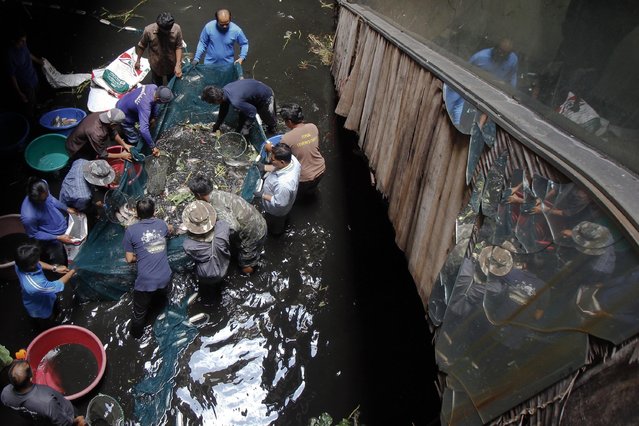
Workers collect fish inside an abandoned department store in Bangkok, Thailand January 13, 2015. Staff from Bangkok Metropolitan Administration (BMA) office were catching fish on Tuesday at the ground floor of the roofless New World department store that was closed down in 1997. Thousands of fish such as catfishes, fancy carps as well as black and red tilapias were released into the ground floor of the building, flooded with rainwater, as local vendors tried to control mosquitoes in the area, local media reported. BMA recently decided to remove the fish and release the water. (Photo by Chaiwat Subprasom/Reuters)
Details
14 Jan 2015 11:57:00
Shovava Wing Scarves By Roza Khamitova

Roza Khamitova was born into a family of artists in Kazakhstan. After finishing design school in Manhattan, New York, she was working in fashion industry for about 8 years. As a visual artist Roza had always drawn most of her inspiration from the natural world around her in the mountains of Kazakhstan. In 2011 she launched Shovava, her personal line of women’s clothing based on her hand drawn paintings and prints of the animals, plants and patterns found in nature. Roza was enchanted by the beauty of wings, its structure and symbolism. First, she sketches big wide-spread wings on paper with a light pencil, adds black ink to create a three-dimensional feel and fills with stunning watercolors.
Details
06 Dec 2015 10:42:00
Joseph Fons holding a Pride Flag, runs in front of the U.S. Supreme Court building after the court ruled that a federal law banning workplace discrimination also covers sexual orientation, in Washington, D.C., U.S., June 15, 2020. (Photo by Tom Brenner/Reuters)

Joseph Fons holding a Pride Flag, runs in front of the U.S. Supreme Court building after the court ruled that a federal law banning workplace discrimination also covers sexual orientation, in Washington, D.C., U.S., June 15, 2020. (Photo by Tom Brenner/Reuters)
Details
20 Jan 2021 00:03:00
An injured demonstrator receives aid during a protest against a lockdown planned for the capital this weekend to halt the spread of the coronavirus disease (COVID-19) in Belgrade, Serbia on July 7, 2020. (Photo by Marko Djurica/Reuters)

An injured demonstrator receives aid during a protest against a lockdown planned for the capital this weekend to halt the spread of the coronavirus disease (COVID-19) in Belgrade, Serbia on July 7, 2020. (Photo by Marko Djurica/Reuters)
Details
28 Jan 2021 10:36:00
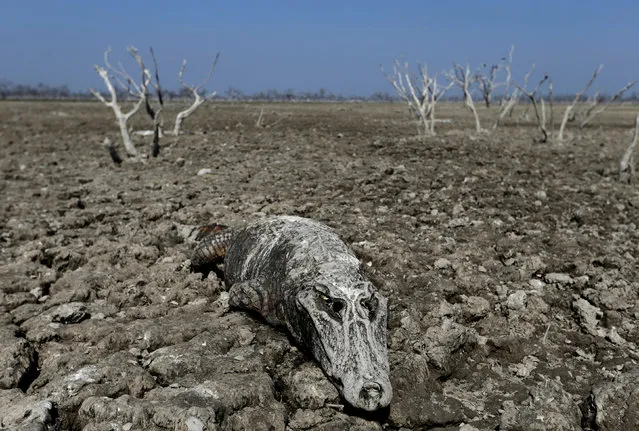
The carcass of a yacare caiman lies in the dried-up river bed of the Pilcomayo river in Boqueron, Paraguay, August 14, 2016. In Paraguay, alongside the Pilcomayo River, black vultures flew over a shrinking pond where a group of crocodilian reptiles known as yacare caimans sought refuge. Water from the river, which divides Paraguay and Argentina in the area of the Gran Chaco, was scarce. This is not an uncommon sight in the region of General Diaz, about 700 kilometres (435 miles) northwest of the country's capital Asuncion, where the Pilcomayo's waters form lakes and streams that give life to capybaras, birds and caimans. “The river's situation is critical. No water is forecast to enter the basin until December, as happens every year”, said Alcides Gonzalez, a resident of the area. (Photo by Jorge Adorno/Reuters)

The carcass of a yacare caiman lies in the dried-up river bed of the Pilcomayo river in Boqueron, Paraguay, August 14, 2016. In Paraguay, alongside the Pilcomayo River, black vultures flew over a shrinking pond where a group of crocodilian reptiles known as yacare caimans sought refuge. Water from the river, which divides Paraguay and Argentina in the area of the Gran Chaco, was scarce. This is not an uncommon sight in the region of General Diaz, about 700 kilometres (435 miles) northwest of the country's capital Asuncion, where the Pilcomayo's waters form lakes and streams that give life to capybaras, birds and caimans. (Photo by Jorge Adorno/Reuters)
Details
03 Nov 2016 12:40:00