Loading...
Done
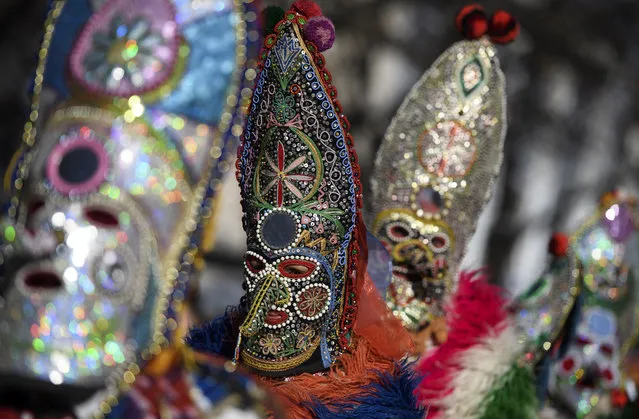
Mask dancers take part in a parade during the the International Festival of Masquerade Games “Surva” in the town of Pernik, some 30 km from Sofia, Bulgaria, 27 January 2019. In ancient times the old Thracians held the Kukeri Ritual Games in honor of god Dionysus – known as a god of wine and ecstasy. Even today these games are also known as the Dionysus' games. Among the Kukeri dancers' are many characters, including Dionysus and his satyrs as well as others from deep history such as the tsar, harachari, plyuvkachi, startzi, and pesyatzi. (Photo by Vassil Donev/EPA/EFE)

Mask dancers take part in a parade during the the International Festival of Masquerade Games “Surva” in the town of Pernik, some 30 km from Sofia, Bulgaria, 27 January 2019. In ancient times the old Thracians held the Kukeri Ritual Games in honor of god Dionysus – known as a god of wine and ecstasy. Even today these games are also known as the Dionysus' games. Among the Kukeri dancers' are many characters, including Dionysus and his satyrs as well as others from deep history such as the tsar, harachari, plyuvkachi, startzi, and pesyatzi. (Photo by Vassil Donev/EPA/EFE)
Details
31 Jan 2019 00:01:00
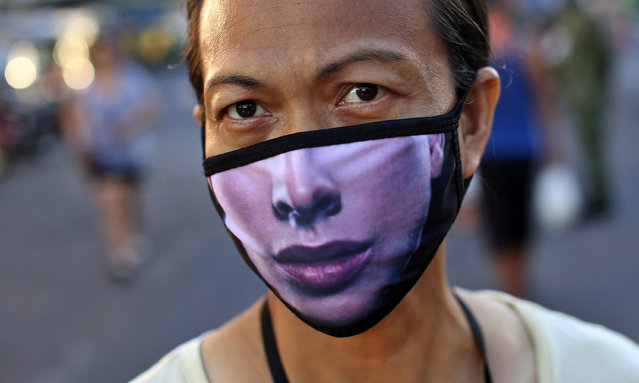
A Filipino woman wears a mask to try and protect against the spread of coronavirus in Malate district, Manila City on March 24, 2020. The Philippines has taken drastic measures to combat the spread of Covid-19. The entire country is under strict quarantine and the army is on the streets to monitor compliance. According to official figures, there are 462 positive cases and 33 dead in the Philippines, but it is thought that thousands of cases remain undetected due to lack of resources in a country where millions of people have no access to health care. In the poorest and most crowded areas, it’s almost impossible to adhere to the physical distancing required during quarantine. (Photo by Alejandro Ernesto/The Guardian)

A Filipino woman wears a mask to try and protect against the spread of coronavirus in Malate district, Manila City on March 24, 2020. The Philippines has taken drastic measures to combat the spread of Covid-19. The entire country is under strict quarantine and the army is on the streets to monitor compliance. According to official figures, there are 462 positive cases and 33 dead in the Philippines, but it is thought that thousands of cases remain undetected due to lack of resources in a country where millions of people have no access to health care. In the poorest and most crowded areas, it’s almost impossible to adhere to the physical distancing required during quarantine. (Photo by Alejandro Ernesto/The Guardian)
Details
08 Apr 2020 00:01:00
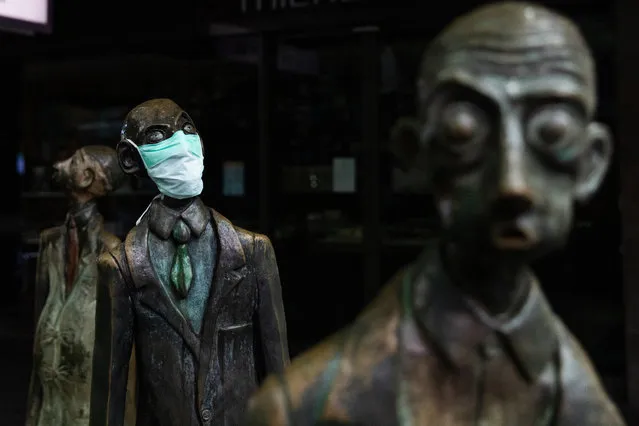
A face mask is placed on one of the 'Three business men who brought lunch' statues on Swanston street on March 29, 2020 in Melbourne, Australia. All international arrivals into Australia from midnight on Saturday will be placed into mandatory quarantine in hotels for 14 days as the Federal Government increases restrictions to stop the spread of COVID-19. All libraries, museums, galleries, beauty salons, tattoo parlours, shopping centre food courts, auctions, open houses, amusement parks, arcades, indoor and outdoor play centres, swimming pools are closed and indoor exercise activities are now banned. This is in addition to the closure of bars, pubs and nightclubs which came into effect on Monday. Restaurants and cafes are restricted to providing takeaway only. Weddings will now be restricted to five people including the couple while funerals are limited to 10 mourners. All Australians are now expected to stay at home except for essential outings such as work, grocery shopping and medical appointments. Exercising outdoors alone is still permitted. Australia now has more than 3,600 confirmed cases of COVID-19 while the death toll now stands at 16. (Photo by Asanka Ratnayake/Getty Images)

A face mask is placed on one of the 'Three business men who brought lunch' statues on Swanston street on March 29, 2020 in Melbourne, Australia. All international arrivals into Australia from midnight on Saturday will be placed into mandatory quarantine in hotels for 14 days as the Federal Government increases restrictions to stop the spread of COVID-19. (Photo by Asanka Ratnayake/Getty Images)
Details
31 Mar 2020 00:07:00
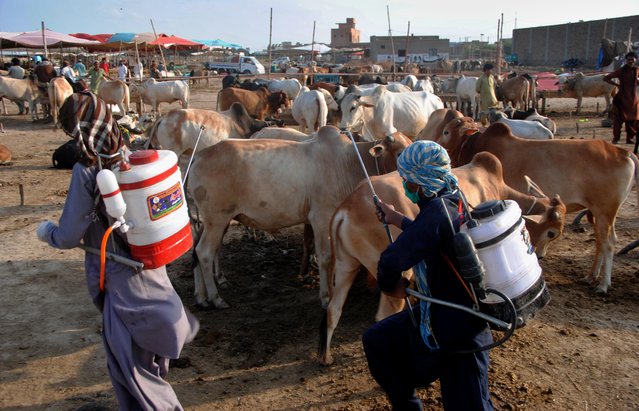
Health workers wearing face masks spray disinfectant liquid on sacrificial animals amid concerns over the spread of the SARS-CoV-2 coronavirus that causes the pandemic COVID-19 disease ahead of the Muslim festival of Eid al-Adha at an animal market in Hyderabad, southern Pakistan, 21 July 2020. Eid al-Adha, also known as the Festival of the Sacrifice, is the second and holiest of the two main Islamic holidays celebrated each year (the other one being Eid al-Fitr). Every year, on the 10th day of the Islamic lunar month of Dhu al-Hijjah, Muslims around the world ritually slaughter a sacrificial animal and split the meat into three parts: one is reserved for the family, another for friends and relatives, and the third is given to the poor and needy. The Saudi Supreme Court has declared that the first day of Eid al-Adha this year falls on 31 July. (Photo by Nadeem Khawar/EPA/EFE)

Health workers wearing face masks spray disinfectant liquid on sacrificial animals amid concerns over the spread of the SARS-CoV-2 coronavirus that causes the pandemic COVID-19 disease ahead of the Muslim festival of Eid al-Adha at an animal market in Hyderabad, southern Pakistan, 21 July 2020. (Photo by Nadeem Khawar/EPA/EFE)
Details
23 Jul 2020 00:07:00
Women wear the traditional costume of the Alto Tio Diego carnival during the Women's Afro-Mestizo Carnival of Alto Tio Diego on February 11, 2024 in Veracruz, Mexico. Alto Tio Diego is a small town near the State capital Xalapa where every year inhabitants celebrate their traditional carnival. Women of the town demanded a special day for them to parade and few years ago, they started to do it by walking through the streets wearing traditional costumes and masks (mostly of animals) but the attires have evolved to more modern characters. (Photo by Hector AD Quintanar/Getty Images)

Women wear the traditional costume of the Alto Tio Diego carnival during the Women's Afro-Mestizo Carnival of Alto Tio Diego on February 11, 2024 in Veracruz, Mexico. Alto Tio Diego is a small town near the State capital Xalapa where every year inhabitants celebrate their traditional carnival. Women of the town demanded a special day for them to parade and few years ago, they started to do it by walking through the streets wearing traditional costumes and masks (mostly of animals) but the attires have evolved to more modern characters. (Photo by Hector AD Quintanar/Getty Images)
Details
24 May 2025 02:27:00
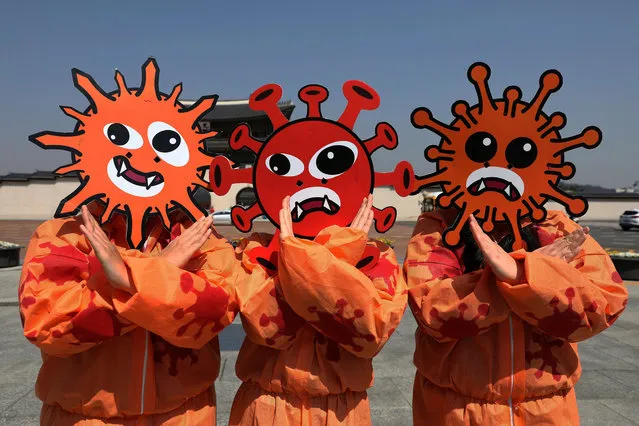
South Korean environmental activists wearing masks symbolizing the coronavirus attend a prevention campaign as South Koreans take measures to protect themselves against the spread of coronavirus (COVID-19) on March 30, 2020 in Seoul, South Korea. South Korea has called for expanded public participation in social distancing, as the country witnesses a wave of community spread and imported infections leading to a resurgence in new cases of COVID-19. According to the Korea Center for Disease Control and Prevention on Monday, 78 new cases were reported. The total number of infections in the nation tallies at 9,661. (Photo by Chung Sung-Jun/Getty Images)

South Korean environmental activists wearing masks symbolizing the coronavirus attend a prevention campaign as South Koreans take measures to protect themselves against the spread of coronavirus (COVID-19) on March 30, 2020 in Seoul, South Korea. South Korea has called for expanded public participation in social distancing, as the country witnesses a wave of community spread and imported infections leading to a resurgence in new cases of COVID-19. According to the Korea Center for Disease Control and Prevention on Monday, 78 new cases were reported. The total number of infections in the nation tallies at 9,661. (Photo by Chung Sung-Jun/Getty Images)
Details
01 Apr 2020 00:07:00
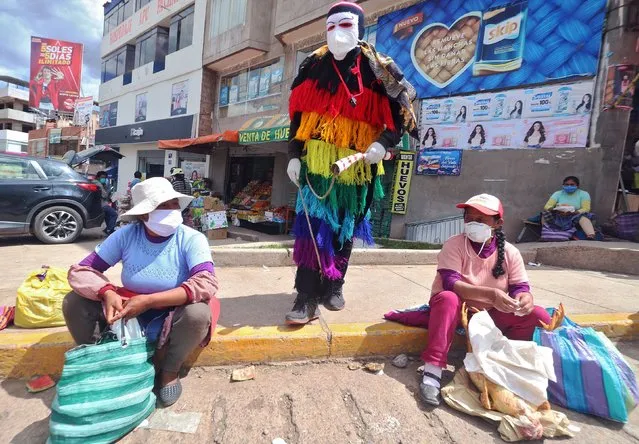
A man dressed in Andean attire as “Ukukus” or “Pabluchas”, a traditional character that acts as a vigilante imposing social order, uses a whip as a threat to force people to maintain their distance and remind them to wear face masks and gloves as a preventive measure against the novel coronavirus COVID-19, in the Vinocanchon market area in San Jeronimo district, close to the Peruvian Andean city of Cusco, on May 2, 2020. The government has identified public markets as major hotspots of the new coronavirus in Peru, where 40,459 confirmed cases and 1,124 deaths were reported on May 1. (Photo by Jose Carlos Angulo/AFP Photo)

A man dressed in Andean attire as “Ukukus” or “Pabluchas”, a traditional character that acts as a vigilante imposing social order, uses a whip as a threat to force people to maintain their distance and remind them to wear face masks and gloves as a preventive measure against the novel coronavirus COVID-19, in the Vinocanchon market area in San Jeronimo district, close to the Peruvian Andean city of Cusco, on May 2, 2020. The government has identified public markets as major hotspots of the new coronavirus in Peru, where 40,459 confirmed cases and 1,124 deaths were reported on May 1. (Photo by Jose Carlos Angulo/AFP Photo)
Details
04 May 2020 00:07:00
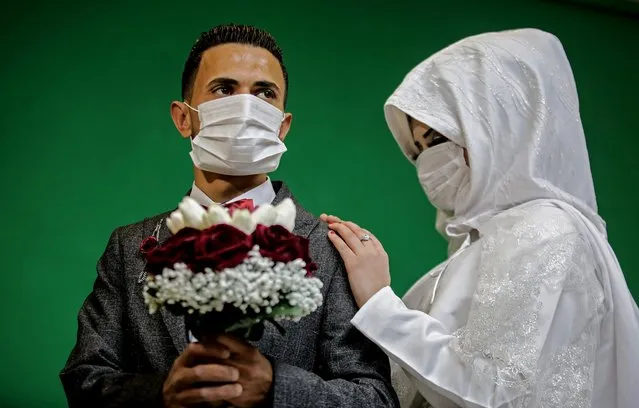
Palestinian groom Mohamed abu Daga and his bride Israa wear face masks amid the COVID-19 epidemic, during a photoshoot at a studio before their wedding ceremony in Khan Yunis in the southern Gaza Strip, on March 23, 2020. Authorities in Gaza confirmed on March 22 the first two cases of novel coronavirus, identifying them as Palestinians who had travelled to Pakistan and were being held in quarantine since their return, as the United Nations warned of potential disastrous outcomes to an outbreak given the high poverty rates and weak health system in the coastal strip, under Israeli blockade since 2007. (Photo by Said Khatib/AFP Photo)

Palestinian groom Mohamed abu Daga and his bride Israa wear face masks amid the COVID-19 epidemic, during a photoshoot at a studio before their wedding ceremony in Khan Yunis in the southern Gaza Strip, on March 23, 2020. Authorities in Gaza confirmed on March 22 the first two cases of novel coronavirus, identifying them as Palestinians who had travelled to Pakistan and were being held in quarantine since their return, as the United Nations warned of potential disastrous outcomes to an outbreak given the high poverty rates and weak health system in the coastal strip, under Israeli blockade since 2007. (Photo by Said Khatib/AFP Photo)
Details
27 Mar 2020 00:07:00