Loading...
Done
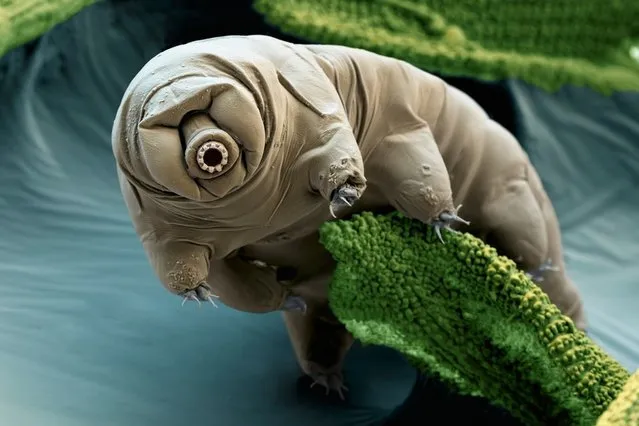
Tardigrades (commonly known as waterbears or moss piglets). (Photo by SPL/East News)

“Tardigrades (commonly known as waterbears or moss piglets) are small, water-dwelling, segmented animals with eight legs. Tardigrades were first discovered in 1773 by Johann August Ephraim Goeze, who called them kleiner Wasserbär, meaning “little water bear” in German. The name Tardigrada means “slow walker” and was given by Lazzaro Spallanzani in 1777. The name water bear comes from the way they walk, reminiscent of a bear's gait. The biggest adults may reach a body length of 1.5 millimetres (0.059 in), the smallest below 0.1 mm. Freshly hatched tardigrades may be smaller than 0.05 mm”. – Wikipedia. Photo: Tardigrades. (Photo by SPL/East News)
Details
26 Sep 2012 09:55:00
Mingora Hovoped Takes No Ordinary Rider. (Kenny Hassan Irwin)

“In the ongoing epics of the Pakistani Starfleet in their ever lasting quest to embrace and protect the freedoms of all humanity and life elsewhere in the cosmos we explore the future of Pakistan as a leader in advanced technology, diverse culture, exploration, helping to preserve peace & help those in need from the less than benign that reside in the darkest reaches of the cosmos to those who share & cherish kinship with all of humanity from the brightest reaches of the cosmos”. – Kenny Hassan Irwin

Mingora Hovoped Takes No Ordinary Rider. (Photo by Kenny Hassan Irwin)

Details
06 Dec 2012 12:15:00
Despite the amazing sight, Netal said that seeing the pools came with a downside. “The smell was horrible, and it was difficult to breath”. (Photo by Neta Dekel/Caters News Agency)

These stunning images show the beauty and drama of Mother Nature at work. Captured deep in heart of the Danakil Desert in East Africa, the images show the acid pools near the Erta Ale volcano. Pools of brightly colored acid can be seen amid the dramatic blast of volcanic ash. The photos were taken by Neta Dekel, an Israeli photographer. He the acid pools were one of the most extraordinary sights he had ever seen. (Photo by Neta Dekel/Caters News Agency)
Details
27 Jun 2018 00:03:00
Pamukkale, Turkey, is home to these terrace pools, formed by the build-up of carbonate mineral from the warm water flowing from the thermal springs above. (Photo by Image Courtesy of Jennifer Hayes/Getty Images)

Pamukkale, Turkey, is home to these terrace pools, formed by the build-up of carbonate mineral from the warm water flowing from the thermal springs above. (Photo by Image Courtesy of Jennifer Hayes/Getty Images)
Details
17 Jul 2017 07:59:00
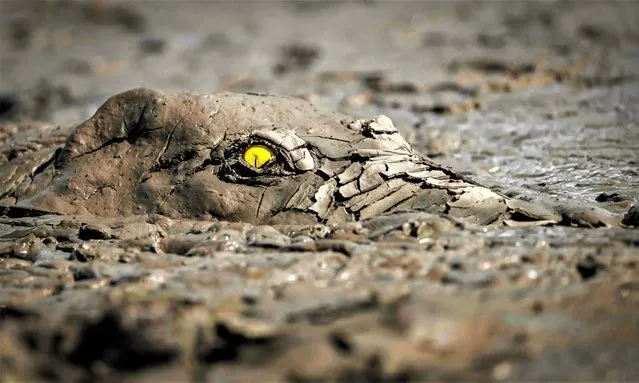
“Danger in the mud” – a crocodile at Mana Pools National Park, Zimbabwe. The grand prize winner. (Photo by Jens Cullmann/World Nature Photography Awards 2022)

“Danger in the mud” – a crocodile at Mana Pools National Park, Zimbabwe. The grand prize winner. (Photo by Jens Cullmann/World Nature Photography Awards 2022)
Details
08 Mar 2023 04:28:00
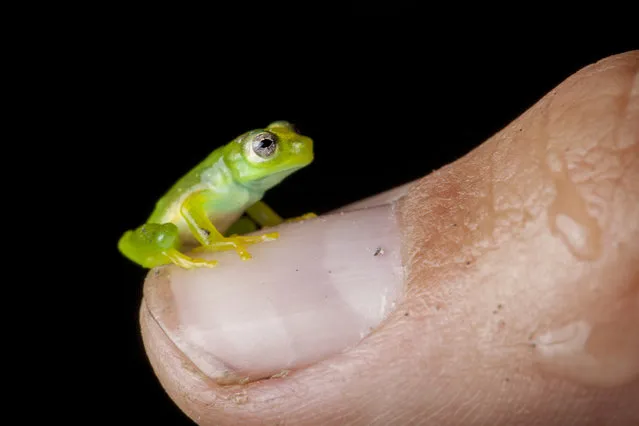
Miniature glass frog. (Photo by Robin Moore)

Thousands of species of amphibians are endangered and hundreds have already disappeared, but in recent years, a team of scientists and conservationists have re-discovered some of these “lost” species and uncovered previously unknown varieties. Here: Miniature glass frog. (Photo by Robin Moore)
Details
10 Oct 2014 12:55:00
With the United Nations and Tudor City in the foreground, lightning strikes in the sky over the East River as a major storm approaches New York City July 2, 2014. Tropical Storm Arthur, the first of the Atlantic hurricane season, gathered strength July 20, 2014 and would likely reach hurricane strength over the next couple of days. (Photo by Timothy A. Clary/AFP Photo)

With the United Nations and Tudor City in the foreground, lightning strikes in the sky over the East River as a major storm approaches New York City July 2, 2014. Tropical Storm Arthur, the first of the Atlantic hurricane season, gathered strength July 20, 2014 and would likely reach hurricane strength over the next couple of days. (Photo by Timothy A. Clary/AFP Photo)
Details
04 Jul 2014 10:32:00
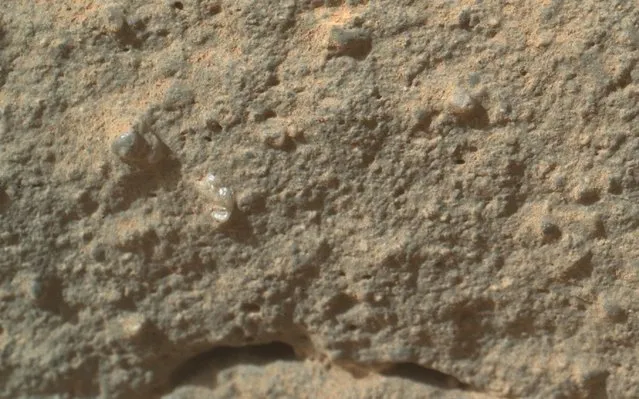
Scientists say that a “Martian flower”, seen here in an image from the Curiosity rover's Mars Hand Lens Imager, is a 2-millimeter-wide grain or pebble that's embedded in the surrounding rock. Another, darker-colored mineral grain can be seen above and to the left. (Photo by NASA)

“The scientists behind NASA's $2.5 billion Curiosity rover mission on Mars on Tuesday explained the nature of a tiny, gleaming "flower" embedded in Red Planet rock, and revealed where they'll be using the SUV-sized robot's drill for the first time”. – Alan Boyle via NBCNews.com

Photo: Scientists say that a “Martian flower”, seen here in an image from the Curiosity rover's Mars Hand Lens Imager, is a 2-millimeter-wide grain or pebble that's embedded in the surrounding rock. Another, darker-colored mineral grain can be seen above and to the left. (Photo by NASA)
Details
16 Jan 2013 11:12:00