An employee of a bakery talks on his mobile while balancing on his head a tray of freshly baked bread from a local bakery in a street in Cairo, Egypt, January 12, 2016. (Photo by Asmaa Waguih/Reuters)
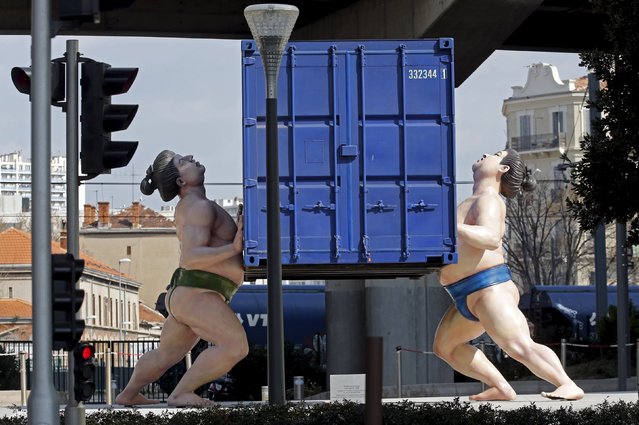
The sculpture “It Takes Two to Tango” by Scottish sculptor David Mach is seen in front of the headquarters of the CMA-CGM shipping company office tower in the port of Marseille, France, March 15, 2016. (Photo by Jean-Paul Pelissier/Reuters)
A racegoer enjoy the atmosphere following 2016 Derby Day at Flemington Racecourse on October 29, 2016 in Melbourne, Australia. Women attendees weren’t afraid to show off some skin as the warm summer weather arrived in Australia. (Photo by Splash News and Pictures)
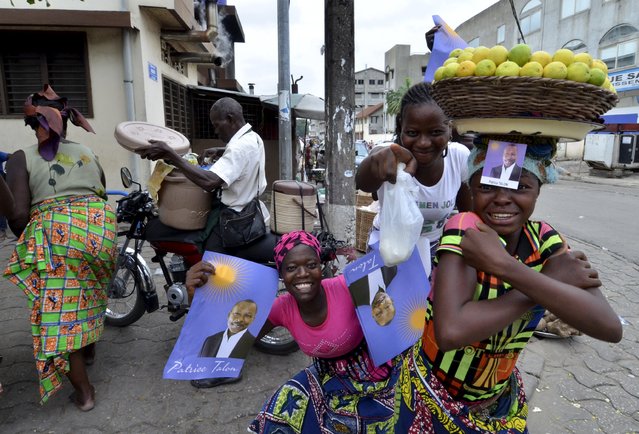
Street vendors hold campaign posters for presidential candidate Patrice Talon ahead of the second round of Benin's presidential election on Sunday in Cotonou, Benin, March 18, 2016. (Photo by Charles Placide Tossou/Reuters)
Miss USA Alyssa Campanella arrives at the 2nd Annual American Giving Awards at the Pasadena Civic Auditorium on December 7, 2012 in Pasadena, California. (Photo by Gregg DeGuire/WireImage)
A journalist takes photographs at the site of Thursday's Malaysia Airlines Boeing 777 plane crash near the settlement of Grabovo, in the Donetsk region July 18, 2014. World leaders demanded an international investigation into the shooting down of Malaysia Airlines Flight MH17 with 298 people on board over eastern Ukraine, as Kiev and Moscow blamed each other for a tragedy that stoked tensions between Russia and the West. (Photo by Maxim Zmeyev/Reuters)
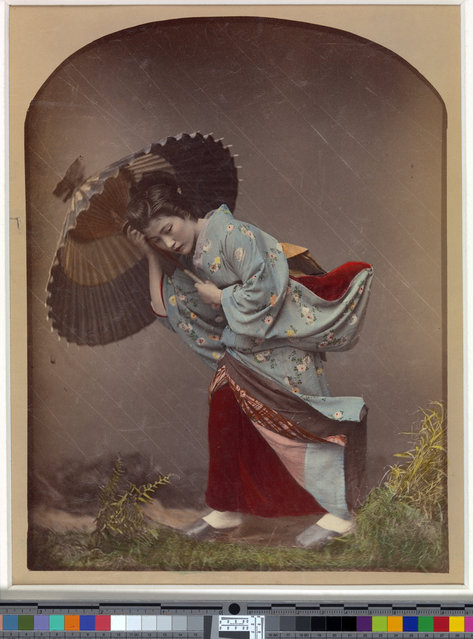
“Woman with Umbrella in Rain” by Raimund von Stillfried. Artist: Kusakabe Kimbei (Japanese, 1841–1934), 1870s. Commercial photography studios in Meiji-era Japan were renowned for the subtlety and refinement of their coloring techniques. This hand-tinted image of a young woman caught in a heavy rainstorm achieved its naturalistic effect by knitting together multiple strands of artifice: the greenery in the foreground was a studio prop; the flaps of the kimono were suspended by thin wires to create the impression of a strong wind; and long, diagonal marks were made on the negative to suggest streaks of rain. (Photo courtesy of The Metropolitan Museum of Art)