Loading...
Done
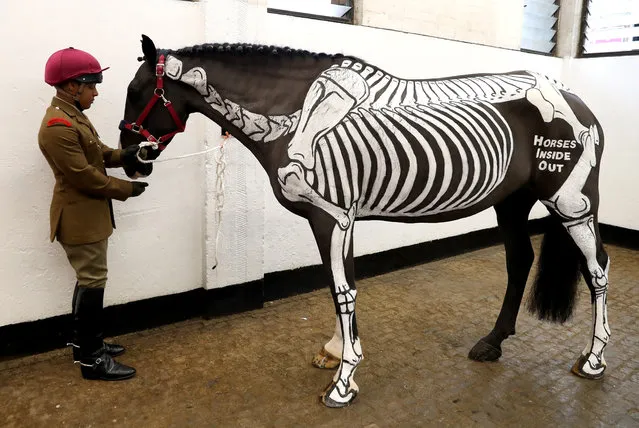
A horse named Quinn, with a skeleton painted on it to help educate officers, is pictured during a visit by Britain's Queen Elizabeth II (unseen) and Britain's Prince Charles, Prince of Wales (unseen) to the Household Cavalry Mounted Regiment at the Hyde Park Barracks in west London on October 24, 2017. (Photo by Chris Jackson/AFP Photo)

A horse named Quinn, with a skeleton painted on it to help educate officers, is pictured during a visit by Britain's Queen Elizabeth II (unseen) and Britain's Prince Charles, Prince of Wales (unseen) to the Household Cavalry Mounted Regiment at the Hyde Park Barracks in west London on October 24, 2017. (Photo by Chris Jackson/AFP Photo)
Details
25 Oct 2017 07:09:00
A model presents a creation from the Versace Fall-Winter 2022/2023 collection during Fashion Week in Milan, Italy, February 25, 2022. (Photo by Alessandro Garofalo/Reuters)

A model presents a creation from the Versace Fall-Winter 2022/2023 collection during Fashion Week in Milan, Italy, February 25, 2022. (Photo by Alessandro Garofalo/Reuters)
Details
28 Feb 2022 04:40:00
A racegoers walks into a rubbish bin following 2016 Melbourne Cup Day at Flemington Racecourse on November 1, 2016 in Melbourne, Australia. (Photo by Scott Barbour/Getty Images)

A racegoers walks into a rubbish bin following 2016 Melbourne Cup Day at Flemington Racecourse on November 1, 2016 in Melbourne, Australia. (Photo by Scott Barbour/Getty Images)
Details
02 Nov 2016 12:42:00


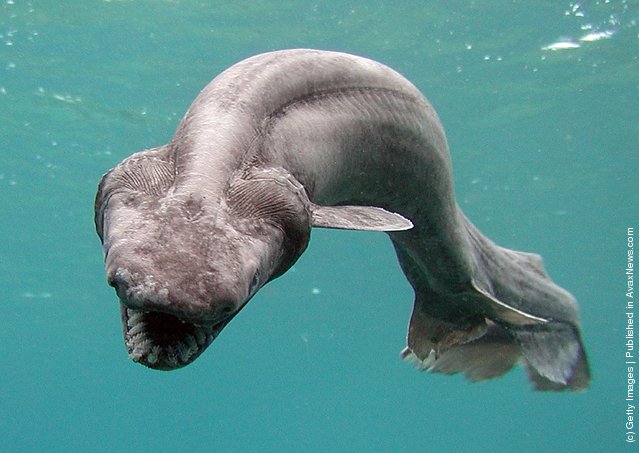
“The frilled shark (Chlamydoselachus anguineus) is one of two extant species of shark in the family Chlamydoselachidae, with a wide but patchy distribution in the Atlantic and Pacific Oceans. This uncommon species is found over the outer continental shelf and upper continental slope, generally near the bottom though there is evidence of substantial upward movements. It has been caught as deep as 1,570 m (5,150 ft), whereas in Suruga Bay, Japan it is most common at depths of 50–200 m (160–660 ft). Exhibiting several “primitive” features, the frilled shark has often been termed a «living fossil»”. – Wikipedia

Photo: A 1.6 meter long Frill shark swims in a tank after being found by a fisherman at a bay in Numazu, on January 21, 2007 in Numazu, Japan. The frill shark, also known as a Frilled shark usually lives in waters of a depth of 600 meters and so it is very rare that this shark is found alive at sea-level. It's body shape and the number of gill are similar to fossils of sharks which lived 350,000,000 years ago. (Photo by Awashima Marine Park/Getty Images)
Details
05 May 2011 10:01:00


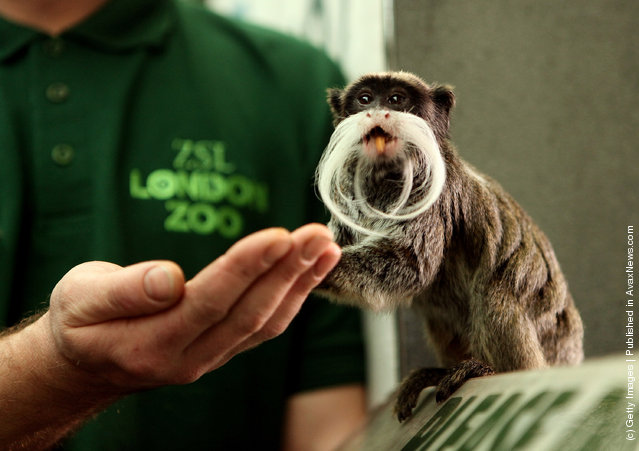
An Emperor Tamarin monkey, native to the Amazon rainforest, experiences its new home in the living rainforest enclosure at ZSL London Zoo on March 25, 2010 in London, England. Entitled “Rainforest Life” the large temperature and humidity controlled bio-dome is home to free-roaming monkeys, sloths, tree anteaters and tropical birds. The exhibit, which is opening in the International Year of Biodiversity, will be open to the public from March 27, 2010. (Photo by Oli Scarff/Getty Images)
Details
19 Apr 2011 11:48:00


The Enigma coding machine used by the Germans in WWII on display at Bletchley Park National Code Centre, November 25, 2004 in Bletchley, England. (Photo by Ian Waldie/Getty Images)
Details
24 Apr 2011 13:14:00
A model showcases The Bride by Stephane Rolland on the catwalk as part of Women's Fashion Week Haute Couture

A model showcases “The Bride” by Stephane Rolland on the catwalk as part of Women's Fashion Week Haute Couture program at Marina Bay Sands on October 30, 2011 in Singapore. (Photo by Chris McGrath/Getty Images)
Details
31 Oct 2011 11:32:00


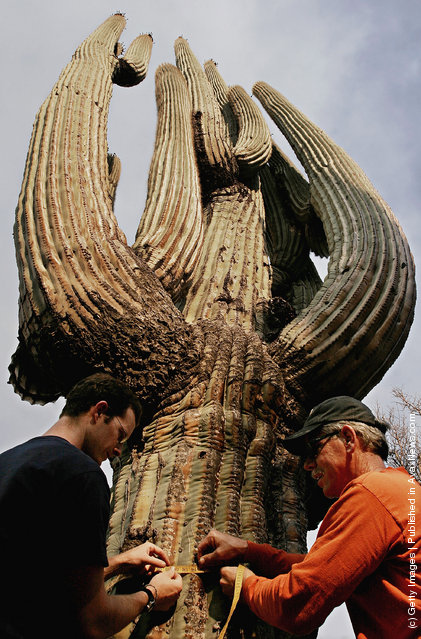
“The saguaro (scientific name Carnegiea gigantea) is a large, tree-sized cactus species in the monotypic genus Carnegiea. It is native to the Sonoran Desert in the U.S. state of Arizona, the Mexican state of Sonora, a small part of Baja California in the San Felipe Desert and an extremely small area of California, U.S. The saguaro blossom is the State Wildflower of Arizona”. – Wikipedia

Photo: Daniel Appel (L), a firefighter with Engine 84 from the Lassen National Forest in California and Mike Hallen, (R), Arizona representative of the National Register of Big Trees, measure the circumference of this Saguaro cactus called the "Grand One," in the Tonto National Forest on July 1, 2005 35 miles north of Phoenix, near Carefree, Arizona. The cactus, estimated to be more than 200 years old, measures a circumference of 7 feet, 10 inches (2.4 meters) and stands 46 feet high (14 meters). The cactus was burned in the Cave Creek Complex fire and may not survive. It was once the largest Saguaro in the world, two others have been found recently that have tied it's measurements. The fire has burned more than 214,000 acres of the Sonoran desert. (Photo by Jeff Topping/Getty Images)

Details
26 Jul 2011 12:27:00