Loading...
Done
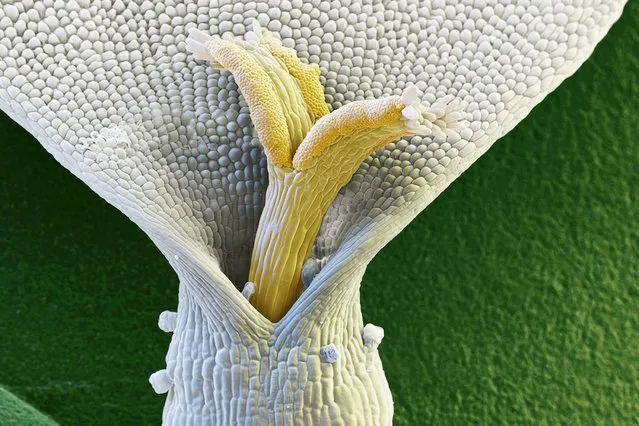
The floret of a Chamomile flower up close and personal. (Photo by Oliver Meckes/Barcroft Media)

These images have been created using a colour scanning electron microscope (SEM) by the award-winning Eye of Science, comprised of snapper Oliver Meckes and biologist Nicole Ottawa. For a decade the pair, based in Reutlingen in the south of Germany, worked with an old SEM they saved from the scrapheap, but for the last five years they have used a £250,000 FEI Quanta Series Field Emission SEM. Oliver said: “Flowers are beautiful in 'normal' view, but when you look closer, some parts get very bizarre and unexpected structures appear – flowers within flowers, worlds within worlds”. Photo: The floret of a Chamomile flower up close and personal. (Photo by Oliver Meckes/Barcroft Media)
Details
26 May 2014 13:51:00
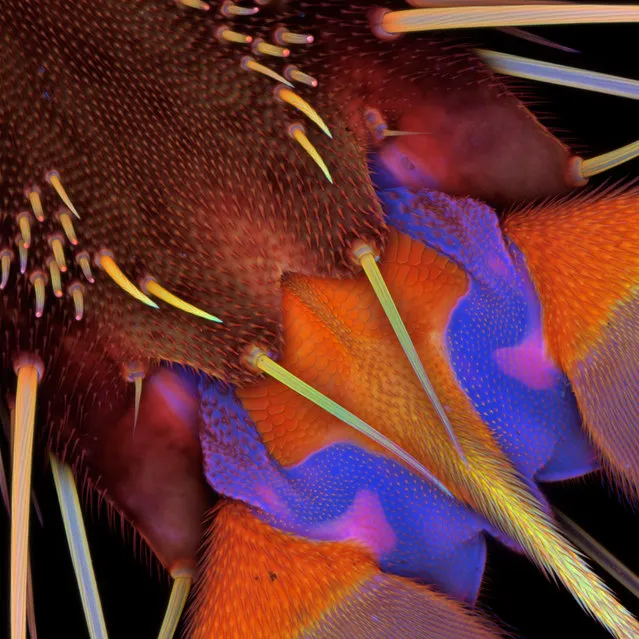
Pretarsus of the third leg of a female drone fly (Eristalis tenax), ventral view, by Dr. Jan Michels, Institute of Zoology, Christian-Albrechts-University of Kiel, Germany. (Photo by Olympus BioScapes)

“Microscope images forge an extraordinary bond between science and art, said Hidenao Tsuchiya, Olympus America's Vice President and General Manager for the Scientific Equipment Group. We founded this competition to focus on the fascinating stories coming out of today's life science research laboratories. The thousands of images that people have shared with the competition over the years reflect some of the most exciting work going on in research today – work that can help shed light on the living universe and ultimately save lives. We look at BioScapes and these beautiful images as sources of education and inspiration to us and the world”. – OlympusBioScapes

Photo: Pretarsus of the third leg of a female drone fly (Eristalis tenax), ventral view, by Dr. Jan Michels, Institute of Zoology, Christian-Albrechts-University of Kiel, Germany. (Photo by Olympus BioScapes)
Details
29 Jul 2012 09:20:00
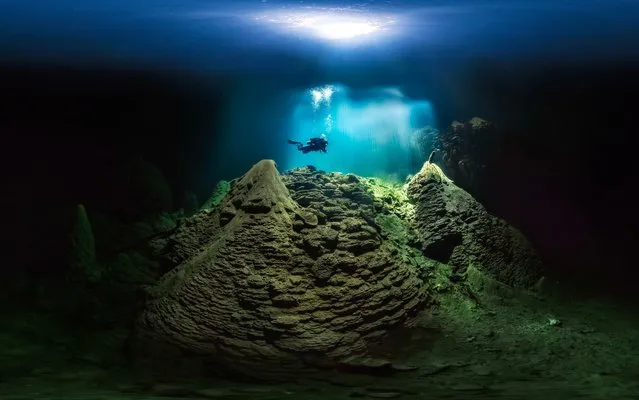
Cave Diver, Anhumas Abyss, Bonito, Brazil: The Anhumas Abyss is an underground cavern with a crystal-clear lake below, more than 260 feet (79 m) deep. A visitor must enter through a narrow opening at the top of the chamber and rappel into the cave. Snorkeling and scuba diving in the lake reveal amazing scenery. Distinctive, conical limestone stalagmites and stalactites occupy the lake and the surrounding area, some reaching 65 feet (20 m) high. “One must rappel about 235 feet (72 m) to get down into this deep lake. The photo was taken at a depth of 50 feet (15 m). It was a challenge to create the image because of the high contrast, plus the diver could not see into the darkness, making communication impossible”. (Photo by Marcio Cabral/Nature’s Best Photography Awards 2017)

Cave Diver, Anhumas Abyss, Bonito, Brazil: The Anhumas Abyss is an underground cavern with a crystal-clear lake below, more than 260 feet (79 m) deep. A visitor must enter through a narrow opening at the top of the chamber and rappel into the cave. Snorkeling and scuba diving in the lake reveal amazing scenery. Distinctive, conical limestone stalagmites and stalactites occupy the lake and the surrounding area, some reaching 65 feet (20 m) high. (Photo by Marcio Cabral/Nature’s Best Photography Awards 2017)
Details
26 Oct 2017 08:10:00
Portal To Hell

If we were to burn NH4Cr2O7 with HgSCN in the Dark Ages in Europe and show it to anyone, it is us who would be burning next on a fiery cross of Inquisition. And it’s no wonder, since this experiment produces a truly marvelous result. At first, as you ignite the mixture of NH4Cr2O7 and HgSCN, all you can see is that it is slowly burning with a reddish flame. After a while, however, a crater is formed in the middle of the burning pile, and then, suddenly, tentacle-like appendages start sprouting from the burning mixture. And you can almost hear the scream of the mad occultist – “Come forth, Kraken! Come forth!” But of course, this is simply a chemical reaction that is called the "Pharoah's Serpent". It was also often sold in firework stores until people realized that it was toxic.
Details
01 Dec 2014 13:51:00
Some riders in the New York City subway in the underwear as the take part in the 2013 No Pants Subway Ride January 13, 2013. Started by Improv Everywhere, the goal is for riders to get on the subway train dressed in normal winter clothes (without pants) and keep a straight face.  AFP PHOTO / TIMOTHY A. CLARY        (Photo credit should read TIMOTHY A. CLARY/AFP/Getty Images)

Pantless people stand on a subway platform on January 13, 2013 in New York City. Thousands of people participated in the 12th annual No Pants Subway Ride, organized by New York City prank collective Improv Everywhere. During the afternoon winter event, participants boarded separate subway stops and removed their pants, pretending that they did not know each other. The event, refered to as a “celebration of silliness” is designed to make fellow subway riders laugh and smile. (Photo by Timothy A. Clary/AFP Photo)
Details
14 Jan 2013 11:03:00
Two woman lie in a puddle of squashed tomatoes during the annual “Tomatina” tomato fight fiesta, in the village of Bunol, 50 kilometers outside Valencia, Spain, Wednesday, August 26, 2015. The streets of an eastern Spanish town are awash with red pulp as thousands of people pelt each other with tomatoes in the annual "Tomatina" battle that has become a major tourist attraction. (Photo by Alberto Saiz/AP Photo)

Two woman lie in a puddle of squashed tomatoes during the annual “Tomatina” tomato fight fiesta, in the village of Bunol, 50 kilometers outside Valencia, Spain, Wednesday, August 26, 2015. The streets of an eastern Spanish town are awash with red pulp as thousands of people pelt each other with tomatoes in the annual "Tomatina" battle that has become a major tourist attraction. At the annual fiesta in Bunol on Wednesday, trucks dumped 150 tons of ripe tomatoes for some 22,000 participants, many from abroad to throw during the hour-long morning festivities. (Photo by Alberto Saiz/AP Photo)
Details
27 Aug 2015 11:51:00
Life reconstruction of the new oviraptorosaurian dinosaur species Anzu wyliei in its 66 million-year-old environment in western North America as seen in an undated handout illustration by Mark A. Klinger, Carnegie Museum of Natural History. Some 18,000 species, great and small, were discovered in 2014, adding to the 2 million already known, scientists said on May 21, 2015 as they released a “Top 10” list that highlights the diversity of life. (Photo by Mark A. Klingler/Reuters/Carnegie Museum of Natural History)

Life reconstruction of the new oviraptorosaurian dinosaur species Anzu wyliei in its 66 million-year-old environment in western North America as seen in an undated handout illustration by Mark A. Klinger, Carnegie Museum of Natural History. Some 18,000 species, great and small, were discovered in 2014, adding to the 2 million already known, scientists said on May 21, 2015 as they released a “Top 10” list that highlights the diversity of life. Anzu wyliei, one of the top 10, dubbed “the chicken from hell”, is extinct. The feathered dinosaur whose partial skeletons were unearthed in the Dakotas was a contemporary of T. rex and Triceratops. (Photo by Mark A. Klingler/Reuters/Carnegie Museum of Natural History)
Details
22 May 2015 12:31:00
Chinese artist Zhou Jie takes a nap on an unfinished iron wire bed, one of her sculpture works, after lunch at Beijing Now Art Gallery, in Beijing August 11, 2014. Zhou started her art project titled “36 Days” on August 9, in which she would live inside an exhibition hall with an unfinished iron wire bed, some iron wire sculptures in the shape of stuffed animal dolls, a certain amount of food and her mobile phone, for 36 days. (Photo by Jason Lee/Reuters)

Chinese artist Zhou Jie takes a nap on an unfinished iron wire bed, one of her sculpture works, after lunch at Beijing Now Art Gallery, in Beijing August 11, 2014. Zhou started her art project titled “36 Days” on August 9, in which she would live inside an exhibition hall with an unfinished iron wire bed, some iron wire sculptures in the shape of stuffed animal dolls, a certain amount of food and her mobile phone, for 36 days. The entire process is open to visitors and she may also interact with them, according to Zhou. (Photo by Jason Lee/Reuters)
Details
22 Aug 2014 12:04:00