Loading...
Done
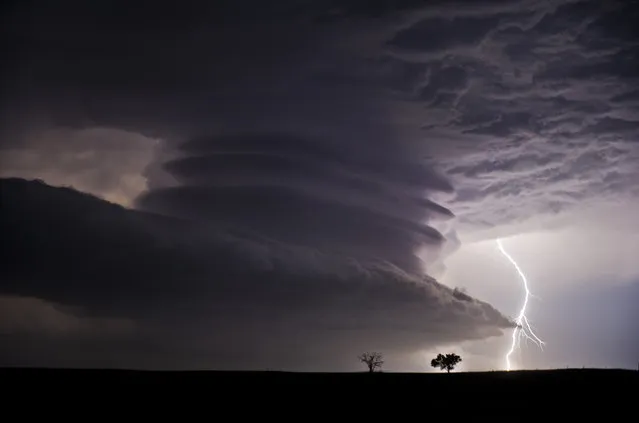
“Stacked Supercell with Lightning”. This huge mesocyclone supercell was near the Nebraska / Kansas border on the night of June 22nd, 2012. What a stunning structure! (Photo and caption by Jennifer Brindley/National Geographic Traveler Photo Contest)

“Stacked Supercell with Lightning”. This huge mesocyclone supercell was near the Nebraska / Kansas border on the night of June 22nd, 2012. What a stunning structure! (Photo and caption by Jennifer Brindley/National Geographic Traveler Photo Contest)

ATTENTION! All pictures are presented in high resolution. To see Hi-Res images – just TWICE click on any picture. In other words, click small picture – opens the BIG picture. Click BIG picture – opens VERY BIG picture.
Details
25 Jun 2013 13:12:00
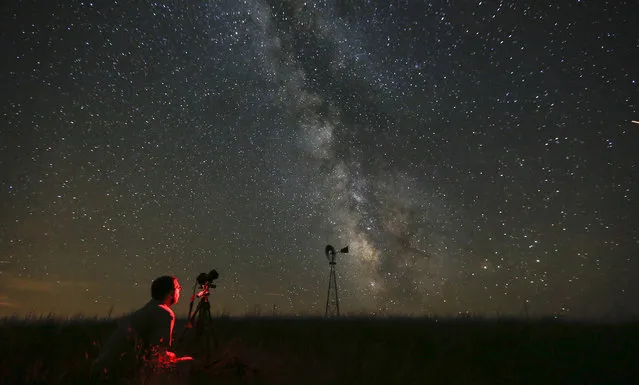
In this Wednesday, July 23, 2014 file photo, Omaha photographer Lane Hickenbottom photographs the night sky in a pasture near Callaway, Neb. With no moon in the sky, the Milky Way was visible to the naked eye. More than one-third of the world’s population can no longer see the Milky Way because of man-made lights, according to a scientific paper by Light Pollution Science and Technology Institute's Fabio Falchi and his team members, published on Friday, June 10, 2016. (Photo by Travis Heying/The Wichita Eagle via AP Photo)

In this Wednesday, July 23, 2014 file photo, Omaha photographer Lane Hickenbottom photographs the night sky in a pasture near Callaway, Neb. With no moon in the sky, the Milky Way was visible to the naked eye. More than one-third of the world’s population can no longer see the Milky Way because of man-made lights, according to a scientific paper by Light Pollution Science and Technology Institute's Fabio Falchi and his team members, published on Friday, June 10, 2016. (Photo by Travis Heying/The Wichita Eagle via AP Photo)
Details
11 Jun 2016 12:37:00
“Cassowaries are large, flightless birds related to emus and (more distantly) to ostriches, rheas, and kiwis”, writes Olivia Judson in the September issue of National Geographic magazine. (Photo by Christian Ziegler/National Geographic)

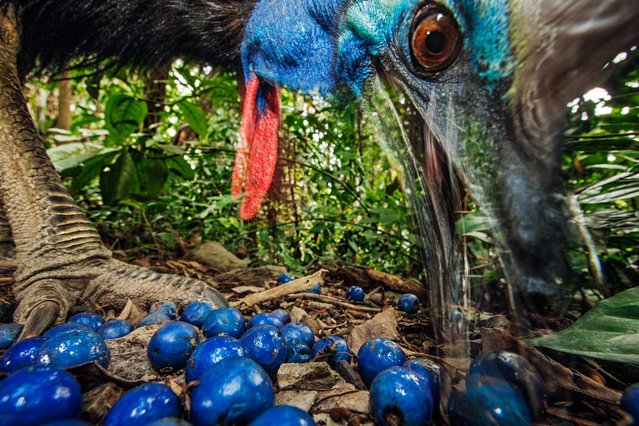
“Cassowaries are large, flightless birds related to emus and (more distantly) to ostriches, rheas, and kiwis”, writes Olivia Judson in the September issue of National Geographic magazine. How large? People-size: Adult males stand well over five foot five and top 110 pounds. Females are even taller, and can weigh more than 160 pounds. Dangerous when roused, they’re shy and peaceable when left alone. But even birds this big and tough are prey to habitat loss. The dense New Guinea and Australia rain forests where they live have dwindled. Today cassowaries might number 1,500 to 2,000. And because they help shape those same forests – by moving seeds from one place to another – “if they vanish”, Judson writes, “the structure of the forest would gradually change” too. (Photo by Christian Ziegler/National Geographic)
Details
06 Jan 2014 12:21:00
Syrian refugees sit behind barbed wire as they wait to cross into Macedonia at the Greek-Macedonian border, near the village of Idomeni, August 21, 2015. (Photo by Yannis Behrakis/Reuters)

Syrian refugees sit behind barbed wire as they wait to cross into Macedonia at the Greek-Macedonian border, near the village of Idomeni, August 21, 2015. (Photo by Yannis Behrakis/Reuters)
Details
12 Dec 2015 08:01:00
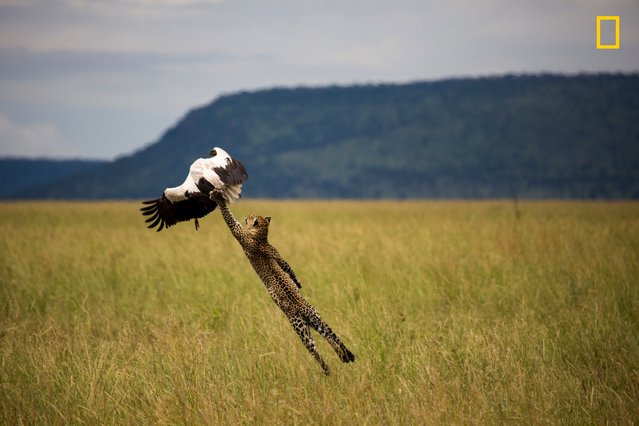
“Leopard Hunting a Stork”. “One-shot capture. I watched the leopard stalking the stork, I only had time to focus at 400mm, no time to change to high speed, I watched the stork, and as soon as it flapped its wings, I shot one shot”. (Photo by Paul Rifkin/National Geographic Travel Photographer of the Year Contest)

“Leopard Hunting a Stork”. “One-shot capture. I watched the leopard stalking the stork, I only had time to focus at 400mm, no time to change to high speed, I watched the stork, and as soon as it flapped its wings, I shot one shot”. (Photo by Paul Rifkin/National Geographic Travel Photographer of the Year Contest)
Details
04 Jun 2018 00:03:00
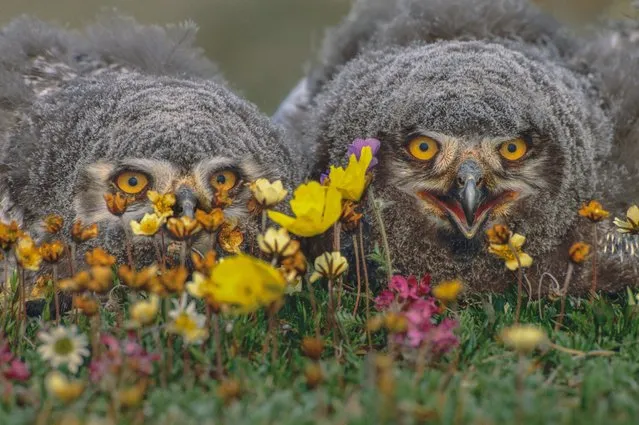
Snowy owlets (Bubo scandiacus), Arctic National Wildlife Refuge, Alaska, USA. “A pair of gray-feathered snowy owlets hunker down in the abundant flowers that flourish in the dropping-enriched soil of their nest mound”. (Photo by Art Wolfe/Art Wolfe Stock)

The photography of Art Wolfe covers the globe, capturing landscapes, wildlife, and cultures from every continent; here he talks through a selection of his favourite images. Art Wolfe is an American photographer and conservationist. His photographs have been noted by environmental advocacy groups for their “stunning” visual impact. Here: Snowy owlets (Bubo scandiacus), Arctic National Wildlife Refuge, Alaska, USA. (Photo by Art Wolfe/Art Wolfe Stock)
Details
19 Mar 2018 00:05:00
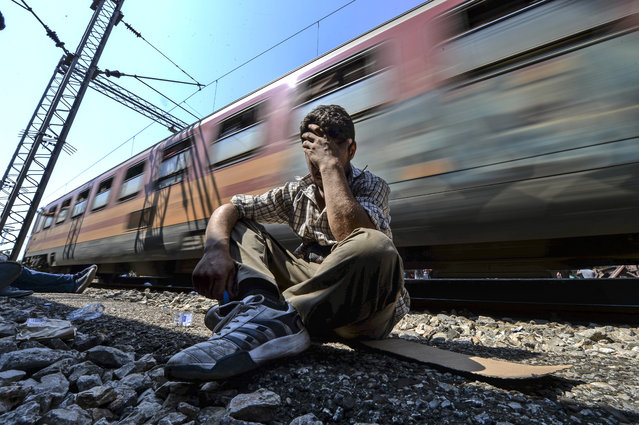
An exhausted and frustated migrant holds his head after he missed to get a place on a train heading to the Serbian border at the train station in Gevgelija, The Former Yugoslav Republic of Macedonia, August 13, 2015. (Photo by Georgi Licovski/EPA)

An exhausted and frustated migrant holds his head after he missed to get a place on a train heading to the Serbian border at the train station in Gevgelija, The Former Yugoslav Republic of Macedonia, August 13, 2015. From the beginning of the year to mid-June 2015, nearly 160,000 migrants landed in the southern European countries, mainly Greece and Italy, on their way to wealthier countries in Western and Northern Europe, according to estimates by the International Organization for Migration (IOM). (Photo by Georgi Licovski/EPA)
Details
14 Aug 2015 13:56:00
A topless woman walks through Bryant Park following the protest march called the GoTopless Day Parade Sunday, August 23, 2015, in New York. The parade took to the streets to counter critics who are complaining about topless tip-seekers in Times Square. Appearing bare-breasted is legal in New York. But Mayor Bill de Blasio and police Commissioner Bill Bratton say the body-painted women in the square who take photos with tourists are a nuisance. (Photo by Kevin Hagen/AP Photo)

A topless woman walks through Bryant Park following the protest march called the GoTopless Day Parade Sunday, August 23, 2015, in New York. The parade took to the streets to counter critics who are complaining about topless tip-seekers in Times Square. Appearing bare-breasted is legal in New York. But Mayor Bill de Blasio and police Commissioner Bill Bratton say the body-painted women in the square who take photos with tourists are a nuisance. (Photo by Kevin Hagen/AP Photo)
Details
24 Aug 2015 13:53:00