Loading...
Done
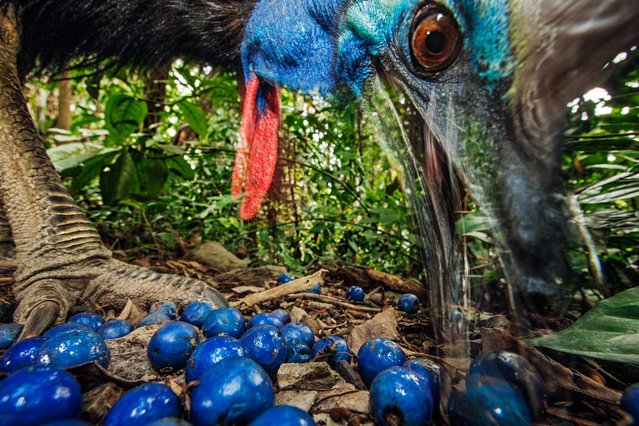
“Cassowaries are large, flightless birds related to emus and (more distantly) to ostriches, rheas, and kiwis”, writes Olivia Judson in the September issue of National Geographic magazine. (Photo by Christian Ziegler/National Geographic)

“Cassowaries are large, flightless birds related to emus and (more distantly) to ostriches, rheas, and kiwis”, writes Olivia Judson in the September issue of National Geographic magazine. How large? People-size: Adult males stand well over five foot five and top 110 pounds. Females are even taller, and can weigh more than 160 pounds. Dangerous when roused, they’re shy and peaceable when left alone. But even birds this big and tough are prey to habitat loss. The dense New Guinea and Australia rain forests where they live have dwindled. Today cassowaries might number 1,500 to 2,000. And because they help shape those same forests – by moving seeds from one place to another – “if they vanish”, Judson writes, “the structure of the forest would gradually change” too. (Photo by Christian Ziegler/National Geographic)
Details
06 Jan 2014 12:21:00
Cars float up from a car garage in a mixture of storm water and gasoline in lower Manhattan as workers begin the process of pumping out the mess. (Photo by Carolyn Cole/Los Angeles Times/MCT)

Cars float up from a car garage in a mixture of storm water and gasoline in lower Manhattan as workers begin the process of pumping out the mess. (Photo by Carolyn Cole/Los Angeles Times/MCT)
Details
31 Oct 2012 13:36:00
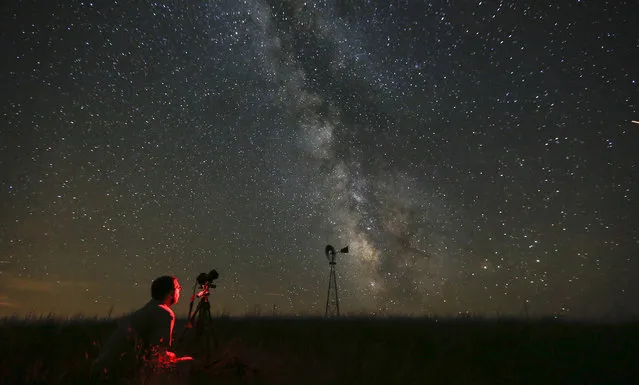
In this Wednesday, July 23, 2014 file photo, Omaha photographer Lane Hickenbottom photographs the night sky in a pasture near Callaway, Neb. With no moon in the sky, the Milky Way was visible to the naked eye. More than one-third of the world’s population can no longer see the Milky Way because of man-made lights, according to a scientific paper by Light Pollution Science and Technology Institute's Fabio Falchi and his team members, published on Friday, June 10, 2016. (Photo by Travis Heying/The Wichita Eagle via AP Photo)

In this Wednesday, July 23, 2014 file photo, Omaha photographer Lane Hickenbottom photographs the night sky in a pasture near Callaway, Neb. With no moon in the sky, the Milky Way was visible to the naked eye. More than one-third of the world’s population can no longer see the Milky Way because of man-made lights, according to a scientific paper by Light Pollution Science and Technology Institute's Fabio Falchi and his team members, published on Friday, June 10, 2016. (Photo by Travis Heying/The Wichita Eagle via AP Photo)
Details
11 Jun 2016 12:37:00
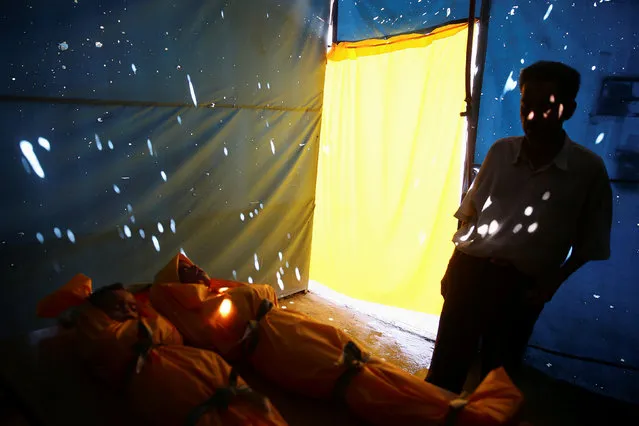
A man stands near bodies of his young relatives after an airstrike in the rebel held Douma neighbourhood of Damascus, Syria August 22, 2016. (Photo by Bassam Khabieh/Reuters)

A man stands near bodies of his young relatives after an airstrike in the rebel held Douma neighbourhood of Damascus, Syria August 22, 2016. (Photo by Bassam Khabieh/Reuters)
Details
26 Aug 2016 10:52:00
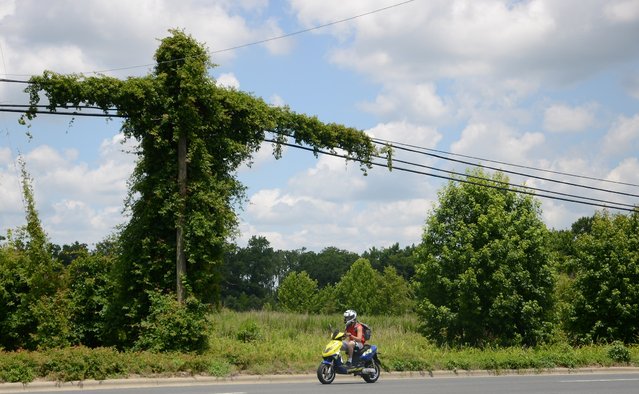
Large trumpet vines spread across electrical lines next to a highway in Kinston, N.C., on June 23, 2014. (Photo by Janet S. Carter/Kinston Free Press via AP Photo)

Large trumpet vines spread across electrical lines next to a highway in Kinston, N.C., on June 23, 2014. (Photo by Janet S. Carter/Kinston Free Press via AP Photo)
Details
28 Jun 2014 13:44:00
A member of the Revolutionary Armed Forces of Colombia (FARC) pose for a picture at a camp in the Colombian mountains on February 2005. (Photo by Frank Piasecki Poulsen)

A member of the Revolutionary Armed Forces of Colombia (FARC) pose for a picture at a camp in the Colombian mountains on February 2005. (Photo by Frank Piasecki Poulsen)
Details
29 Sep 2016 08:51:00
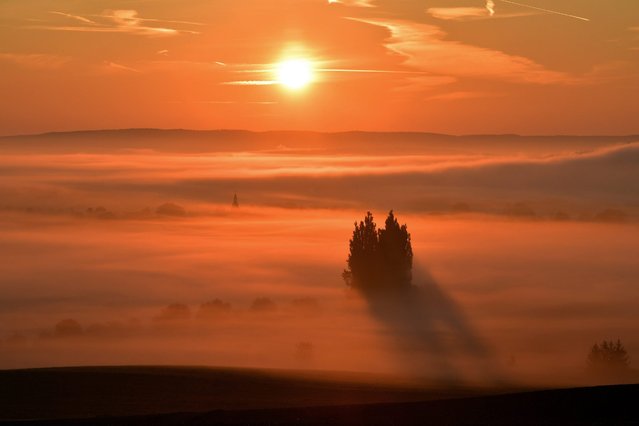
A layer of morning mist still covers the fields as the sun rises into the morning sky over Hohenfelden, Thuringia state, Germany, early 07 September 2016. Meteorologists predict the weather to become warm and sunny in the region with temperatures reaching around 256 degrees Celsius. (Photo by Martin Schutt/EPA)

A layer of morning mist still covers the fields as the sun rises into the morning sky over Hohenfelden, Thuringia state, Germany, early 07 September 2016. Meteorologists predict the weather to become warm and sunny in the region with temperatures reaching around 256 degrees Celsius. (Photo by Martin Schutt/EPA)
Details
22 Oct 2016 10:36:00
“Early morning in Mandawa, rural Rajasthan: it was the morning of Diwali and the streets were swept by smiling women in brightly coloured sarees as I took an early morning cup of chai. Celebrations started later, when darkness fell”. (Photo by Hamish Scott-Brown/Guardian Witness)

“Early morning in Mandawa, rural Rajasthan: it was the morning of Diwali and the streets were swept by smiling women in brightly coloured sarees as I took an early morning cup of chai. Celebrations started later, when darkness fell”. (Photo by Hamish Scott-Brown/Guardian Witness)
Details
20 Dec 2016 12:57:00