Loading...
Done


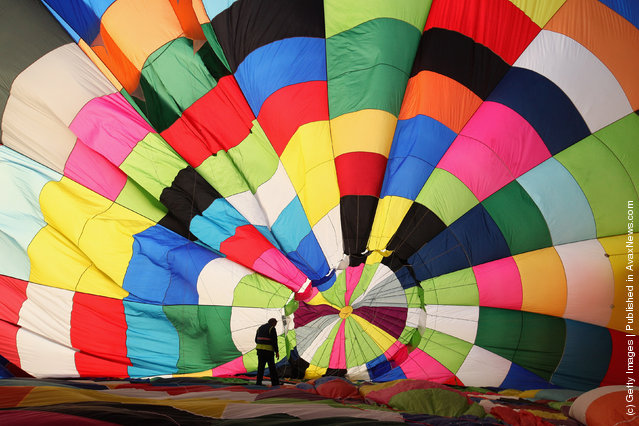
WOOTTON, UNITED KINGDOM - APRIL 07: Hot air balloons prepare to depart from Lydden Hill race circuit near Canterbury to take part in mass crossing of the Channel on April 7, 2011 in Wootton, England. 51 balloonists of various nationalities from across Europe took off from Kent making for Calais, France at about 7am. It is the first time a Guinness World Record bid has been made for "the largest group of hot air balloons to make the Channel crossing". (Photo by Oli Scarff/Getty Images)
Details
07 Apr 2011 10:15:00
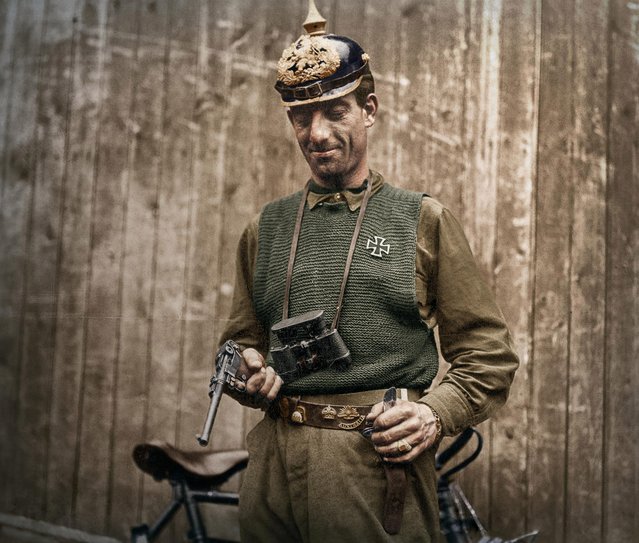
One image shows an unidentified American soldier posing with a pistol, helmet, and Iron Cross medal taken from a German soldier, 1918. (Photo by Mario Unger/Mediadrumworld)

The faces of war have been brought back to life after a series of World War One photographs were expertly colourised. The black and white snaps were painstakingly restored and colourised by photographer Mario Unger (53) from Rotenturm, Austria. Here: One image shows an unidentified American soldier posing with a pistol, helmet, and Iron Cross medal taken from a German soldier, 1918. (Photo by Mario Unger/Mediadrumworld)
Details
04 Dec 2017 07:47:00
Wrestlers compete in a 'Sindhi Malakhra' wrestling match, an ancient form of wrestling that originated in Pakistan's Sindh region, during a local tournament in Karachi on October 21, 2025. (Photo by Asif Hassan/AFP Photo)

Wrestlers compete in a 'Sindhi Malakhra' wrestling match, an ancient form of wrestling that originated in Pakistan's Sindh region, during a local tournament in Karachi on October 21, 2025. (Photo by Asif Hassan/AFP Photo)
Details
24 Dec 2025 10:10:00
Haitian soldiers shoot in the air to try to control the crowd as they wait for food to be handed out after Hurricane Matthew hit Jeremie, Haiti, October 18, 2016. (Photo by Carlos Garcia Rawlins/Reuters)

Haitian soldiers shoot in the air to try to control the crowd as they wait for food to be handed out after Hurricane Matthew hit Jeremie, Haiti, October 18, 2016. (Photo by Carlos Garcia Rawlins/Reuters)
Details
20 Oct 2016 11:02:00
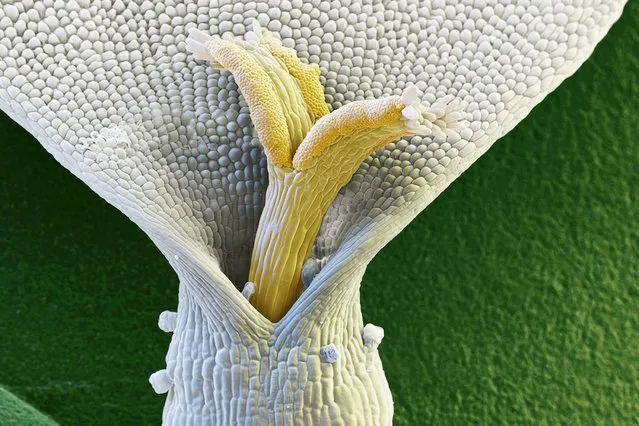
The floret of a Chamomile flower up close and personal. (Photo by Oliver Meckes/Barcroft Media)

These images have been created using a colour scanning electron microscope (SEM) by the award-winning Eye of Science, comprised of snapper Oliver Meckes and biologist Nicole Ottawa. For a decade the pair, based in Reutlingen in the south of Germany, worked with an old SEM they saved from the scrapheap, but for the last five years they have used a £250,000 FEI Quanta Series Field Emission SEM. Oliver said: “Flowers are beautiful in 'normal' view, but when you look closer, some parts get very bizarre and unexpected structures appear – flowers within flowers, worlds within worlds”. Photo: The floret of a Chamomile flower up close and personal. (Photo by Oliver Meckes/Barcroft Media)
Details
26 May 2014 13:51:00
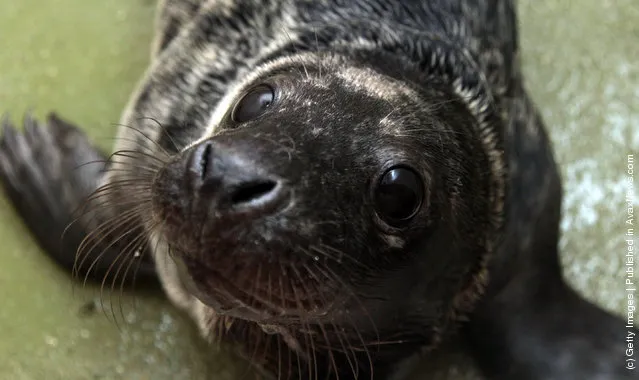
A recently rescued grey seal pup looks up from its indoor kennel at the RSPCA West Hatch Wildlife Centre

A recently rescued grey seal pup looks up from its indoor kennel at the RSPCA West Hatch Wildlife Centre on January 9, 2012 in Taunton, England. The centre is currently dealing with a number of mainly grey seals that have been rescued from the coast due to the recent storms. Staff at the centre hope to release all the seals back into the wild by the spring. (Photo by Matt Cardy/Getty Images)
Details
10 Jan 2012 13:34:00
2013. A woman is visible through a narrow passageway between two buildings. Norilsk's urban spaces were designed to shorten distances around large developments and give residents maximum protection from arctic winds. (Photo by Elena Chernyshova)

Elena Chernyshova's vision of Norilsk, Russia, the northernmost city in the world, is a series of surprises by which she extracts otherworldly beauty from ugly realities. Here: 2013. A woman is visible through a narrow passageway between two buildings. Norilsk's urban spaces were designed to shorten distances around large developments and give residents maximum protection from arctic winds. (Photo by Elena Chernyshova)
Details
10 Jan 2016 08:03:00
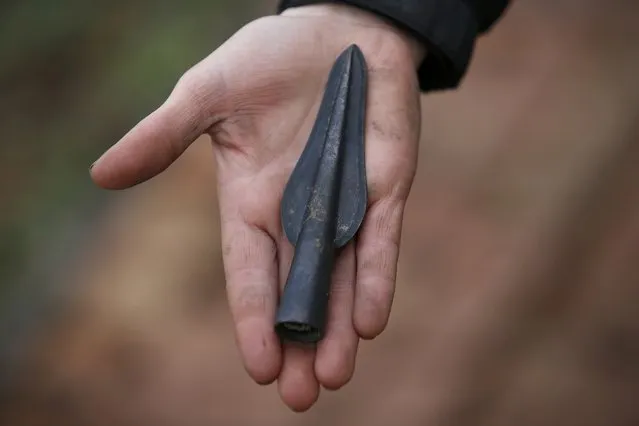
An arrow-head discovered in 2006 by Archaeologists of the University of Cambridge Archaeological Unit, is displayed by one of the team uncovering Bronze Age wooden houses, preserved in silt, from a quarry near Peterborough, Britain, January 12, 2016. (Photo by Peter Nicholls/Reuters)

An arrow-head discovered in 2006 by Archaeologists of the University of Cambridge Archaeological Unit, is displayed by one of the team uncovering Bronze Age wooden houses, preserved in silt, from a quarry near Peterborough, Britain, January 12, 2016. Archaeologists said on Tuesday they had discovered what were believed to be the best-preserved Bronze Age dwellings ever found in Britain, providing an extraordinary insight into prehistoric life from 3,000 years ago. (Photo by Peter Nicholls/Reuters)
Details
14 Jan 2016 08:00:00