Loading...
Done
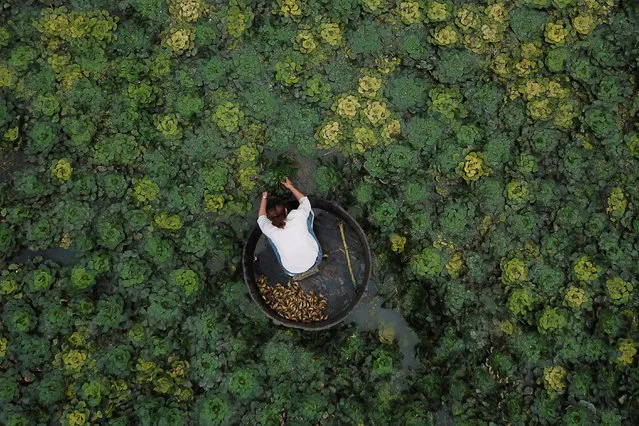
A villager harvests water chestnuts in Feijiadai Village, Zhejiang Province, China on September 20, 2019. (Photo by Huang Zongzhi/Xinhua News Agency/Barcroft Media)

A villager harvests water chestnuts in Feijiadai Village, Zhejiang Province, China on September 20, 2019. (Photo by Huang Zongzhi/Xinhua News Agency/Barcroft Media)
Details
01 Nov 2019 00:01:00
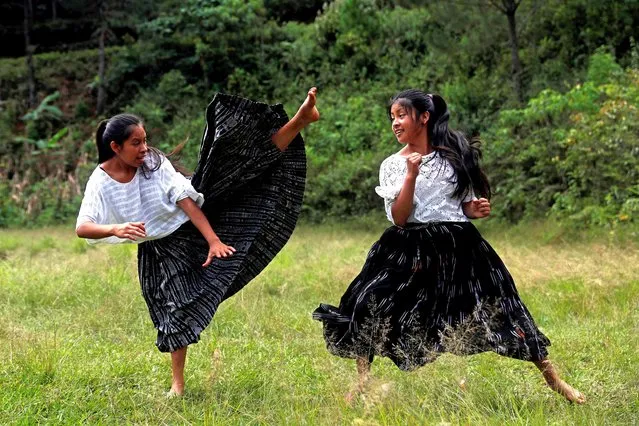
Indigenous Q'eqchi girls practice taekwondo with their teacher, Danny Coy, on a dirt court in the middle of the village in Tipulcan village, San Pedro Carcha, Guatemala, on 25 November 2019 (issued 27 November 2019). Tipulcan village girls learn taekwondo to combat sexist violence and harassment they have suffered in their community in northern Guatemala. (Photo by Esteban Biba/EPA/EFE)

Indigenous Q'eqchi girls practice taekwondo with their teacher, Danny Coy, on a dirt court in the middle of the village in Tipulcan village, San Pedro Carcha, Guatemala, on 25 November 2019 (issued 27 November 2019). Tipulcan village girls learn taekwondo to combat sexist violence and harassment they have suffered in their community in northern Guatemala. (Photo by Esteban Biba/EPA/EFE)
Details
01 Dec 2019 00:07:00
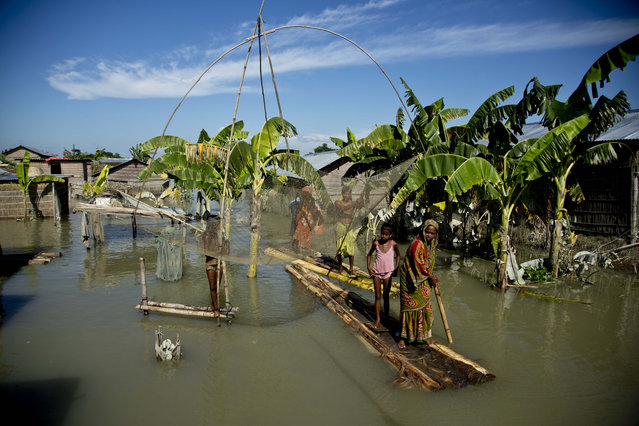
A flood affected family moves on a banana raft past a fishing net in Morigaon district, east of Gauhati, northeastern Assam state, India, Sunday, July 31, 2016. A week of heavy rain has killed dozens of people and uprooted tens of thousands of others from their homes. Floods are an annual occurrence in Assam and many parts of India during the June-September monsoon season. (Photo by Anupam Nath/AP Photo)

A flood affected family moves on a banana raft past a fishing net in Morigaon district, east of Gauhati, northeastern Assam state, India, Sunday, July 31, 2016. A week of heavy rain has killed dozens of people and uprooted tens of thousands of others from their homes. Floods are an annual occurrence in Assam and many parts of India during the June-September monsoon season. (Photo by Anupam Nath/AP Photo)
Details
01 Aug 2016 10:30:00
A visitor jumps for a photograph on the world's highest and longest glass-bottomed bridge  above a valley in Zhangjiajie in China's Hunan Province on August 21, 2016. The bridge, which opened to the public on a trial basis on Saturday, spans 430 meters (1,410 feet) and rises about 300 meters (984 feet) above a valley in a scenic zone, making it the world's highest and longest glass-bottomed bridge according to Chinese state media. (Photo by Fred Dufour/AFP Photo)

A visitor jumps for a photograph on the world's highest and longest glass-bottomed bridge above a valley in Zhangjiajie in China's Hunan Province on August 21, 2016. The bridge, which opened to the public on a trial basis on Saturday, spans 430 meters (1,410 feet) and rises about 300 meters (984 feet) above a valley in a scenic zone, making it the world's highest and longest glass-bottomed bridge according to Chinese state media. (Photo by Fred Dufour/AFP Photo)
Details
22 Aug 2016 13:19:00
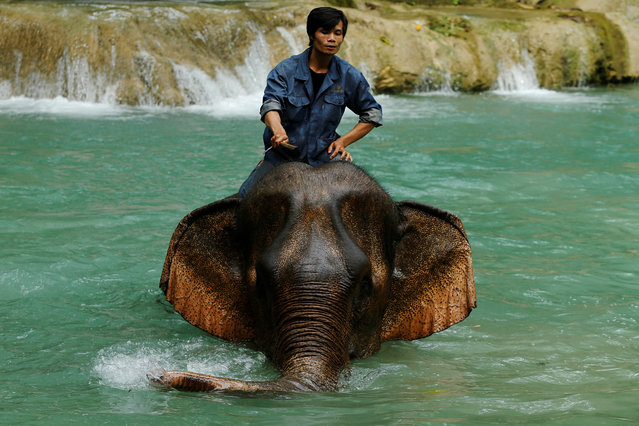
A mahout rides an elephant at Tad Sae Waterfall outside Luang Prabang, Laos July 31, 2016. (Photo by Jorge Silva/Reuters)

A mahout rides an elephant at Tad Sae Waterfall outside Luang Prabang, Laos July 31, 2016. Protected by the United Nations cultural heritage agency UNESCO, Luang Prabang is one of the most alluring places in the region – a city that evokes old-world romance that has gained a reputation as a travellers' Shangri La. (Photo by Jorge Silva/Reuters)
Details
04 Sep 2016 09:05:00
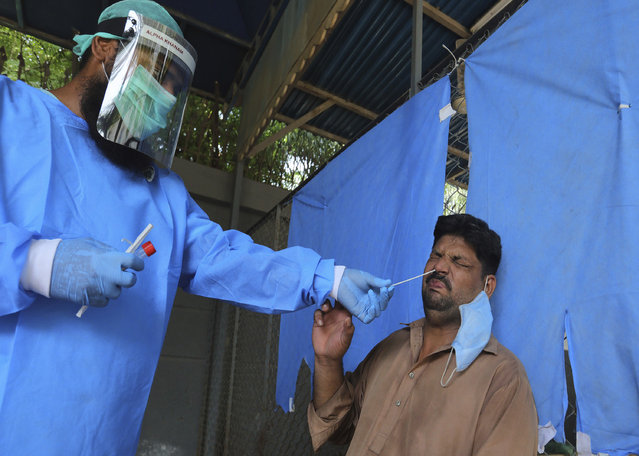
A man reacts while having a nasal swab sample taken at a testing and screening facility for the coronavirus, in a hospital in Karachi, Pakistan, Friday, August 21, 2020. (Photo by Fareed Khan/AP Photo)

A man reacts while having a nasal swab sample taken at a testing and screening facility for the coronavirus, in a hospital in Karachi, Pakistan, Friday, August 21, 2020. (Photo by Fareed Khan/AP Photo)
Details
16 Sep 2020 00:01:00
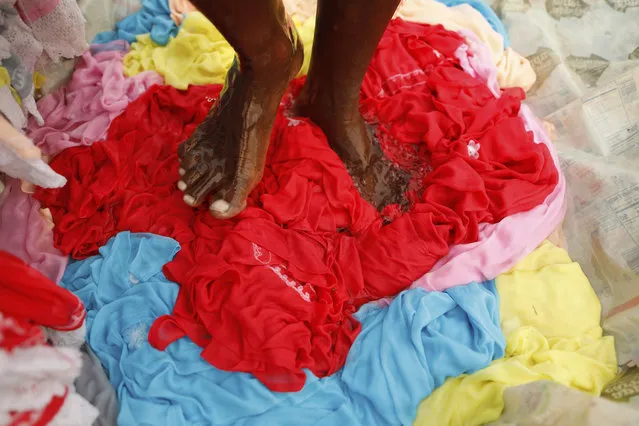
A dhobi, or a washerman washes cloths on the banks of the River Gomti in Lucknow, India, Saturday, September 12, 2020. Dhobis are traditional laundry workers who wash clothes by hand and dry them in the sun, an occupation which has been in existence for generations. Most cities in India have a Dhobi Ghat, or washermen's area, where the city's pile of clothes is laundered. This practice is still popular in India, despite of modern technology. Around 1,000 families work in Lucknow's Dhobi Ghat. However, in light of the novel coronavirus, their wages have decreased drastically. With each family earning around US$100-200 per month. (Photo by Rajesh Kumar Singh/AP Photo)

A dhobi, or a washerman washes cloths on the banks of the River Gomti in Lucknow, India, Saturday, September 12, 2020. Dhobis are traditional laundry workers who wash clothes by hand and dry them in the sun, an occupation which has been in existence for generations. Most cities in India have a Dhobi Ghat, or washermen's area, where the city's pile of clothes is laundered. This practice is still popular in India, despite of modern technology. Around 1,000 families work in Lucknow's Dhobi Ghat. However, in light of the novel coronavirus, their wages have decreased drastically. With each family earning around US$100-200 per month. (Photo by Rajesh Kumar Singh/AP Photo)
Details
25 Sep 2020 00:03:00
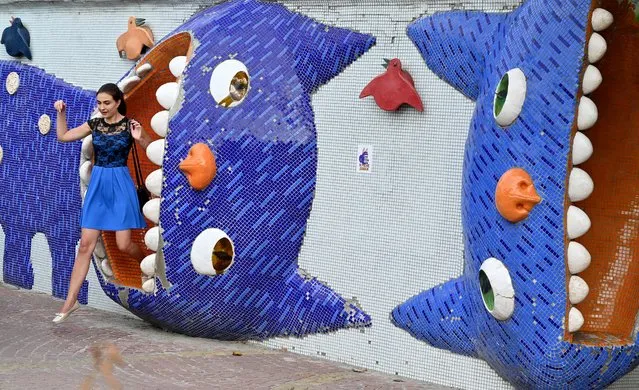
A woman jumps out of a street art object in the center of the Ukrainian capital of Kiev during a warm autumn day on September 25, 2020. (Photo by Sergei Supinsky/AFP Photo)

A woman jumps out of a street art object in the center of the Ukrainian capital of Kiev during a warm autumn day on September 25, 2020. (Photo by Sergei Supinsky/AFP Photo)
Details
09 Oct 2020 00:05:00