Loading...
Done
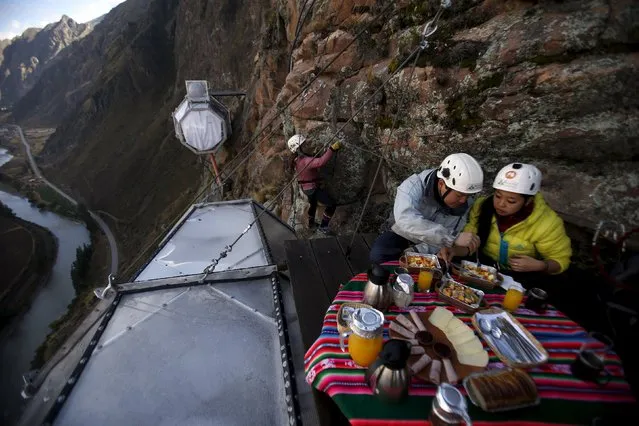
Guests have breakfast as another guest climbs to gather at the Skylodge Adventure Suites in the Sacred Valley in Cuzco, Peru, August 14, 2015. Tourists taking on an arduous climb up the steep cliff face of Peru's Sacred Valley are being rewarded for their efforts by being able to spend the night in transparent mountaintop sleeping pods at the “Skylodge Adventure Suites”. (Photo by Pilar Olivares/Reuters)

Guests have breakfast as another guest climbs to gather at the Skylodge Adventure Suites in the Sacred Valley in Cuzco, Peru, August 14, 2015. Tourists taking on an arduous climb up the steep cliff face of Peru's Sacred Valley are being rewarded for their efforts by being able to spend the night in transparent mountaintop sleeping pods at the “Skylodge Adventure Suites”. To reach the pods, visitors need to climb 400 metres of via ferrata (a steel cable and rungs) up the valley side or hike an intrepid trail through zip lines. (Photo by Pilar Olivares/Reuters)
Details
19 Aug 2015 12:53:00
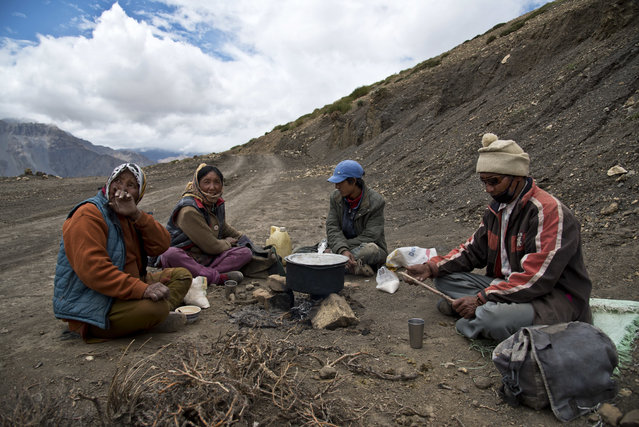
In this August 17, 2016, photo, from left to right, Chhering Chodom, 60, Tashi Yangzom, 50, Lobsang Chhering, 27, and Dorje Tandup, 58, drink milk tea on the side of the road. For centuries, the sleepy valley nestled in the Indian Himalayas remained a hidden Buddhist enclave forbidden to outsiders. Enduring the harsh year-round conditions of the high mountain desert, the people of Spiti Valley lived by a simple communal code – share the Earth's bounty, be hospitable to neighbors, and eschew greed and temptation at all turns. That's all starting to change, for better or worse. Since India began allowing its own citizens as well as outsiders to visit the valley in the early 1990s, tourism and trade have boomed. And the marks of modernization, such as solar panels, asphalt roads and concrete buildings, have begun to appear around some of the villages that dot the remote landscape at altitudes above 4,000 meters (13,000 feet). (Photo by Thomas Cytrynowicz/AP Photo)

In this August 17, 2016, photo, from left to right, Chhering Chodom, 60, Tashi Yangzom, 50, Lobsang Chhering, 27, and Dorje Tandup, 58, drink milk tea on the side of the road. For centuries, the sleepy valley nestled in the Indian Himalayas remained a hidden Buddhist enclave forbidden to outsiders. Enduring the harsh year-round conditions of the high mountain desert, the people of Spiti Valley lived by a simple communal code – share the Earth's bounty, be hospitable to neighbors, and eschew greed and temptation at all turns. That's all starting to change, for better or worse. (Photo by Thomas Cytrynowicz/AP Photo)
Details
15 Sep 2016 09:22:00
Airmen and their Japanese  dates “do” the town together, visiting the local points of interest. Almost every community in Japan has it's famous shrines and parks.  Tachikawa boasts beautiful environment. Girls are wearing western dress, May 1952. (Photo by National Archives and Records Administration)

Airmen and their Japanese dates “do” the town together, visiting the local points of interest. Almost every community in Japan has it's famous shrines and parks. Tachikawa boasts beautiful environment. Girls are wearing western dress, May 1952. (Photo by National Archives and Records Administration)
Details
10 Oct 2016 09:55:00
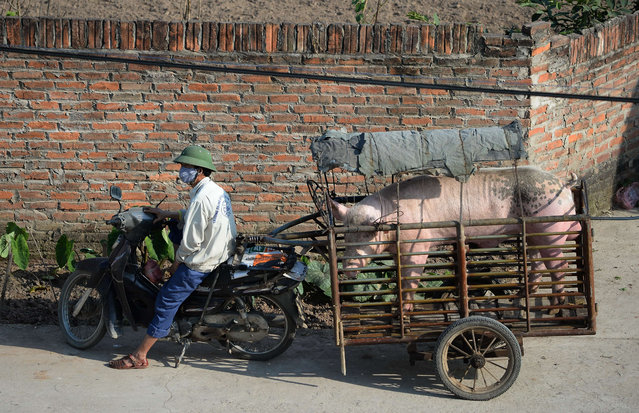
This picture taken on March 1, 2016 shows a man running a mobile pig mating service and waiting outside a customer's home with his male pig in a cage pulled behind his motorcycle in the northern province of Bac Ninh. (Photo by Hoang Dinh Nam/AFP Photo)

This picture taken on March 1, 2016 shows a man running a mobile pig mating service and waiting outside a customer's home with his male pig in a cage pulled behind his motorcycle in the northern province of Bac Ninh. (Photo by Hoang Dinh Nam/AFP Photo)
Details
24 May 2016 09:20:00
The six-months-old female koala cub holds on to the back of zoo keeper Lena at the zoo in Duisburg, Germany, 23 October 2015. The yet unnamed baby weighs 580 grams. (Photo by Roland Weihrauch/EPA)

The six-months-old female koala cub holds on to the back of zoo keeper Lena at the zoo in Duisburg, Germany, 23 October 2015. The yet unnamed baby weighs 580 grams. (Photo by Roland Weihrauch/EPA)
Details
26 Oct 2015 08:03:00
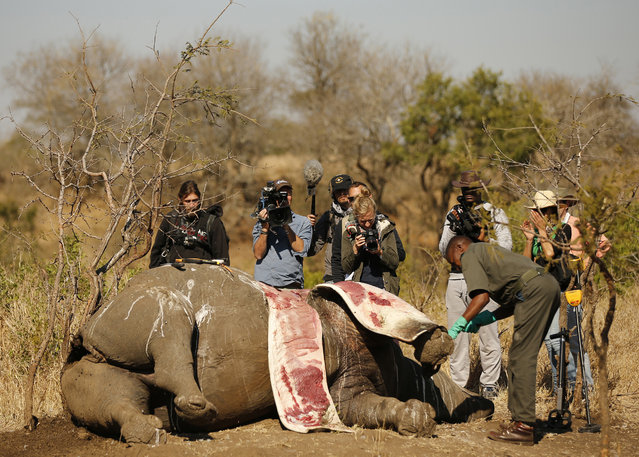
Members of the media film as a ranger performs a post mortem on the carcass of a rhino after it was killed for its horn by poachers at the Kruger national park in Mpumalanga province August 27, 2014. Rhino poachers in South Africa now risk giving themselves away when they shoot thanks to a high-tech, gunfire-detection system being piloted in the country's flagship Kruger National Park. (Photo by Siphiwe Sibeko/Reuters)

Members of the media film as a ranger performs a post mortem on the carcass of a rhino after it was killed for its horn by poachers at the Kruger national park in Mpumalanga province August 27, 2014. Rhino poachers in South Africa now risk giving themselves away when they shoot thanks to a high-tech, gunfire-detection system being piloted in the country's flagship Kruger National Park. The stakes are high, for rhinos are being slain in escalating numbers for their prized horns, alarming both conservationists and the government since wildlife in South Africa is an important tourist draw. (Photo by Siphiwe Sibeko/Reuters)
Details
07 Nov 2015 08:03:00
The tempestuous stellar nursery called the Carina Nebula, located 7,500 light-years away from Earth in the southern constellation Carina. (Photo by Reuters/NASA)

The tempestuous stellar nursery called the Carina Nebula, located 7,500 light-years away from Earth in the southern constellation Carina. (Photo by Reuters/NASA)
Details
22 Oct 2014 13:34:00
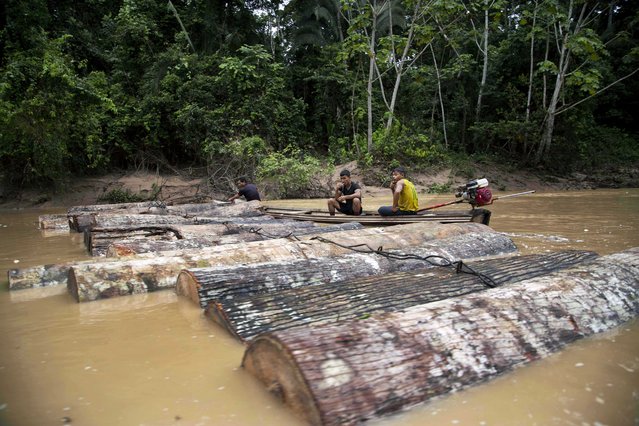
In this March 17, 2015 photo, Ashaninka Indian men, identified by locals as illegal loggers, tie tree trunks together to move them along the Putaya River near the hamlet of Saweto, Peru. Illegal logging persists unabated in this remote Amazon community where four indigenous leaders who resisted it were slain in September. The Putaya River is the waterway that transports felled trees, cut both legally and illegally, to the city of Pucallpa. (Photo by Martin Mejia/AP Photo)

In this March 17, 2015 photo, Ashaninka Indian men, identified by locals as illegal loggers, tie tree trunks together to move them along the Putaya River near the hamlet of Saweto, Peru. Illegal logging persists unabated in this remote Amazon community where four indigenous leaders who resisted it were slain in September. The Putaya River is the waterway that transports felled trees, cut both legally and illegally, to the city of Pucallpa. (Photo by Martin Mejia/AP Photo)
Details
27 Mar 2015 12:40:00