Loading...
Done
A devotee of the Ban Tha Rua Chinese shrine is helped with a spike pierced through her cheeks during a street procession celebrating the annual vegetarian festival in Phuket September 28, 2014. (Photo by Damir Sagolj/Reuters)

A devotee of the Ban Tha Rua Chinese shrine is helped with a spike pierced through her cheeks during a street procession celebrating the annual vegetarian festival in Phuket September 28, 2014. The festival, featuring face-piercing, spirit mediums and strict vegetarianism celebrates the local Chinese community's belief that abstinence from meat and various stimulants during the ninth lunar month of the Chinese calendar will help them obtain good health and peace of mind. (Photo by Damir Sagolj/Reuters)
Details
28 Sep 2014 11:34:00
People attend a wounded man after an explosion in Istikla Street in central Istanbul, Turkey on November 13, 2022. (Photo by Ihlas News Agency (IHA) via Reuters)

People attend a wounded man after an explosion in Istikla Street in central Istanbul, Turkey on November 13, 2022. According to governor Ali Yerlikaya, an explosion that occurred at roughly 4.20 p.m. local time has resulted in losses and injuries. Emergency personnel were dispatched to the incident. (Photo by Ihlas News Agency (IHA) via Reuters)
Details
15 Nov 2022 04:33:00
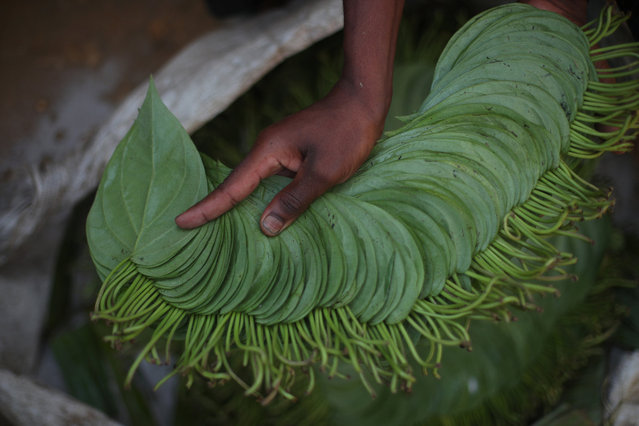
Faruk, 17, a Rohingya refugee trader holds betel leaves which are on sale at a stall in Palong Khali refugee camp near Cox's Bazar, Bangladesh, November 3, 2017. He left his village in Myanmar when the military opened fire towards the Rohingya. “I buy this betel leaf from Palong Khali market, in one bundle there are 160 pieces, I buy it for 80 taka and I sell it for 100 taka. Bangladeshi's and I sell for the same rate in the camp. Outside in the local market it is 80 taka per bundle. My problem is that I don't have money so I can't buy anything to eat, I can't buy fish to eat”, he said. (Photo by Hannah McKay/Reuters)

Faruk, 17, a Rohingya refugee trader holds betel leaves which are on sale at a stall in Palong Khali refugee camp near Cox's Bazar, Bangladesh, November 3, 2017. He left his village in Myanmar when the military opened fire towards the Rohingya. “I buy this betel leaf from Palong Khali market, in one bundle there are 160 pieces, I buy it for 80 taka and I sell it for 100 taka (1 Bangladeshi Taka = 0.012 US Dollar). Bangladeshi's and I sell for the same rate in the camp. Outside in the local market it is 80 taka per bundle. My problem is that I don't have money so I can't buy anything to eat, I can't buy fish to eat”, he said. (Photo by Hannah McKay/Reuters)
Details
27 Nov 2017 08:54:00

A handout image provided by the New Zealand Defence Force shows aid supplies being unloaded by Fijian soldiers from an Royal New Zealand Airforce C-130 Hercules plane in Suva, Fiji, 23 February 2016. Tool kits, generators, ration packs, water containers and chainsaws make up part of the New Zealand relief following Tropical Cyclone Winston. The death toll from the cyclone that hit Fiji over the weekend climbed to 29, local media reported ON 23 February. (Photo by Sam Shepherd/EPA/NZ Defence Force)

A handout image provided by the New Zealand Defence Force shows aid supplies being unloaded by Fijian soldiers from an Royal New Zealand Airforce C-130 Hercules plane in Suva, Fiji, 23 February 2016. Tool kits, generators, ration packs, water containers and chainsaws make up part of the New Zealand relief following Tropical Cyclone Winston. The death toll from the cyclone that hit Fiji over the weekend climbed to 29, local media reported ON 23 February. Cyclone Winston, the most powerful storm in Fiji's history, battered the country's main island of Viti Levu and other smaller surrounding islands on Saturday, the Fiji Broadcasting Corporation reported. (Photo by Sam Shepherd/EPA/NZ Defence Force)
Details
24 Feb 2016 12:56:00
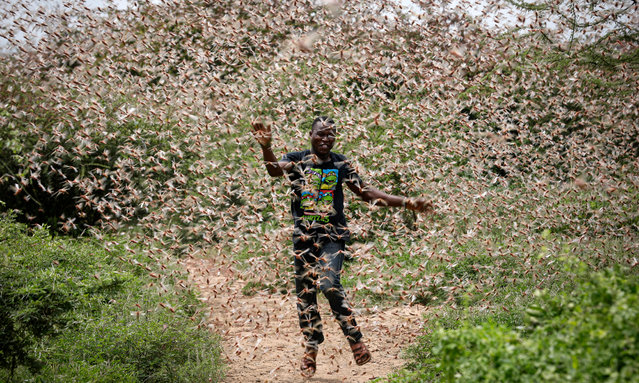
A local farmer Theophilus Mwendwa runs through a swarm of desert locusts to chase them away in the bush near Enziu, Kitui County, some 200km east of the capital Nairobi, Kenya, 24 January 2020. Large swarms of desert locusts have been invading Kenya for weeks, after having infested some 70 thousand hectares of land in Somalia which the United Nations Food and Agriculture Organisation (FAO) has termed the “worst situation in 25 years” in the Horn of Africa. FAO cautioned that it poses an “unprecedented threat” to food security and livelihoods in the region. (Photo by Dai Kurokawa/EPA/EFE)

A local farmer Theophilus Mwendwa runs through a swarm of desert locusts to chase them away in the bush near Enziu, Kitui County, some 200km east of the capital Nairobi, Kenya, 24 January 2020. Large swarms of desert locusts have been invading Kenya for weeks, after having infested some 70 thousand hectares of land in Somalia which the United Nations Food and Agriculture Organisation (FAO) has termed the “worst situation in 25 years” in the Horn of Africa. FAO cautioned that it poses an “unprecedented threat” to food security and livelihoods in the region. (Photo by Dai Kurokawa/EPA/EFE)
Details
22 Feb 2020 00:01:00
A member of the contemporary circus company Cirk La Putyka perform on the mobile trampoline as he amuses local residents in Prague, Czech Republic, 09 April 2020. The aim of the Cirk La Putyka events in the streets of Czech capital is to get live art back to people during the lockdown. According to them, when people can't go to the artists, to the theater, the actors go to the people. The Czech government has imposed a lockdown in an attempt to slow down the spread of the pandemic COVID-19 disease caused by the SARS-CoV-2 coronavirus. (Photo by Martin Divisek/EPA/EFE)

A member of the contemporary circus company Cirk La Putyka perform on the mobile trampoline as he amuses local residents in Prague, Czech Republic, 09 April 2020. The aim of the Cirk La Putyka events in the streets of Czech capital is to get live art back to people during the lockdown. According to them, when people can't go to the artists, to the theater, the actors go to the people. The Czech government has imposed a lockdown in an attempt to slow down the spread of the pandemic COVID-19 disease caused by the SARS-CoV-2 coronavirus. (Photo by Martin Divisek/EPA/EFE)
Details
11 Apr 2020 00:07:00
Girls of the Long Horn Miao ethnic minority group wear headdresses as they prepare gather for Tiaohua or Flower Festival as part of the Lunar New Year on February 6, 2017 in Longga village, Guizhou province, southern China. The Long Horn Miao are recognized for their declining practice of wrapping a blend of linen, wool, and the hair of their ancestors around animal horns or a wooden clip to make headdresses. Many young women say they now wear the headdresses only for special occasions and festivals, as the ornaments, which are attached by the horns to their real hair, have proved impractical for modern daily life in a fast changing world. China officially recognizes 56 different ethnic minorities, and statistics show over 7 million Chinese identifying themselves as Miao. But the small Long Horn Miao community counts only around 5000 people living in 12 villages, whose age-old traditions, language, and culture are fading. It is increasingly difficult in a modernizing China, as young people are drawn from remote rural villages to opportunities in bigger cities amongst wide-scale urbanization. Farming and labour remain the mainstays of life for the Long Horn Miao, leaving the area relatively poor in comparison with many parts of China. The government has invested significant amounts into local infrastructure and the tourism industry to try to bolster the local economy. (Photo by Kevin Frayer/Getty Images)

Girls of the Long Horn Miao ethnic minority group wear headdresses as they prepare gather for Tiaohua or Flower Festival as part of the Lunar New Year on February 6, 2017 in Longga village, Guizhou province, southern China. (Photo by Kevin Frayer/Getty Images)
Details
13 Feb 2017 00:01:00
Nursery plants are seen placed in people's seats during a rehearsal as Barcelona's Gran Teatre del Liceu opera reopens its doors with a concert for plants, to raise awareness about the importance of an audience after the coronavirus lockdown, in Barcelona, Spain on June 22, 2020. The Gran Teatre del Liceu reopens its doors, in which the 2,292 seats of the auditorium will be occupied on this occasion by plants. It will be on 22 June, broadcast live online, when the UceLi Quartet string quartet performs Puccini's “Crisantemi” for this verdant public, brought in from local nurseries. (Photo by Nacho Doce/Reuters)

Nursery plants are seen placed in people's seats during a rehearsal as Barcelona's Gran Teatre del Liceu opera reopens its doors with a concert for plants, to raise awareness about the importance of an audience after the coronavirus lockdown, in Barcelona, Spain on June 22, 2020. The Gran Teatre del Liceu reopens its doors, in which the 2,292 seats of the auditorium will be occupied on this occasion by plants. It will be on 22 June, broadcast live online, when the UceLi Quartet string quartet performs Puccini's “Crisantemi” for this verdant public, brought in from local nurseries. (Photo by Nacho Doce/Reuters)
Details
24 Jun 2020 00:07:00