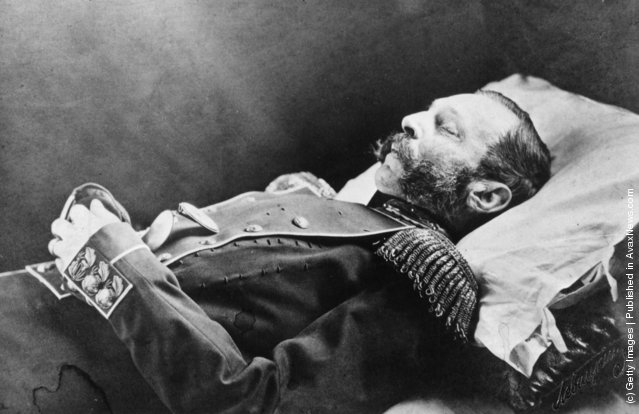
Tsar Alexander II (1818–1881) known as “The Liberator” lying in state. He was mortally wounded by an assassination attack in St Petersburg. (Photo by Hulton Archive/Getty Images). March 1881
A visiitor bungee jumps during an outdoor festival to celebrate German Unity Day on the 21st anniversary of German reunification on October 3, 2011 in Berlin, Germany. German Unity Day is a national holiday and marks the day West Germany and East Germany were reunited in 1990 following the collapse of the Iron Curtain. (Photo by Adam Berry/Getty Images)
Indian girls in traditional attire pose for photographs as they practice the Garba, the traditional dance of Gujarat state, ahead of Navratri festival in Ahmadabad, India, Saturday, October 3, 2015. Navratri or nine night festival will begin on October 13. (Photo by Ajit Solanki/AP Photo)
Rebel fighters from the Ahrar al-Sham Islamic Movement fire a heavy machine gun during what they said was an offensive to take the northwestern city of Idlib March 24, 2015. (Photo by Khalil Ashawi/Reuters)
The sculpture “It Takes Two to Tango” by Scottish sculptor David Mach is seen in front of the headquarters of the CMA-CGM shipping company office tower in the port of Marseille, France, March 15, 2016. (Photo by Jean-Paul Pelissier/Reuters)
Cyclists compete during the UCI BMX World Championships Elite Women's Moto Race on May 29, 2016 in Medellin, Antioquia department, Colombia. (Photo by Raul Arboleda/AFP Photo)
Eurocopter's X³ high-speed hybrid helicopter demonstrator performs, September 6, 2010. The Eurocopter X³ (X-Cubed) is an experimental high-speed compound helicopter developed by Eurocopter (now Airbus Helicopters). A technology demonstration platform for Eurocopter “high-speed, long-range hybrid helicopter” or H³ concept, the X³ achieved 255 knots in level flight on 7 June 2013, setting an unofficial speed record for a helicopter. (Photo by Reuters/HO/Eurocopter/Penna)
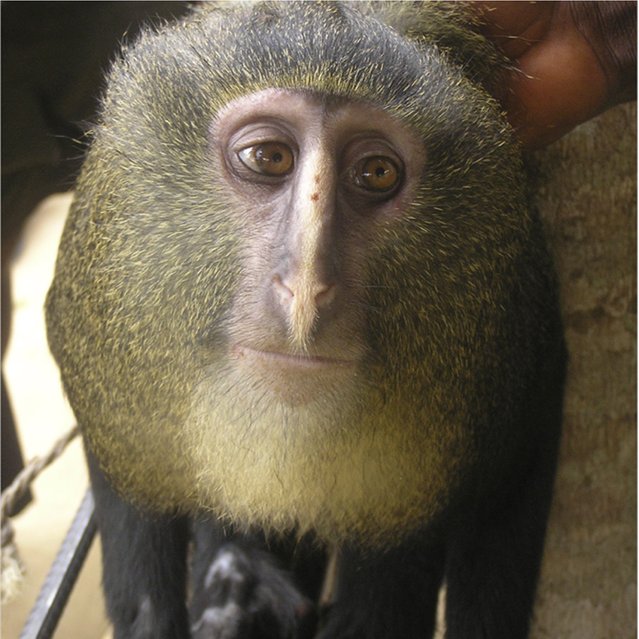
A new species of monkey found in the Democratic Republic of the Congo and identified as Lesula (Cercopithecus lomamiensis) is seen in this undated photograph from an article published September 12, 2012 in the science journal PLOS One. The monkey was first seen in 2007 by researchers John and Terese Hart of the Peabody Museum of Natural History at Yale Research Project. The finding of C. lomamiensis represents only the second new species of African monkey to be discovered in the past 28 years, according to the research article. (Photo by Hart J. A., Detwiler K. M., Gilbert C. C./Reuters)