Loading...
Done
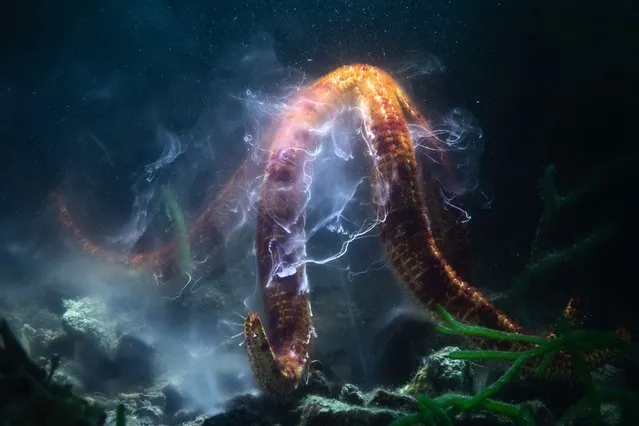
Shooting star by Tony Wu, US/Japan. Winner, underwater. The electrifying reproductive dance of a giant sea star. As the surrounding water filled with sperm and eggs from spawning sea stars, Wu faced several challenges. Stuck in a small, enclosed bay with only a macro lens for photographing small subjects, he backed up to squeeze the undulating sea star into his field of view. The dancing posture of spawning sea stars rising and swaying may help release eggs and sperm, or may help sweep the eggs and sperm into the currents where they fertilise together in the water. Kinko Bay, Japan. (Photo by Tony Wu/Wildlife Photographer of the Year)

Shooting star by Tony Wu, US/Japan. Winner, underwater. The electrifying reproductive dance of a giant sea star. As the surrounding water filled with sperm and eggs from spawning sea stars, Wu faced several challenges. Stuck in a small, enclosed bay with only a macro lens for photographing small subjects, he backed up to squeeze the undulating sea star into his field of view. The dancing posture of spawning sea stars rising and swaying may help release eggs and sperm, or may help sweep the eggs and sperm into the currents where they fertilise together in the water. Kinko Bay, Japan. (Photo by Tony Wu/Wildlife Photographer of the Year)
Details
15 Oct 2022 03:50:00
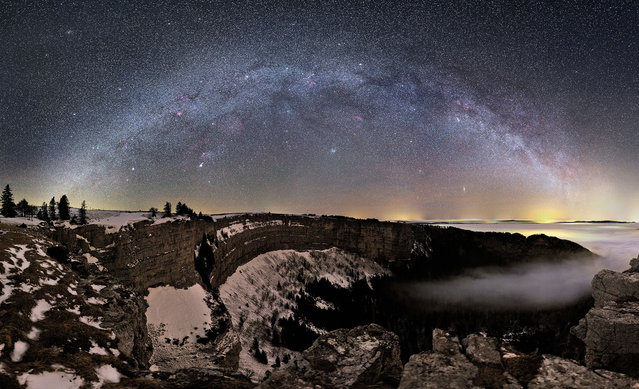
Milky Way over Switzerland

Milky Way over Switzerland

The Milky Way is the galaxy in which Earth is contained. This name derives from its appearance as a dim “milky” glowing band arching across the night sky, in which the naked eye cannot distinguish individual stars. The term “Milky Way” is a translation of the Classical Latin via lactea, from the Hellenistic Greek γαλαξίας κύκλος (pr. galaxías kýklos, “milky circle”). The Milky Way appears like a band because it is a disk-shaped structure being viewed from inside. The fact that this faint band of light is made up of stars was proven in 1610 when Galileo Galilei used his telescope to resolve it into individual stars. In the 1920s, observations by astronomer Edwin Hubble showed that the Milky Way is just one of many galaxies.


Details
20 Jun 2012 10:11:00
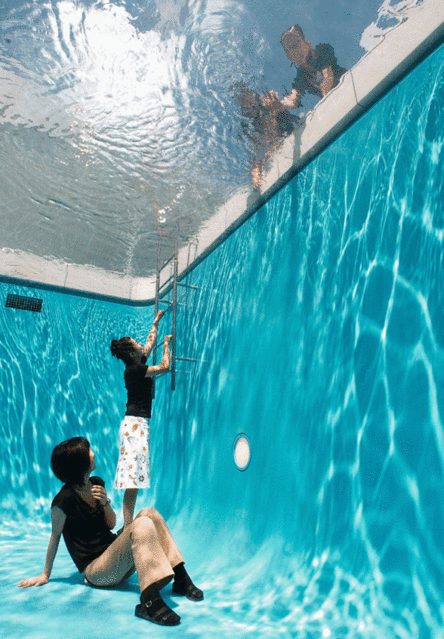
Swimming Pool Art Installation by Leandro Erlich

In one of the Museum’s courtyards is a swimming pool framed by a limestone deck. When seen from the deck, the pool appears to be filled with deep, shimmering water. In fact, however, a layer of water only some 10 centimeters deep is suspended over transparent glass. Below the glass is an empty space with aquamarine walls that viewers can enter. The work sets up an unfolding sequence of experiences—we view the pool through the glass wall enclosing the courtyard; from the deck, looking down into the pool; and from the interior of the pool, looking up. The Swimming Pool might hence be considered a place where, slowly, with time, different perspectives and perceptions of self and others all come to intersect.
Details
25 Aug 2012 07:31:00
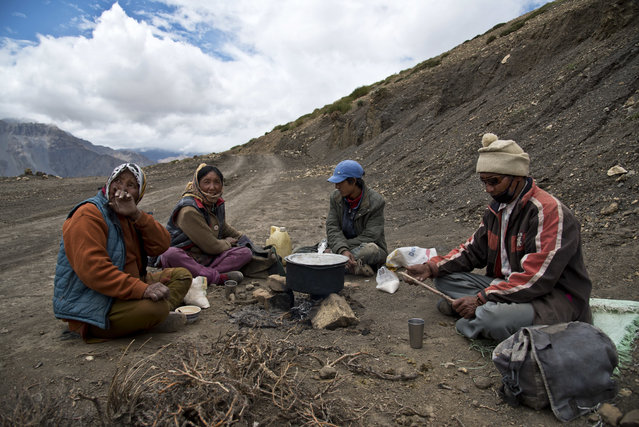
In this August 17, 2016, photo, from left to right, Chhering Chodom, 60, Tashi Yangzom, 50, Lobsang Chhering, 27, and Dorje Tandup, 58, drink milk tea on the side of the road. For centuries, the sleepy valley nestled in the Indian Himalayas remained a hidden Buddhist enclave forbidden to outsiders. Enduring the harsh year-round conditions of the high mountain desert, the people of Spiti Valley lived by a simple communal code – share the Earth's bounty, be hospitable to neighbors, and eschew greed and temptation at all turns. That's all starting to change, for better or worse. Since India began allowing its own citizens as well as outsiders to visit the valley in the early 1990s, tourism and trade have boomed. And the marks of modernization, such as solar panels, asphalt roads and concrete buildings, have begun to appear around some of the villages that dot the remote landscape at altitudes above 4,000 meters (13,000 feet). (Photo by Thomas Cytrynowicz/AP Photo)

In this August 17, 2016, photo, from left to right, Chhering Chodom, 60, Tashi Yangzom, 50, Lobsang Chhering, 27, and Dorje Tandup, 58, drink milk tea on the side of the road. For centuries, the sleepy valley nestled in the Indian Himalayas remained a hidden Buddhist enclave forbidden to outsiders. Enduring the harsh year-round conditions of the high mountain desert, the people of Spiti Valley lived by a simple communal code – share the Earth's bounty, be hospitable to neighbors, and eschew greed and temptation at all turns. That's all starting to change, for better or worse. (Photo by Thomas Cytrynowicz/AP Photo)
Details
15 Sep 2016 09:22:00
Villagers from Jiexi Jiantan village perform a ritual of “Zha Laoye”, or “Cracking local spirits”, in Chaoshan, Guangdong Province, China, 10 February 2019. Jiexi Jiantan Village celebrates the annual custom of “Zha Laoye” where Laoye are local spirits. Every third day of the lunar New Year, statues of local spirits known as the “Thousand-mile Eye” Laoye and “Ear Following the Wind” Laoye are brought out to the village committee to receive incensed tea offered by believers. By the sixth day of the year, the “Zha Laoye” activities begin with each man holding one of the statues on a chair above his head while run around a bonfire. Two other men light firecrackers strung up on a long bamboo poles and chase the spirit around the bonfire, signifying a bountiful new year. (Photo by EPA/EFE/ZNSEN)

Villagers from Jiexi Jiantan village perform a ritual of “Zha Laoye”, or “Cracking local spirits”, in Chaoshan, Guangdong Province, China, 10 February 2019. Jiexi Jiantan Village celebrates the annual custom of “Zha Laoye” where Laoye are local spirits. Every third day of the lunar New Year, statues of local spirits known as the “Thousand-mile Eye” Laoye and “Ear Following the Wind” Laoye are brought out to the village committee to receive incensed tea offered by believers. (Photo by EPA/EFE/ZNSEN)
Details
23 Feb 2019 00:07:00
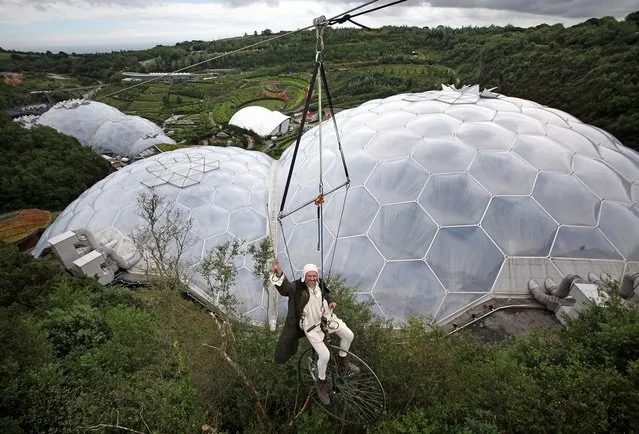
England's Longest Zip Wire Opens At The Eden Project

Marco Fiera from NoFit State Circus tries out the SkyWire, the new zip wire attraction which opens to the public this week at The Eden Project on July 17, 2012 in St Austell, England. The new 740m zip wire, currently the longest in England, allows the public a bird's eye view of the iconic Rainforest and Mediterranean Biome structures as well as the Cornish attractions outdoor gardens. The Eden Project – which opened in 2001 and has attracted over one million visitors – showcases 100,000 plants from around the world in two giant transparent domes, one of which is the world's largest greenhouse, each recreating different climate conditions. (Photo by Matt Cardy)
Details
19 Jul 2012 10:00:00
The following “Utopian Tours” drawings are conceptual images of what tourism in North Korea might one day look like, created by North Korean architects. The images, curated by Nick Bonner, are on view as part of the exhibition at the Venice Architecture Biennale in the Korean Pavilion. Bonner runs the Beijing-based Koryo Tours – a company that organizes tours of outsiders into North Korea. (Photo by Nick Bonner/Kyle Vanhemert/Venice Architecture Biennale)

At this year’s Venice Bienniale in Italy, the Korean pavilion has a curious exhibit called “Commissions for Utopia”. It includes renderings from North Korea’s top architects and artists (all anonymous), many of whom studied at the Paekho Institute of Architecture, North Korea’s state-run architectural college, and none of whom have ever left the country. They were asked to create a vision of North Korea’s future sustainable architecture for its expanding tourism industry. Their final products are a glimpse into what it would be like to envision the future after being entirely cut off from the present for almost 70 years. (Photo by Nick Bonner/Kyle Vanhemert/Venice Architecture Biennale)
Details
08 Aug 2014 11:03:00


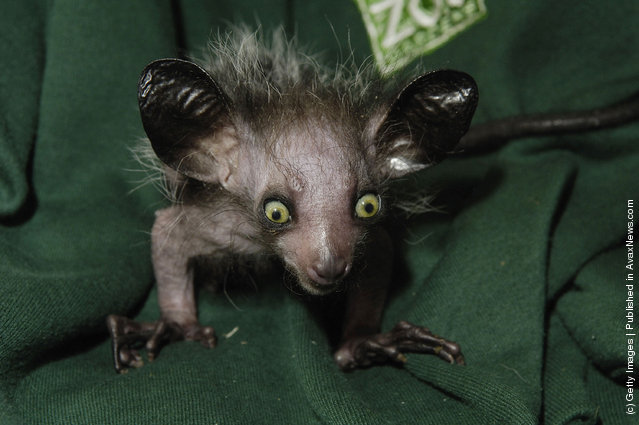
“The aye-aye (Daubentonia madagascariensis) is a lemur, a strepsirrhine primate native to Madagascar that combines rodent-like teeth and a special thin middle finger to fill the same ecological niche as a woodpecker. It is the world's largest nocturnal primate, and is characterized by its unusual method of finding food; it taps on trees to find grubs, then gnaws holes in the wood and inserts its narrow middle finger to pull the grubs out. The only other animal species known to find food in this way is the striped possum. From an ecological point of view the aye-aye fills the niche of a woodpecker as it is capable of penetrating wood to extract the invertebrates within”. – Wikipedia

Photo: In this handout image from Bristol Zoo is seen the first captive bred aye-aye in the UK named “Kintana” (meaning star in Malagasy) April 15, 2005 at Bristol Zoo Gardens, England. The zoo announced today only the second baby aye-aye to be hand-reared in the world (the first was in Jersey Zoo) and has now made his first public appearance since his birth on 11 February 2005. (Photo by Rob Cousins/Bristol Zoo via Getty Images)
Details
13 Apr 2011 13:33:00