Loading...
Done
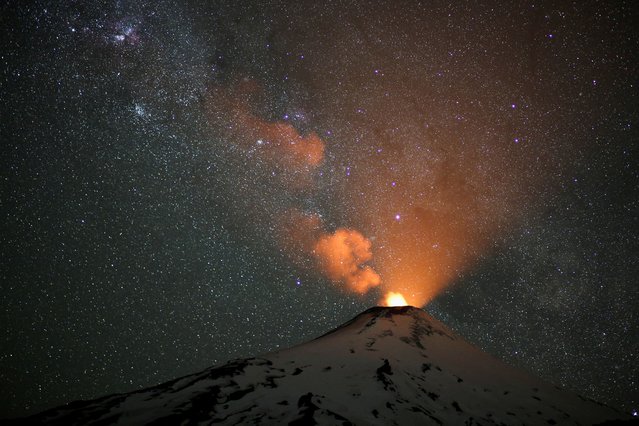
Plumes of smoke rise from the snow covered volcano Villarrica, in Pucon, Chile on December 7, 2023. (Photo by Cristobal Saavedra Escobar/Reuters)

Plumes of smoke rise from the snow covered volcano Villarrica, in Pucon, Chile on December 7, 2023. (Photo by Cristobal Saavedra Escobar/Reuters)
Details
18 May 2024 00:13:00
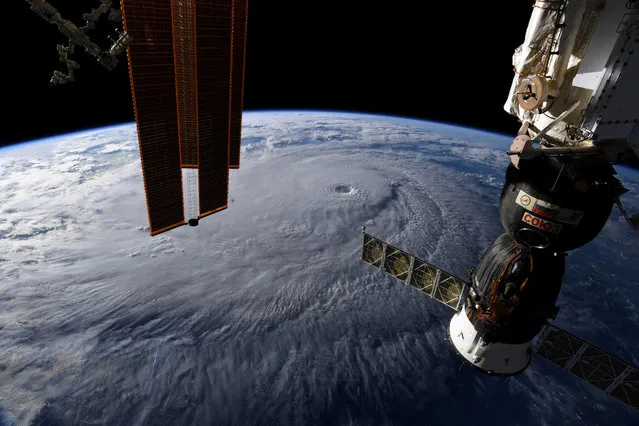
A photo taken from the International Space Station shows Hurricane Lane in the early morning hours near Hawaii, August 22, 2018. (Photo by Courtesy @astro_ricky/NASA/Handout via Reuters)

A photo taken from the International Space Station shows Hurricane Lane in the early morning hours near Hawaii, August 22, 2018. (Photo by Courtesy @astro_ricky/NASA/Handout via Reuters)
Details
01 Jan 2019 00:01:00
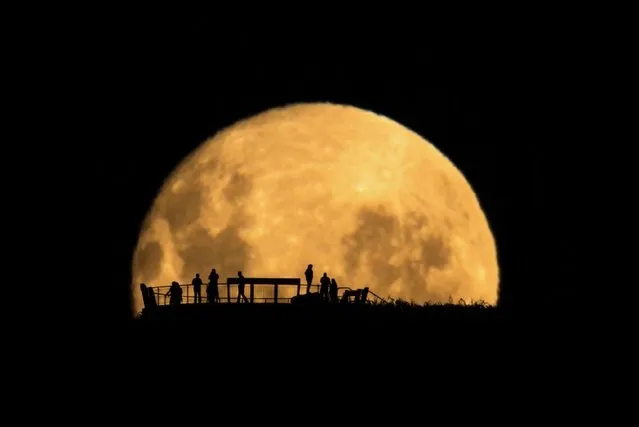
Astronomy Photographer Of The Year 2013 Part1

The Royal Observatory just announced its Astronomy Photographer Of The Year 2013 winners. Australian photographer Mark Gee was chosen among a thousand amateur and professional photographers around the globe to win the top title. His work is part of an exhibition of the winning photographers, which opened on Sept. 19 at the Royal Observatory Greenwich. The Royal Observatory shared with us the winners and notable mentions of the competition. Their descriptions of the prizewinners can be found below the images.
Details
04 Oct 2013 11:45:00
A model poses backstage ahead of the NLP show at Mercedes-Benz Fashion Week Australia 2014 at Carriageworks on April 7, 2014 in Sydney, Australia.  (Photo by Brendon Thorne/Getty Images)

A model poses backstage ahead of the NLP show at Mercedes-Benz Fashion Week Australia 2014 at Carriageworks on April 7, 2014 in Sydney, Australia. (Photo by Brendon Thorne/Getty Images)
Details
12 Apr 2014 13:06:00
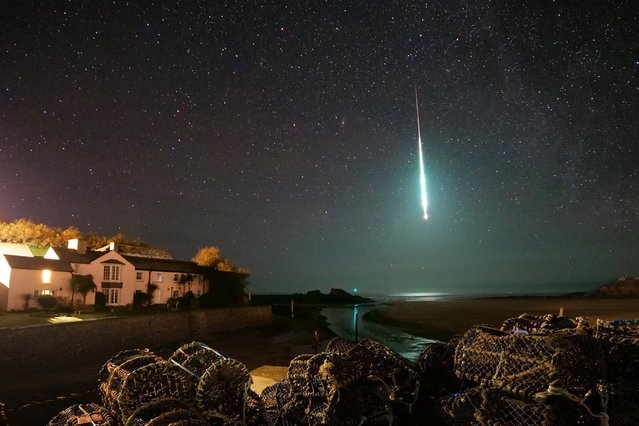
A brightly burning magnesium-rich meteor known as a bolide was captured near Bude, Cornwall on January 24, 2020. (Photo by Chris Small/Apex News)

A brightly burning magnesium-rich meteor known as a bolide was captured near Bude, Cornwall on January 24, 2020. (Photo by Chris Small/Apex News)
Details
14 Jul 2020 00:03:00
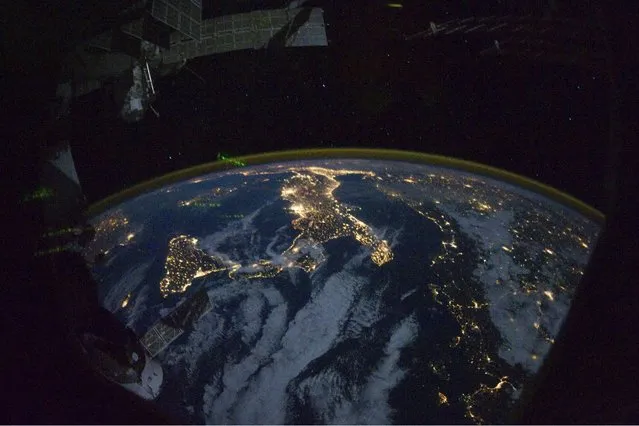
This image provided by NASA shows parts of Europe and Africa very easily recognizable in this night time image shot by one of the Expedition 25 crew members aboard the International Space Station flying 220 miles above Earth on Thursday Oct. 28, 2010. The view “looks” northward over Sicily and the “boot” of Italy, with the Mediterranean Sea representing most of the visible water in the view and the Adriatic Sea to the right of center. Tunisia is partially visible at left. Part of a docked Russian spacecraft and other components of the ISS are in the foreground. (Photo by AP photo/NASA)

This image provided by NASA shows parts of Europe and Africa very easily recognizable in this night time image shot by one of the Expedition 25 crew members aboard the International Space Station flying 220 miles above Earth on Thursday October 28, 2010. The view “looks” northward over Sicily and the “boot” of Italy, with the Mediterranean Sea representing most of the visible water in the view and the Adriatic Sea to the right of center. Tunisia is partially visible at left. Part of a docked Russian spacecraft and other components of the ISS are in the foreground. (Photo by AP Photo/NASA)
Details
11 May 2013 12:29:00
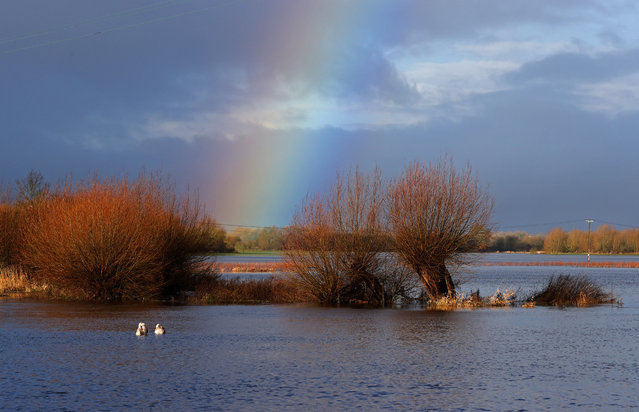
A rainbow rises over flooded fields after the Rivers Thames and Churn burst their banks, in Cricklade, western England on January 3, 2024, following Storm Henk which brought strong winds and heavy rain across much of the country. (Photo by Adrian Dennis/AFP Photo)

A rainbow rises over flooded fields after the Rivers Thames and Churn burst their banks, in Cricklade, western England on January 3, 2024, following Storm Henk which brought strong winds and heavy rain across much of the country. (Photo by Adrian Dennis/AFP Photo)
Details
08 Mar 2024 07:39:00
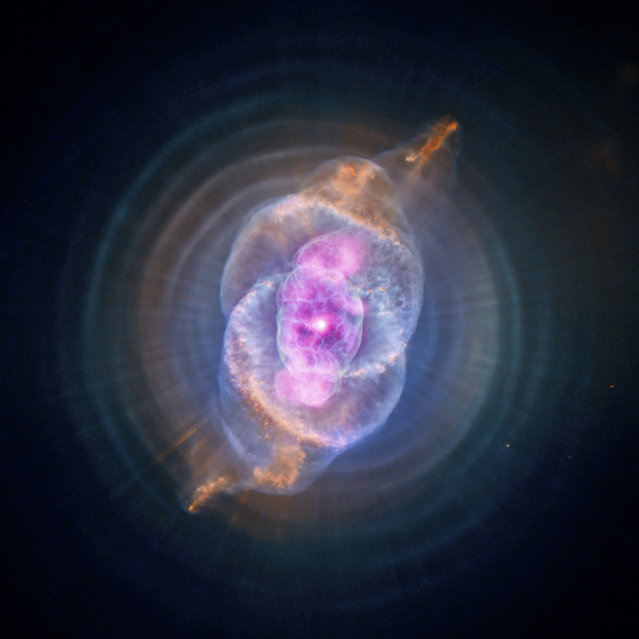
This image is NGC 6543 known as the Cat's Eye Nebula as it appears to the Chandra X-Ray Observatory and Hubble Telescope. A planetary nebula is a phase of stellar evolution that the sun should experience several billion years from now, when it expands to become a red giant and then sheds most of its outer layers, leaving behind a hot core that contracts to form a dense white dwarf star. This image was released October 10, 2012. (Photo by J. Kastner/NASA/CXC/RIT)

This image is NGC 6543 known as the Cat's Eye Nebula as it appears to the Chandra X-Ray Observatory and Hubble Telescope. A planetary nebula is a phase of stellar evolution that the sun should experience several billion years from now, when it expands to become a red giant and then sheds most of its outer layers, leaving behind a hot core that contracts to form a dense white dwarf star. This image was released October 10, 2012. (Photo by J. Kastner/NASA/CXC/RIT)
Details
15 Apr 2013 10:09:00