Loading...
Done
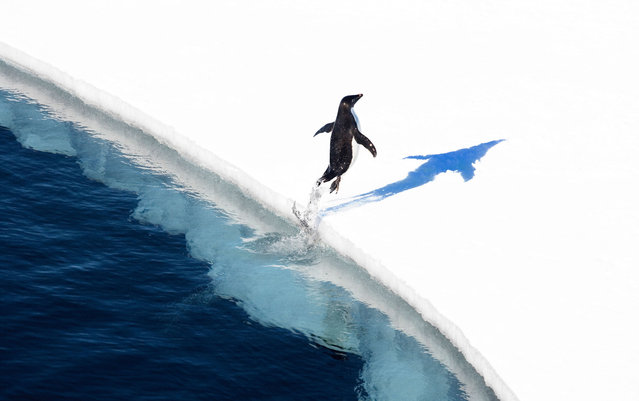
This undated handout photo received from the Antarctic Ocean Alliance on October 28, 2016 shows a adelie penguin jumping onto the ice in the Ross Sea in Antarctica. The world's largest marine reserve aimed at protecting the pristine wilderness of Antarctica will be created after a “momentous” agreement was finally reached on October 28, 2016 with Russia dropping its long-held opposition. A remote and largely pristine stretch of ocean off Antarctica received international protection on Friday, becoming the world's largest marine reserve as a broad coalition of countries came together to protect 598,000 square miles of water. The new marine protected area in the Ross Sea was created by a unanimous decision of the international body that oversees the waters around Antarctica – the Commission for the Conservation of Antarctic Marine Living Resources – and was announced at the commission's annual meeting in Tasmania. The commission comprises 24 countries, including the United States, and the European Union. (Photo by John Weller/AFP Photo/Antarctic Ocean Alliance)

This undated handout photo received from the Antarctic Ocean Alliance on October 28, 2016 shows a adelie penguin jumping onto the ice in the Ross Sea in Antarctica. The world's largest marine reserve aimed at protecting the pristine wilderness of Antarctica will be created after a “momentous” agreement was finally reached on October 28, 2016 with Russia dropping its long-held opposition. (Photo by John Weller/AFP Photo/Antarctic Ocean Alliance)
Details
29 Oct 2016 11:43:00
An employee in protective gears sprays disinfectant at the main exhibition tank at the Sea World at Jaya Ancol Dream Park as it is closed for public in the wake of coronavirus outbreak in Jakarta, Indonesia, Saturday, March 14, 2020. Indonesia's capital city announced a lockdown of all tourist destinations and entertainment spots as well as the closing all of its public schools for the next 14 days amid the global outbreak. For most people, the new coronavirus causes only mild or moderate symptoms. For some it can cause more severe illness. (Photo by Dita Alangkara/AP Photo)

An employee in protective gears sprays disinfectant at the main exhibition tank at the Sea World at Jaya Ancol Dream Park as it is closed for public in the wake of coronavirus outbreak in Jakarta, Indonesia, Saturday, March 14, 2020. Indonesia's capital city announced a lockdown of all tourist destinations and entertainment spots as well as the closing all of its public schools for the next 14 days amid the global outbreak. For most people, the new coronavirus causes only mild or moderate symptoms. For some it can cause more severe illness. (Photo by Dita Alangkara/AP Photo)
Details
18 Apr 2020 00:01:00


“Sektor gaza” (Russian: Сектор газа) was a Russian rock band formed on 5 December 1987 in the city of Voronezh, Russia. Despite only semi-officially existing (due to obscene lyrics), the group remains popular in Russia today. The group name was taken from an eponymous industrial district of Voronezh (itself named for high levels of environmental contamination). Their music style could be defined as Russian punk, integrated with elements of different musical genres such as rock, rap, and Russian folk. On 4 July 2000, group leader Yuri “Hoy” Klinskih complained of strong pains in his stomach and the left side of his chest. He suffered heart failure shortly thereafter. Klinskikh died in Voronezh (Russia)at the age of 35. He is buried in the Levoberezhniy Cemetery. The group ceased to exist.

About the music video: The First Chechen War, also known as the War in Chechnya, was a conflict between the Russian Federation and the Chechen Republic of Ichkeria, fought from December 1994 to August 1996. After the initial campaign of 1994 – 1995, culminating in the devastating Battle of Grozny, Russian federal forces attempted to seize control of the mountainous area of Chechnya but were set back by Chechen guerrilla warfare and raids on the flatlands in spite of Russia's overwhelming manpower, weaponry, and air support...

Details
24 May 2012 14:38:00


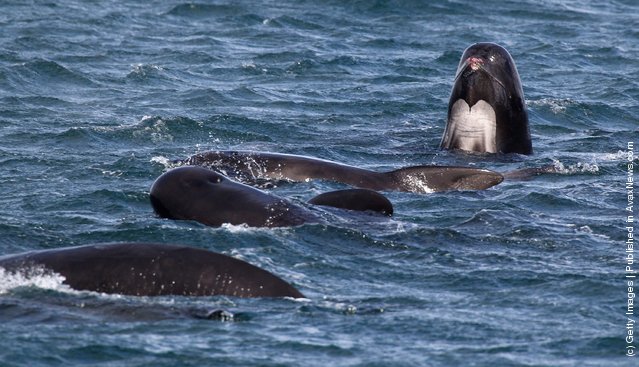
“Pilot whales are cetaceans belonging to the genus Globicephala. There are two extant species, the long-finned pilot whale (G. melas) and the short-finned pilot whale (G. macrorhynchus). The two are not readily distinguished at sea and analysis of the skulls is the best way to tell the difference between the two species. Between the two species, pilot whales range in waters nearly worldwide with long-finned pilot whales living in cooler waters and short-finned pilot whales living in warmer waters. Pilot whales are among the largest of the oceanic dolphins, exceeded in size only by the killer whale. They and other large members of the dolphin family are also known as blackfish”. – Wikipedia

Photo: Pilot whales swim in Loch Carron on May 20, 2011 in South Uist, Scotland. A major operation is underway to prevent up to 100 pilot whales from stranding on the rocky shoreline of Loch Carron on South Uist in the Western Isles. (Photo by Jeff J Mitchell/Getty Images)
Details
21 May 2011 07:58:00
Darth Mykolaiovych Vader, who is dressed as the 'Star Wars' character Darth Vader, poses for a picture as he dries his mask and helmet with a hairdryer in the bathroom of his apartments in Odessa, Ukraine, December 2, 2015. (Photo by Valentyn Ogirenko/Reuters)

Darth Mykolaiovych Vader, who is dressed as the “Star Wars” character Darth Vader, poses for a picture as he dries his mask and helmet with a hairdryer in the bathroom of his apartments in Odessa, Ukraine, December 2, 2015. Darth Vader was bent on galactic domination, but his Ukrainian namesake enjoys more mundane pursuits: local politics, walking the family dog and a spot of embroidery. The Ukrainian citizen, who has changed his name to Darth Mykolaiovych Vader, ran for the post of local mayor in October, his political backers dressed as Stormtroopers. In his trademark black outfit, he is a regular sight around Odessa, a major port city on southern Ukraine's Black Sea coast. (Photo by Valentyn Ogirenko/Reuters)
Details
13 Dec 2015 08:06:00
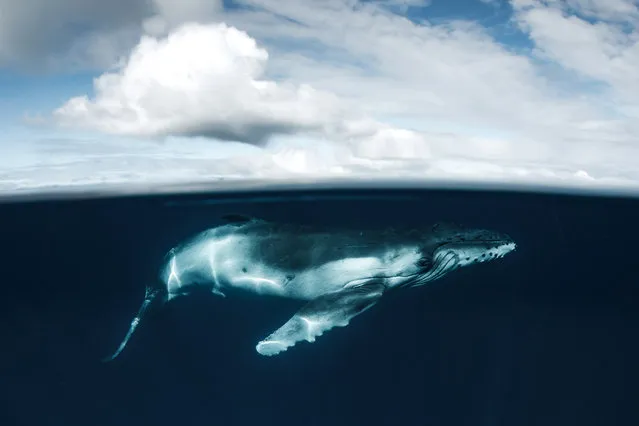
The images were taken off the coast of Tonga in the South Pacific. Photographer Grant Thomas said: “Through my images I aim to show off the amazing life we have on our planet in hope of inspiring more people to experience it for themselves and, most importantly, care for it. There is nothing to be afraid of with the humpback whales, as these animals are some of the most majestic and peaceful creatures in the sea. They will often be very curious of people in the water and will even seek out interactions with us”. (Photo by Grant Thomas/Caters News Agency)

The images were taken off the coast of Tonga in the South Pacific. Photographer Grant Thomas said: “Through my images I aim to show off the amazing life we have on our planet in hope of inspiring more people to experience it for themselves and, most importantly, care for it”. (Photo by Grant Thomas/Caters News Agency)
Details
28 Nov 2019 00:03:00
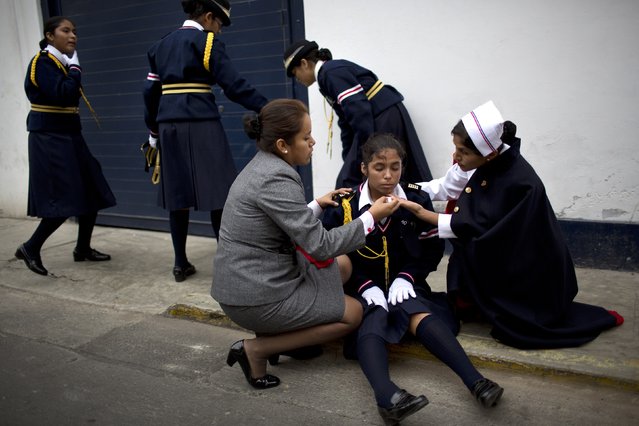
A student is assisted by teachers after she fell ill while marching in a parade celebrating Saint Peter's day in Lima, Peru, Monday, June 29, 2015. (Photo by Rodrigo Abd/AP Photo)

A student is assisted by teachers after she fell ill while marching in a parade celebrating Saint Peter's day in Lima, Peru, Monday, June 29, 2015. During the feast day of the Catholic saint, who is the patron saint of fishermen, coastal communities pay homage to St. Peter, whose statue is paraded to the sea and petitions are made to keep their vessels and all who work on them safe. (Photo by Rodrigo Abd/AP Photo)
Details
01 Jul 2015 13:46:00
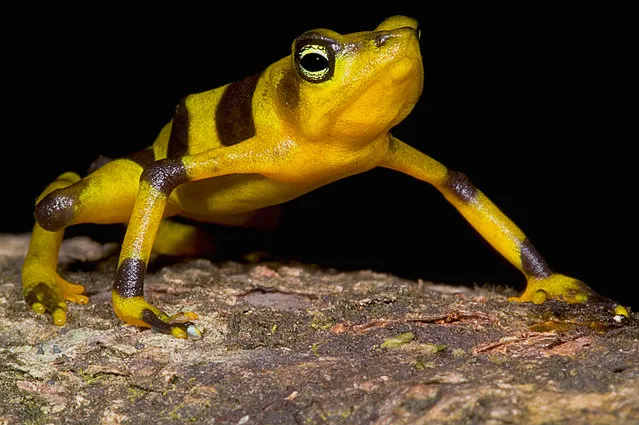
The golden harlequin toad has vanished from the wild, and only a small number live on in captivity. A fungus caused them, and many other amphibians, to die out in their home in Central America. (Photo by Danté Fenolio/The Guardian/Johns Hopkins University Press)

Wildlife photographer Danté Fenolio has headed into areas untouched by sunlight – deep seas, caves and underground – and found creatures that are exploding with colour. Here: The golden harlequin toad has vanished from the wild, and only a small number live on in captivity. A fungus caused them, and many other amphibians, to die out in their home in Central America. (Photo by Danté Fenolio/The Guardian/Johns Hopkins University Press)
Details
20 Jun 2016 12:19:00