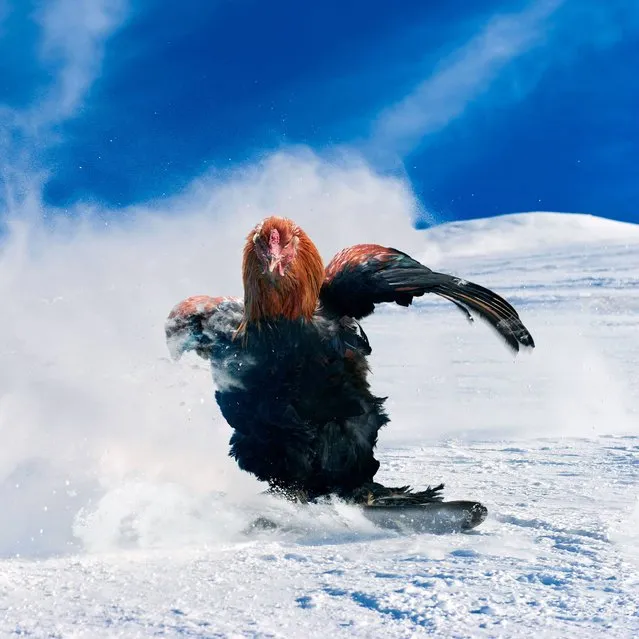
The happy egg co. has released its annual cockerel pin-up calendar: “Nice Pecks” – with an egg-streme sports edition. Taking inspiration from upcoming sporting events and the world of extreme sports, the 2015 calendar stars 12 rad roosters with a penchant for adrenaline highs in a range of high octane sporting scenarios including jumping off slopes, riding gnarly waves and snowboarding. Here: “Nice Pecks” calendar: Snowboarding. (Photo by The happy egg co.)
Partygoers in United Kingdom flocked to bars and clubs across the nation on Friday as they drunk in the 34C scorcher. Revellers were pictured in Leeds on June 17, 2022 necking drinks and going wild as the sun set on the hottest day of the year so far. (Photo by Nb press ltd)
Anti-government protesters take cover during clashes with security forces who are firing tear gas from La Carlota airbase in Caracas, Venezuela, Wednesday, May 1, 2019. Opposition leader Juan Guaidó called for Venezuelans to fill streets around the country Wednesday to demand President Nicolás Maduro's ouster. Maduro is also calling for his supporters to rally. (Photo by Ariana Cubillos/AP Photo)
Costumed attendees participate in the Dragon Con Parade, during the annual science fiction, pop culture and fantasy convention in Atlanta, Georgia, USA, 02 September 2023. Thousands of attendees, some costumed, crowd downtown Atlanta for the annual Labor Day Weekend gathering. (Photo by Erik S. Lesser/EPA/EFE)
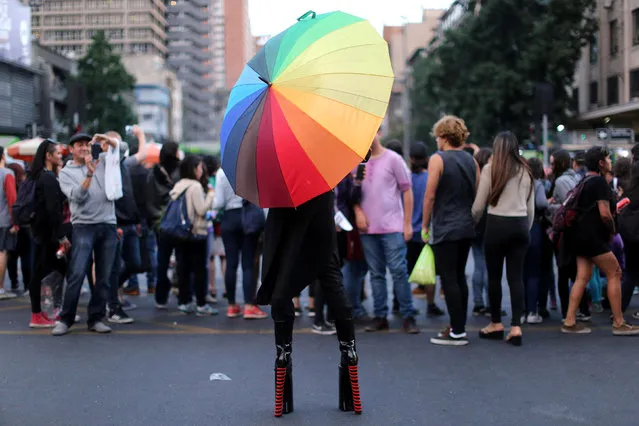
A protester wearing high heels during a demonstration to support International Day for the Elimination of Violence Against Women in Santiago, Chile, November 25, 2016. (Photo by Pablo Sanhueza/Reuters)
A woman reacts after performing Otonamaki, which translates as “adult wrapping”, a new form of therapy where people are wrapped in large swaddling cloth to alleviate posture problems and stiffness, at a session in Asaka, Saitama prefecture, Japan, February 4, 2017. (Photo by Toru Hanai/Reuters)
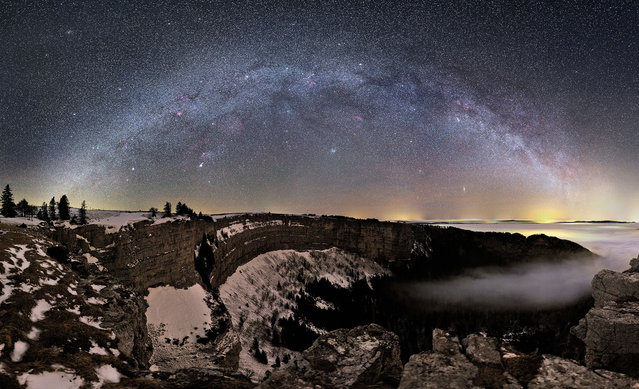
The Milky Way is the galaxy in which Earth is contained. This name derives from its appearance as a dim “milky” glowing band arching across the night sky, in which the naked eye cannot distinguish individual stars. The term “Milky Way” is a translation of the Classical Latin via lactea, from the Hellenistic Greek γαλαξίας κύκλος (pr. galaxías kýklos, “milky circle”). The Milky Way appears like a band because it is a disk-shaped structure being viewed from inside. The fact that this faint band of light is made up of stars was proven in 1610 when Galileo Galilei used his telescope to resolve it into individual stars. In the 1920s, observations by astronomer Edwin Hubble showed that the Milky Way is just one of many galaxies.